
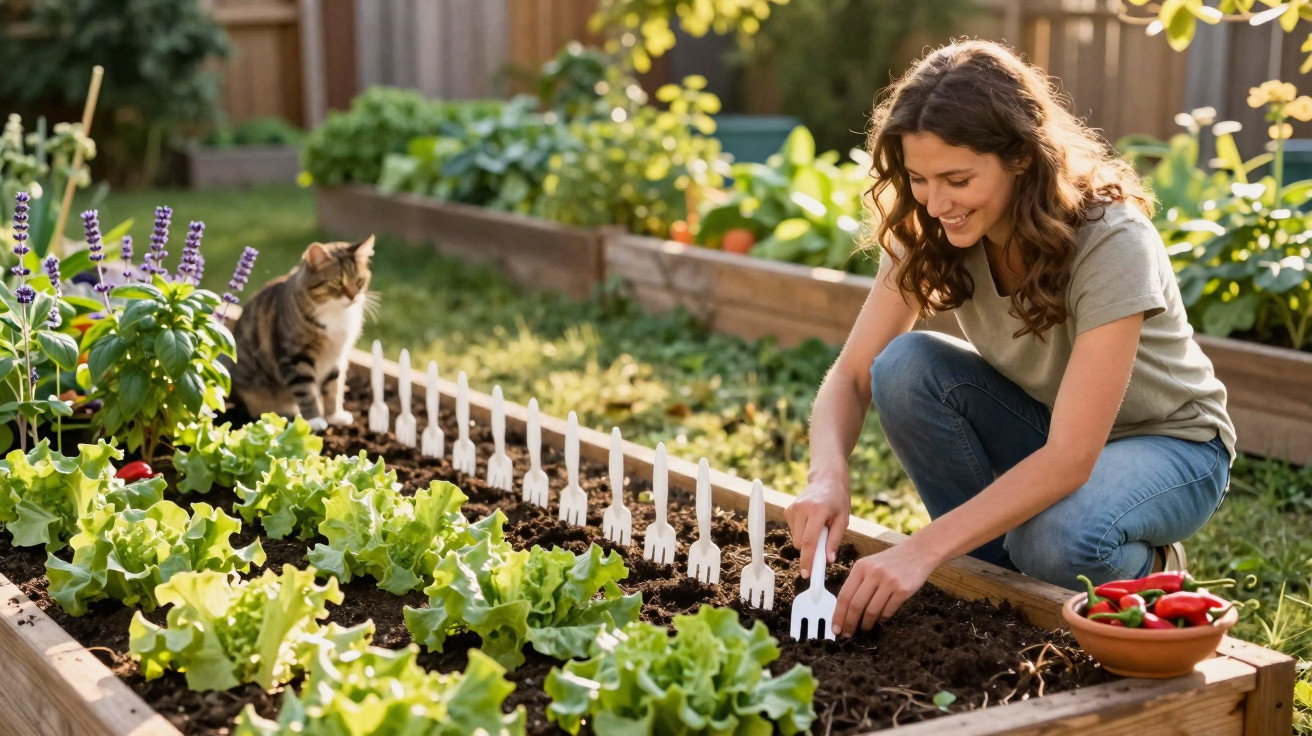
If you currently look around allotments or across your own balcony, you may notice something unusual: white or colourful fork prongs are suddenly sticking out of the soil among the lettuce, strawberries and tomatoes. This is not a decorating craze, but a highly practical way to deter cats, rabbits, squirrels and other unwanted visitors – entirely without chemicals.
Why plastic forks in a vegetable bed genuinely make sense
The idea may sound rather odd at first: can cheap plastic forks really protect delicate young plants? Yet that is exactly what is happening in many gardens. The method takes advantage of two things animals react to particularly strongly: physical discomfort and wariness of unfamiliar structures.
“Plastic forks turn a comfortable digging area for animals into an unpleasant obstacle course.”
Cats, rabbits, hedgehogs and squirrels are especially drawn to loose, damp soil where they can walk, scratch or settle down comfortably. When fork prongs are pushed throughout the bed, every step becomes uncomfortable. Rather than soft earth, their paws meet firm, pointed obstacles.
Cats in particular can be a major nuisance in vegetable gardens. Newly raked soil appears to invite them to use it as a toilet or dig around in it. If their paws repeatedly encounter fork prongs, they soon learn that this bed is unpleasant and choose not to go there.
Squirrels looking in the ground for buried nuts respond in much the same way, as do rabbits intending to nibble young lettuce plants. Because the soil feels unsafe and hazardous, they avoid it – ideally in favour of the neighbouring garden.
Visual deterrence also matters
As well as making contact with the ground uncomfortable, this approach has a second benefit: the forks noticeably alter the appearance of the bed. For many animals, that acts as a warning sign.
Wild animals are naturally cautious. Lines of upright forks resemble miniature fences or rods. They do not fit their familiar pattern of food and surroundings, which makes them suspicious. A bed with a smooth soil surface is readily entered, whereas one full of “rods” is more likely to be avoided.
Another advantage is that, unlike liquid or powdered treatments, forks simply stay in place. Rain cannot wash them away and wind cannot blow them off. After a storm, at most, a few forks may need straightening again.
“During the vulnerable seedling stage in particular, a single overnight visit from cats or rabbits can destroy an entire row of young plants.”
Experienced gardeners report that densely placed forks prevent most damage during precisely this critical period. Once plants have grown larger and become sturdier, the number of forks can be reduced or they can be moved to other beds.
How to position plastic forks correctly
Success depends less on the number of forks than on arranging them intelligently. Ten forks scattered at random will achieve very little. A well-planned layout, however, can bring remarkable calm to a bed.
Four strategies used by many gardeners
- Protective border ring: Place forks close together along the edges of the bed. This makes getting into the bed more difficult.
- Circles around individual plants: Put four to six forks around especially tempting plants, such as lettuce or strawberries, to create a small protective circle.
- Forks between rows: Set forks in lines between vegetable rows so that animals have no clear “path” through the bed.
- Blocking animal routes: If you notice regular routes used by cats or rabbits, obstruct these exact tracks with forks.
A spacing of roughly eight centimetres between forks has proved effective. Their prongs should always point upwards. Animals will immediately take advantage of larger gaps. It is therefore worth checking briefly after heavy rain or wind: if forks are leaning, simply push them upright into the soil again.
Which forks work best?
In principle, almost any lightweight plastic forks found around the home will work, including leftovers from old parties or takeaway meals. A few considerations make choosing easier:
- light-coloured or white forks are easier to see; dark forks barely stand out against soil
- choose prongs sturdy enough not to snap in the ground
- avoid handles that are too short, so the forks remain securely in place even in rain
Anyone who dislikes plastic forks can switch to reusable alternatives, such as small wooden skewers with blunted tips or plant supports. The principle always remains the same: make the soil feel uncomfortable and uncertain for animals.
Natural additions: scents, heat and plant combinations
The fork method works particularly well when combined with other natural deterrents. No two gardens are alike, and different locations and animal species require different approaches.
Fragrant helpers in the vegetable bed
People enjoy many aromatic plants, but some animals dislike them intensely. Planting marigolds, basil or mint deliberately around the edges of a vegetable bed creates an extra scent barrier.
Popular combinations include:
- tomatoes with marigolds planted between them
- peppers or chillies with basil nearby
- brassicas with mint close by (in pots, so it does not spread uncontrollably)
This companion planting not only helps deter unwanted visitors; it often also supports vegetable growth and attracts beneficial insects.
Heat and powerful aromas as a barrier
Cayenne pepper or chilli powder is another established option. Sprinkled thinly around plants, it irritates the sensitive noses and paws of mammals. The protection must be renewed after rain, however, as the powder washes away.
Essential oils such as peppermint, eucalyptus or citrus oil can also be used: add a few drops to water, shake well and spray around the beds. This temporarily creates an unpleasant scented area for many animals without harming bees or other pollinators.
Used coffee grounds serve several purposes at once. Their coarse texture and strong smell deter both slugs and some small mammals. They also add valuable nitrogen to the soil. Spread thinly around plants, they are an easy addition to the vegetable garden.
Sustainability: turning disposable plastic into vegetable-bed protection
One point that convinces many gardeners is that the forks gain a second use instead of ending up in the bin. Anyone who already has old disposable forks in a cupboard can put them to worthwhile use rather than buying new products.
“Plastic forks replace chemical sprays, noisy deterrents or expensive specialist mesh – and can be reused every year.”
Depending on the season, the forks can simply be moved to different parts of the bed. When one area no longer needs protection, the “fork fence” moves on to the next vulnerable section of the garden. The soil is neither exposed to chemicals nor left with unsightly remnants after years of use.
What to consider: safety and the limits of the method
Despite its advantages, this technique requires a little care. If children use the garden, do not place forks directly beside paths where they may be missed and stepped on. In narrow beds that you need to step into regularly, it is also sensible to keep a clearly defined fork-free stepping area.
The trick eventually reaches its limits with particularly persistent or larger animals, such as martens or raccoons. In many areas, sturdy fencing or professional traps are then the only effective options, sometimes even requiring consultation with the authorities.
For the everyday issues faced by hobby gardeners – cat faeces in beds, chewed young plants or dug-up rows – fork protection is sufficient in most cases and greatly reduces the stress.
Practical examples and useful everyday combinations
In a terraced-house garden, a narrow bed beside the patio is often all that is available. Here, forks work especially well as an edge barrier: position them along the patio edge, then add a few circles around lettuce and strawberries. Combined with a strip of coffee grounds and several pots of mint, this small area usually remains surprisingly undisturbed.
In larger gardens with several beds, a flexible approach is worthwhile. Many gardeners use forks only in beds containing freshly sown rows or very young plants. Once the plants have become stronger, the forks are moved to the next batch of sowings. This saves materials while ensuring protection is always provided where it is needed most.
For anyone who enjoys gardening with children, the method can even become a small project: paint the forks, number them or mark them with colourful tape. The “deterrent fence” then doubles as a guide in the bed, so children know exactly which row belongs to which plants.
The central point remains simple: ordinary plastic forks turn an apparently defenceless vegetable bed into a far safer place for seedlings and young plants. With minimal effort, low cost and no toxic substances, they create a clever protective shield that can easily be combined with other natural methods.


Comments
No comments yet. Be the first to comment!
Leave a Comment