
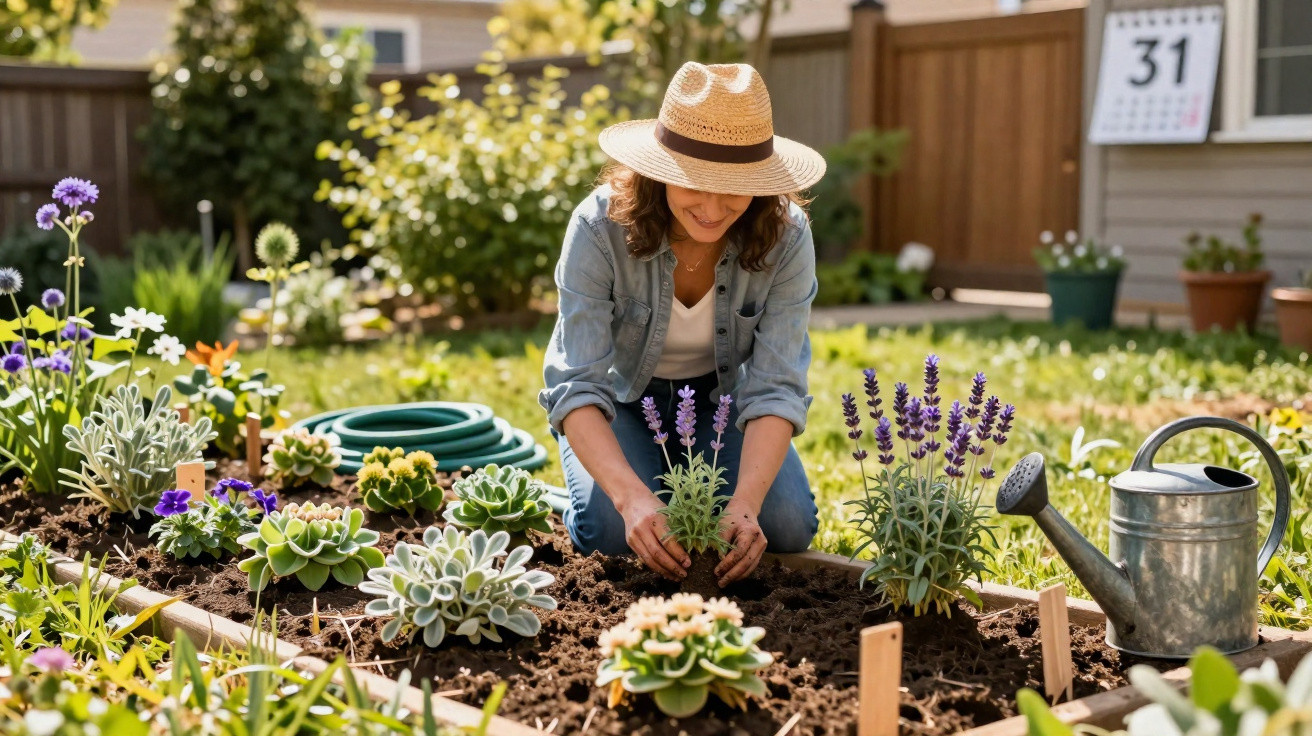
Act quickly in March and you could save countless watering sessions in July and August. Five particularly resilient perennials, combined with a smart planting technique, can leave your border relying almost entirely on rainwater later in the year. The secret is not expensive equipment, but timing, soil preparation and plant selection.
Why 31 March can be a crucial garden deadline
Spring brings an invisible countdown in the garden. By the end of March, the soil is emerging from winter dormancy, plants are only just beginning their growing season, and temperatures are generally still moderate. This transition is the ideal time to plant new perennials.
Planting early means roots are placed into soil that is still moist. Young feeder roots have several weeks to spread before the first hot spell arrives. As a result, the perennial can later draw moisture from deeper in the ground and needs far less watering from above.
“Anyone who plants by 31 March at the latest gives perennials a head start of several weeks – and dramatically reduces their summer water needs.”
Once temperatures start climbing towards 25°C and beyond, conditions change. Newly planted specimens must cope with transplant shock and heat at the same time. The result is drooping foliage, brown leaf edges and a constant need to reach for the hose. This is not simply about appearance; it is about biology and sensible timing.
Five “camel” perennials that cope remarkably well with drought
A border that is not dependent on daily watering needs perennials with exceptional staying power. These five plants have proved especially tough, making them ideal for sunny, well-drained sites.
Perovskia: airy flowers above silvery foliage
Perovskia, often sold as Russian sage, produces a sea of blue-violet flowers from high summer into autumn. Its grey, finely cut leaves lose little moisture, helping the plant conserve water. It thrives in full sun, prefers poor, fairly sandy soils, and copes with wind without difficulty.
It has another advantage: Perovskia attracts numerous insects and remains dependable during hot periods, provided its soil never stays permanently wet.
Sedum ‘Herbstfreude’: leaves that store water
The familiar stonecrop cultivar ‘Herbstfreude’ is a classic choice for dry borders. Its fleshy leaves act like small reservoirs, storing water. This allows it to withstand prolonged dry spells far better than many other perennials.
From late summer, it forms large, flat flower heads that shift in colour from soft pink to bronze. Bees, butterflies and other pollinators visit them in great numbers. Its dry stems remain attractive through winter; leaving them in place until late winter also provides extra protection for the plant.
Gaura: delicate flowers with strong roots
Gaura develops a long, deep taproot. It draws water from soil layers that an ordinary lawn sprinkler barely reaches. For months, the plant sends out countless small flowers on fine stems that dance in the breeze and give the border an airy feel.
Gaura performs particularly well in gravel gardens and on poor, sunny ground. Plant it early so that its taproot can establish properly before the soil becomes hard and dry.
Globe thistle (Echinops): architectural and undemanding
With its blue-grey, spherical flower heads, globe thistle has an almost graphic presence. It favours free-draining, rather calcareous and dry soils. Once established in spring, it is remarkably unaffected by a lack of rain.
It is especially practical because slugs generally avoid its prickly leaves. The dried globes can later be used beautifully in bouquets, saving materials and extra trips as well.
True lavender: fragrance, a bee magnet and drought specialist
Lavender has long been a star of drought-tolerant gardens. It is strongly scented, flowers generously and attracts large numbers of bees and bumblebees. Soil is the deciding factor: lavender does not tolerate waterlogging at all, and winter wet can cause rot in particular.
A mineral, free-draining growing medium containing gravel or grit is ideal. If lavender is watered thoroughly at planting time and then not continually “pampered”, it develops deep roots and will usually cope perfectly well on rainfall alone.
Ground-level garden helpers: why hardy geraniums fill the gaps
Alongside the five main plants, hardy geraniums are well worth considering. They adapt to a wide range of conditions, survive frost without additional protection and grow reliably in many types of soil.
Use these ground-covering plants wherever the border has bare patches or needs softer transitions. A simple trim, or the removal of dried material at the end of winter, is usually enough. They regrow on their own and shade the soil, which in turn reduces evaporation.
Step-by-step: how to plant perennials correctly in March
Correct planting technique also determines whether your perennials can genuinely manage without constant watering later on. A careful start in March saves substantial effort and water afterwards.
- Soak the rootball: Submerge the pot-grown rootball in water for around 15 minutes, until air bubbles stop rising.
- Dig a sufficiently large planting hole: Make it at least three times as wide as the pot, and lightly roughen the sides so roots do not remain “in the pot”.
- Loosen the soil: Break up compacted layers with a garden fork so that water and air can circulate more effectively.
- Improve heavy ground: In loam or clay soils, mix in around 20 per cent gravel or coarse sand.
- Water generously once: Give each plant around 10 litres, even if the soil appears moist, as this closes air pockets.
- Mulch the surface: Apply roughly 7 cm of mineral mulch, such as lava rock or gravel.
“One very thorough watering after planting is often more effective than lots of small sips in summer.”
Mineral mulch protects soil from drying out and erosion without behaving like a wet blanket in summer. Unlike bark mulch, it ties up less nitrogen and is much better suited to drought-loving perennials.
How much water early planting can really save
A comparison shows just how substantial the difference can be. If a Gaura is planted in mid-May, it will often need water every two days during a hot summer. Over the season, that can easily add up to around 200 litres per plant.
Put the same plant in the ground in March and it has enough time to acclimatise. Instead of continual watering, a few waterings during extended hot spells will often be sufficient. This not only reduces the bill, but also better suits any water restrictions introduced during dry periods.
What still works when April is already approaching
Missing the March deadline does not mean all is lost. Planting in April can still work if you accept two things: the first season will require some rescue watering, and the soil will need even closer attention.
A sunny position remains essential, as does free-draining soil topped with mineral mulch. As soon as the first heatwaves arrive, inspect plants carefully in the morning and evening. If leaves stay limp, give a substantial but infrequent watering rather than repeated “tiny sips”.
How to arrange the five perennials in the border
A straightforward structure creates a clear, low-maintenance result. The plants’ height and growth habit almost provide the plan themselves:
| Position in the border | Plant | Characteristic |
|---|---|---|
| Back | Perovskia, globe thistle | Taller growth, distinct silhouettes |
| Middle | Gaura, Sedum ‘Herbstfreude’ | Abundant flowers and structure |
| Front | Lavender | Fragrance, insect magnet, border edging |
First plant into well-loosened soil improved with gravel or sand, then add the mineral mulch. Adding hardy geraniums at the edge or between the perennials closes gaps and creates dense cover where weeds have little chance to establish.
Background: why drainage matters increasingly in a changing climate
Many regions now experience a sequence of heavy rainfall followed by dry spells. Poorly drained soils often absorb rain only at the surface. Water runs off instead of soaking in, leaving the garden dry again in summer.
Well-drained ground containing coarse material stores rainfall deeper down and releases it gradually to plant roots. Drought-tolerant perennials make use of exactly this reserve. Paying attention to soil structure when creating a border is therefore a direct response to the effects of climate fluctuations.
Practical advice for reluctant waterers and full borders
Anyone who knows that picking up a watering can in high summer feels more irritating than motivating should plan accordingly. Rather than filling the garden with thirsty flowering stars that demand constant water, choose a mixture of the “camel” perennials listed above, tough grasses such as feather grass or fountain grass, and long-flowering plants such as hardy geraniums.
A few routine tasks still remain: cutting back in late winter, pulling weeds from time to time, and occasionally removing spent stems. Yet the difference from a “thirsty garden” is clear: you respond when conditions change, rather than spending the whole summer permanently on hose duty.



Comments
No comments yet. Be the first to comment!
Leave a Comment