
Anyone who remembers seeing dense flocks of birds above fields in childhood may now notice little more than silence. A new assessment of long-term data from North America makes it strikingly clear where declines are progressing especially quickly – and what is driving them: large-scale intensive farming with heavy use of pesticides and fertilisers.
Study finds: almost every second species has declined substantially
The research team examined populations of 261 bird species in North America between 1987 and 2021. The figures came from systematic monitoring programmes in which volunteers and specialists record birds annually according to standardised protocols.
- Study period: 34 years
- Species examined: 261 bird species
- Average population decline: around 15 per cent
- Species with markedly declining populations: 47 per cent
- Species with accelerating declines: 24 per cent
The researchers considered not only the overall losses, but also whether declines were speeding up over time. This is precisely what is happening to almost a quarter of the species assessed: their populations are not merely falling, but collapsing at an increasingly rapid rate.
Hotspots of accelerating bird declines are found primarily in regions with extensive arable land and high use of pesticides and fertilisers.
These patterns are not coincidental. The assessment identifies a clear link between farming intensity and the pace at which bird populations diminish. The more chemicals are used and the more uniform the land becomes, the sharper the decline.
How industrial farming harms birds
Intensive farming accelerates biodiversity loss in several ways at once. It often begins with the wholesale conversion of natural habitats into arable land or areas for growing animal feed.
Habitat loss caused by landscape conversion
Places that once contained hedgerows, wet meadows, woodland or species-rich grassland are now frequently vast, uniform fields. This conversion removes several essential resources at the same time:
- Nesting sites in hedgerows, trees and field margins
- Cover from predators
- Varied food supplies, including seeds, berries and insects
- Features that moderate the microclimate, such as shade and windbreaks
Landscape fragmentation by tracks, roads and irrigation systems adds to the problem. Many species are highly sensitive to these breaks, because they interrupt movement routes and isolate small remaining habitat patches.
Pesticides primarily disrupt the food chain
The study shows that the use of insecticides, herbicides and fertilisers is a key element of the problem. These chemicals do not chiefly kill birds directly; instead, they destroy the foundations on which birds depend for survival.
Insects are among the areas most severely affected. Many songbirds, including familiar farmland species such as larks and swallows, rely heavily on insects during the breeding season. They feed them to their chicks because protein-rich food supports rapid growth.
When insects disappear because of pesticides, birds simply lose their food – especially during the sensitive breeding period.
Insecticides often kill insects directly, while herbicides remove the plants on which they live, and heavily fertilised, uniform crops offer scarcely any habitat. Fertilisers can also indirectly alter the composition of plant and insect species, for example through nutrient enrichment of soils and watercourses.
For birds, this means:
- Fewer insects and seeds in fields
- Less structural variety in the landscape
- More toxins in food chains when residues are consumed
Global warming increases pressure on bird species
The study also linked bird records with changes in temperature. It found that rising temperatures are associated with general population declines, while intensive farming is particularly correlated with an acceleration of those declines.
The impact is greatest in regions where agriculture is becoming more intensive while temperatures are rising markedly. There, bird numbers do not just fall faster; they also recover less effectively after extremes such as heatwaves or droughts.
Intensive farming and climate change act like two mutually reinforcing stress factors – especially for populations that are already weakened.
Researchers suspect a double effect. Farming changes the microclimate, for example through the loss of shade, drier soils and the removal of trees that would otherwise absorb carbon dioxide. At the same time, global warming shifts the timing of flowering, insect emergence and migration. Birds may therefore arrive too late, after the peak food supply has already passed.
Global dimension: farming as a key driver of species decline
The North American study fits into a worldwide pattern. An analysis by the International Union for Conservation of Nature (IUCN) concludes that populations of 61 per cent of all bird species are declining globally. Agricultural expansion and intensification are among the most important causes.
| Aspect | Impact on birds |
|---|---|
| Land sealing and conversion to arable land | Loss of breeding sites and refuges |
| Pesticide use | Declining insect numbers, indirect poisoning |
| Fertiliser use | Altered plant communities, nutrient surpluses |
| Monocultures | Lack of structural diversity, limited food supply |
| Climate change | Heat stress, extreme weather, shifted breeding and migration periods |
The new study stresses that many of these processes operate at the same time. As a result, birds experience a form of continuous stress, reflected in lower breeding success, poorer health and increased mortality.
Are there alternatives? Opportunities through different farming methods
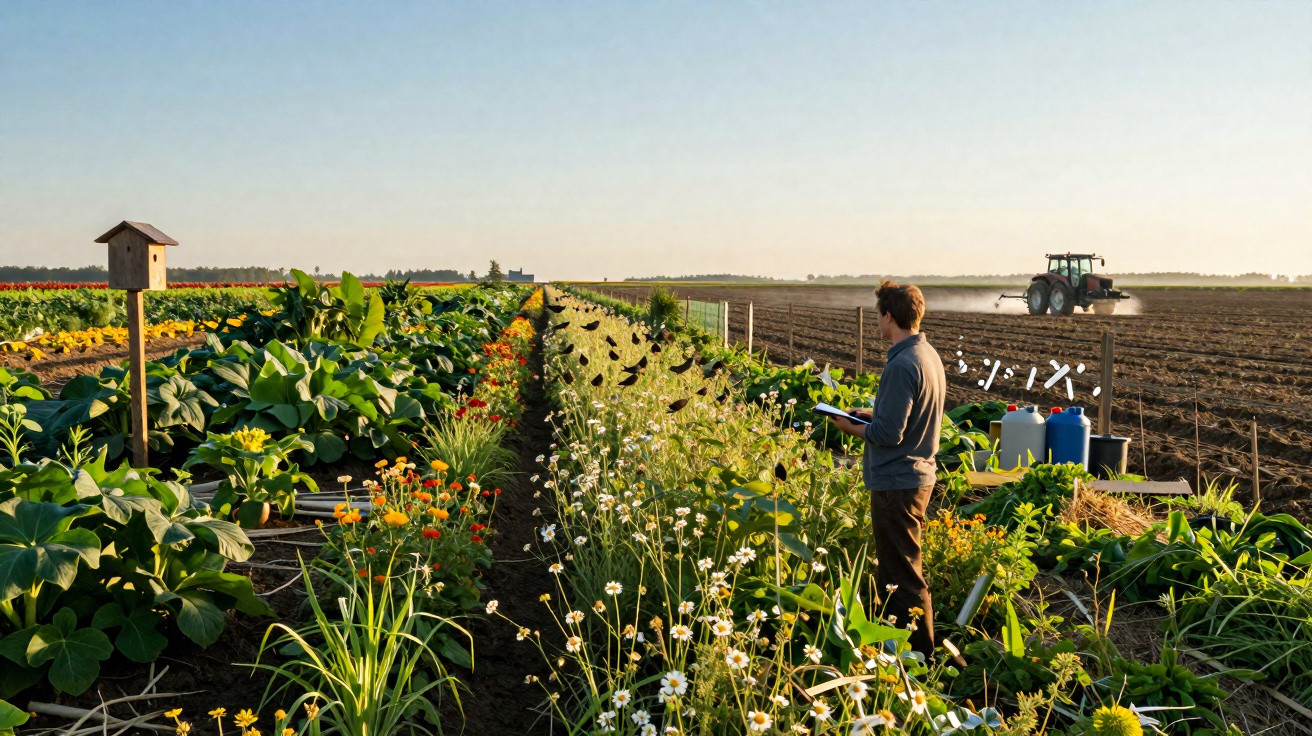
Researchers do see ways to break this cycle. Regenerative and less intensive forms of land management are regarded as promising approaches for bringing farming and conservation into better balance.
How farmland can become more bird-friendly
A number of measures have shown positive effects on bird populations in studies and practical projects:
- Reduced use of pesticides and mineral fertilisers
- Retaining and establishing hedgerows, field copses and wildflower strips
- Avoiding huge monocultures in favour of smaller fields and crop rotations
- Delaying meadow cutting so that young birds can fledge
- Leaving fallow land and field margins uncultivated
Such measures do not benefit birds alone. They generally also support pollinators such as bees, improve soil fertility and make ecosystems more resilient to extreme weather.
Why the issue matters to people too
Birds are more than simply “beautiful companions in the sky”. They eat pest insects, disperse plant seeds and serve as early warning systems for environmental problems. When their populations collapse, it indicates fundamental disruption to ecosystems that ultimately affects farming itself.
Where birds disappear, entire ecosystems often begin to fail – with consequences for harvests, water systems and the climate.
Many characteristic farmland birds in Europe, including lapwings, grey partridges and skylarks, show trends very similar to those of their counterparts in North America. This makes clear that the study’s findings cannot simply be dismissed as a distant problem: they also point to risks for agricultural landscapes in German-speaking regions.
What terms such as intensive farming and regenerative farming mean
Intensive farming mainly refers to systems designed to achieve high yields per unit of land. Typical features include large fields, extensive machinery, targeted breeding, and high inputs of fertiliser and plant protection products. This model can deliver large production volumes in the short term, but often at the expense of soil quality, biodiversity and landscape structure.
Regenerative farming has a different objective: soils should become more fertile over the long term, store carbon and provide habitat. Farmers may use diverse crop rotations, cover crops, as little soil cultivation as possible, measures to build humus, and the integration of hedgerows or tree strips. Such systems can reduce chemical use, improve water absorption and create habitats for birds and insects.
The new study underlines how urgently land use needs to be reconsidered. Birds respond sensitively to changes in landscapes and climate. Their populations reveal whether an agricultural system is functioning in balance or is already reaching its ecological limits.



Comments
No comments yet. Be the first to comment!
Leave a Comment