
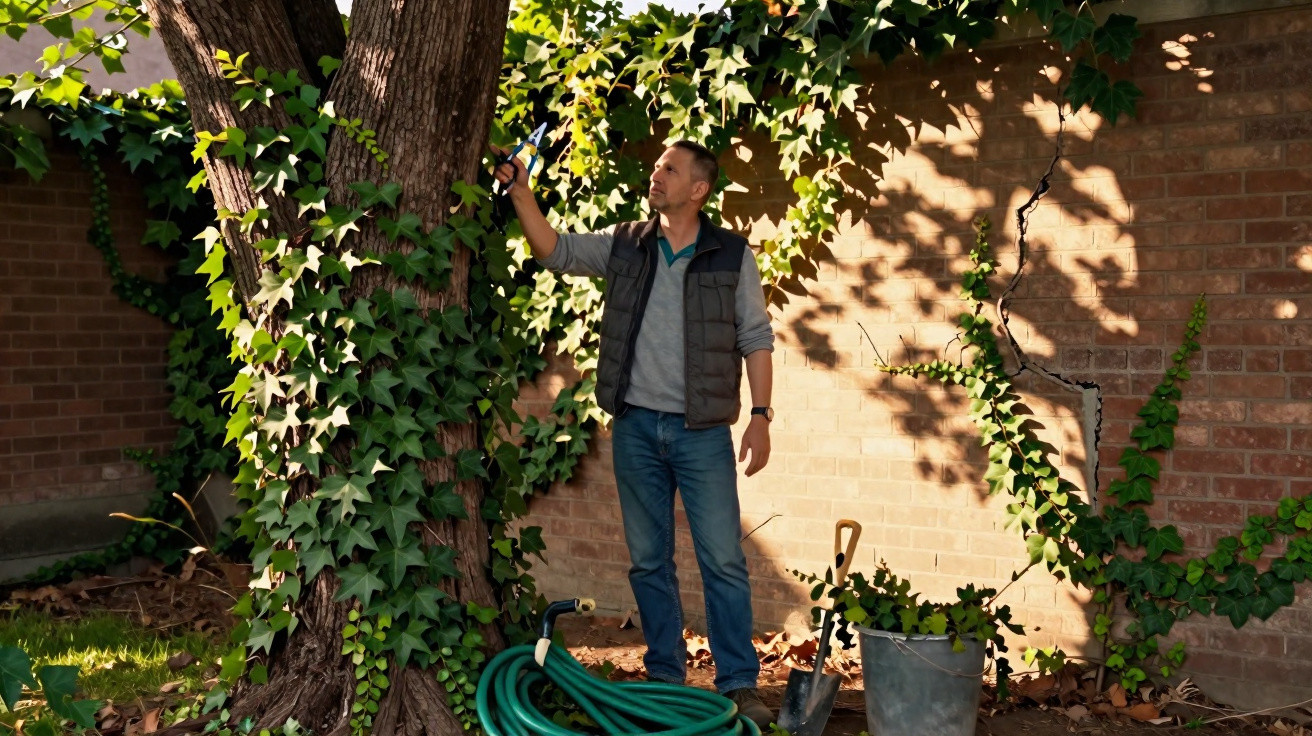
People often tear ivy away from garden fences and historic stone walls in the name of “good maintenance”. However, an increasing number of arborists, ecologists and building experts warn that this automatic response can be counterproductive: it may harm trees, speed up erosion and even reduce a home's resilience.
Ivy is not the parasite many think it is
The fundamental misconception concerns its roots. Common ivy (Hedera helix) is not a parasite, unlike mistletoe. It does not take sap from a tree trunk or draw nutrients from a wall.
Its actual roots remain in the ground, taking up water and minerals from the soil. The climbing parts are small aerial holdfasts, which work as tiny anchors on bark or masonry. They secure the plant but do not extract anything from the material beneath them.
When a tree is vigorous and structurally sound, research shows ivy does not reduce its vitality or “strangle” it.
This difference is crucial. On a healthy tree or structurally sound façade, ivy acts more like an outer coat than a leech. Pulling it off “just in case” may remove a protective covering that has taken years to develop.
On trees, ivy can be a living shield
Seeing dense ivy winding around a trunk can alarm gardeners. The usual reaction is to sever it at the bottom and pull away the remaining growth. But when the trunk is strong, this leafy covering can provide several understated benefits.
A microclimate for bark and wildlife
Thick foliage provides insulation, reducing the severe heat and cold that would otherwise affect bark directly. During summer, it protects the trunk from intense sunlight. In winter, it lessens wind chill and may ease freeze-thaw strain on the wood's outer layers.
Ivy also retains a light layer of moisture around the bark. This can limit rapid drying and reduce cracking at the surface in exposed places. Along the ground, trailing stems make a dense cover that holds soil in place, slows erosion and reduces water loss.
Ivy thickets can shelter nesting birds, small mammals and well over a hundred species of insects, all inside a single mature clump.
In urban areas, where mature trees and hedgerows may be limited, a mature ivy-covered trunk can serve as a miniature apartment block for wildlife.
When ivy becomes a real problem for trees
Problems arise where the supporting tree is already weak. An old or diseased tree with decayed heartwood or fragile branches may find it difficult to cope with the additional weight and wind resistance created by ivy in its canopy.
Young trees, particularly fruit trees, can also be affected. Their narrow branches require plenty of light to develop strongly and bear fruit. Thick ivy may shade new growth, conceal evidence of disease and form damp areas in which fungi can flourish.
In storms, a canopy packed with evergreen foliage behaves like a sail. Its greater surface area raises wind loading. For a weakened trunk, that may be the difference between remaining standing and breaking or being uprooted.
- Healthy, well-rooted mature tree: ivy is usually safe, provided it is lightly and regularly trimmed.
- Very old, hollow or structurally damaged tree: ivy may raise the risk of failure.
- Young trees and fruit trees: keep ivy low or remove it from the crown.
Specialists therefore favour a measured approach: reduce ivy in the upper canopy of vulnerable trees instead of stripping every stem away and leaving bare bark.
On walls, ivy can protect rather than destroy
Ivy has an especially poor reputation around buildings. Many householders attribute cracked stonework or peeling render to it. Yet structural inspections frequently reveal the reverse sequence: damage is generally present first, and ivy colonises it afterwards.
How ivy behaves on a sound façade
Where a wall is stable and its mortar and render are intact, ivy holdfasts stay at the surface. They adhere to the wall but seldom penetrate deeply into the underlying material.
This green cover can then function as a natural cladding layer. It slows wind-driven rain, so less water reaches the wall directly. Its foliage also moderates temperature changes, leaving masonry cooler during heatwaves and a little warmer during cold spells.
Well-managed ivy on a solid wall can cut surface temperature peaks and shield bricks from repeated wetting and drying cycles.
The leaves catch airborne dust and certain pollutants as they pass, potentially making a small improvement to local street-level air quality. For properties beside busy roads, this is meaningful.
Where cracks exist, ivy exploits them
The situation is different where a wall has existing damage. Weak mortar joints, neglected pointing and fine cracks create small spaces into which ivy's clinging roots can settle.
As the stems grow thicker and move in the wind, these locations undergo repeated physical pressure. Water remains in the gaps, hastening frost damage and salt crystallisation. Over time, joints may open further, fragile bricks can become loose and water penetration may increase.
Older, unrenovated stone properties are particularly at risk. Dense ivy may also block gutters and downpipes, directing water into unsuitable places. For these buildings, experts advise a straightforward order: inspect the masonry, fix faults, and only then decide whether ivy should be allowed to return.
| Wall condition | What ivy tends to do | Recommended approach |
|---|---|---|
| Sound brick or stone, good mortar | Adheres to the surface, providing shade and rain protection | Retain it, but prune around windows, gutters and the roofline |
| Hairline cracks, slightly soft joints | Roots may settle in and gradually enlarge gaps | Cut back the ivy, repair the joints, then review the situation |
| Severely degraded masonry | May hide and worsen major moisture issues | Remove it gradually and complete full repairs |
How to manage ivy without harming trees or buildings
Experts recommend beginning with a basic assessment of the structure supporting the plant before doing anything to the ivy. For trees, examine trunk stability, the root flare, branch arrangement and any signs of decay. For walls, check the mortar, render and existing patches of damp.
Ivy can generally remain on a sturdy tree. Pruning lightly every two to three years stops it from taking over the crown. The objective is to retain a green column on the trunk while avoiding thick growth at the very top, where wind loading is most important.
For a leaning or damaged tree, a firmer approach is needed. Arborists commonly cut through a ring of ivy stems at the base and allow the growth above to die back on its own. This prevents bark from being torn away, which could create long wounds and leave the tree vulnerable to infection.
Brutal tearing of ivy from trunks or façades often causes more damage than the plant ever did on its own.
A similarly gradual method can be used on walls. Severing ivy at ground level and allowing it to dry makes later removal simpler. After dying, stems release more cleanly from the wall, lowering the chance of dislodging pieces of mortar or render.
Practical scenarios for homeowners and gardeners
If your garden tree is wrapped in ivy
Consider a mature oak or maple carrying a substantial column of ivy. If the tree appears sturdy, its crown has plenty of its own foliage and there is no clear dieback, the ivy can be retained as a wildlife habitat and climate buffer. Thin it near the crown, however, and stop it spreading across major limbs, where it could conceal early disease symptoms.
Change that example to a hollow trunk that leans and has been damaged in previous storms, also covered in ivy. In this case, internal weakness combined with external weight makes the situation more serious. Paying for a professional assessment is worthwhile, while reducing or removing ivy from the crown should form part of a wider safety plan.
If your house wall is covered in green
Take a well-pointed brick wall from the 1990s without visible cracking. If ivy has grown up one side to the eaves, it is less a villain than an unpaid helper. You may still choose to remove it from gutters, roof tiles and window frames, but the main area can stay as a natural screen providing shade.
By contrast, imagine a 19th-century stone cottage with deteriorating joints and indoor damp. Heavy ivy on the façade could be concealing substantial faults. The priority is then to remove the plant safely, let the wall dry, repair the masonry and deal with drainage. Allowing ivy to grow back is sensible only after the building is structurally sound.
Key terms and side effects worth knowing
Two technical concepts explain ivy's mixed reputation. The first is the “sail effect”: a dense body of foliage catches the wind much like a boat's sail. On trees, this added drag increases pressure on the trunk and roots. On walls, heavy stems moved by the wind can put strain on weak joints.
The second concept is the “microclimate”. Around bark or brick, ivy creates its own small climatic layer. Marginally higher humidity and less extreme temperature variation may benefit living wood and certain types of masonry, but can be harmful on walls that are already damp and poorly ventilated.
There is a trade-off for people, too. Ivy helps urban biodiversity, takes in a modest quantity of air pollution and softens the appearance of hard landscapes. Conversely, flowering ivy can cause allergies in sensitive people, while thick growth can offer rodents or wasps a sheltered hiding place close to buildings.
With some understanding, ivy can move from being viewed as a threat to becoming a managed ally. The key factor is not so much the plant itself, but the state of the surface it grows on - and how readily we reach for the pruning saw.



Comments
No comments yet. Be the first to comment!
Leave a Comment