
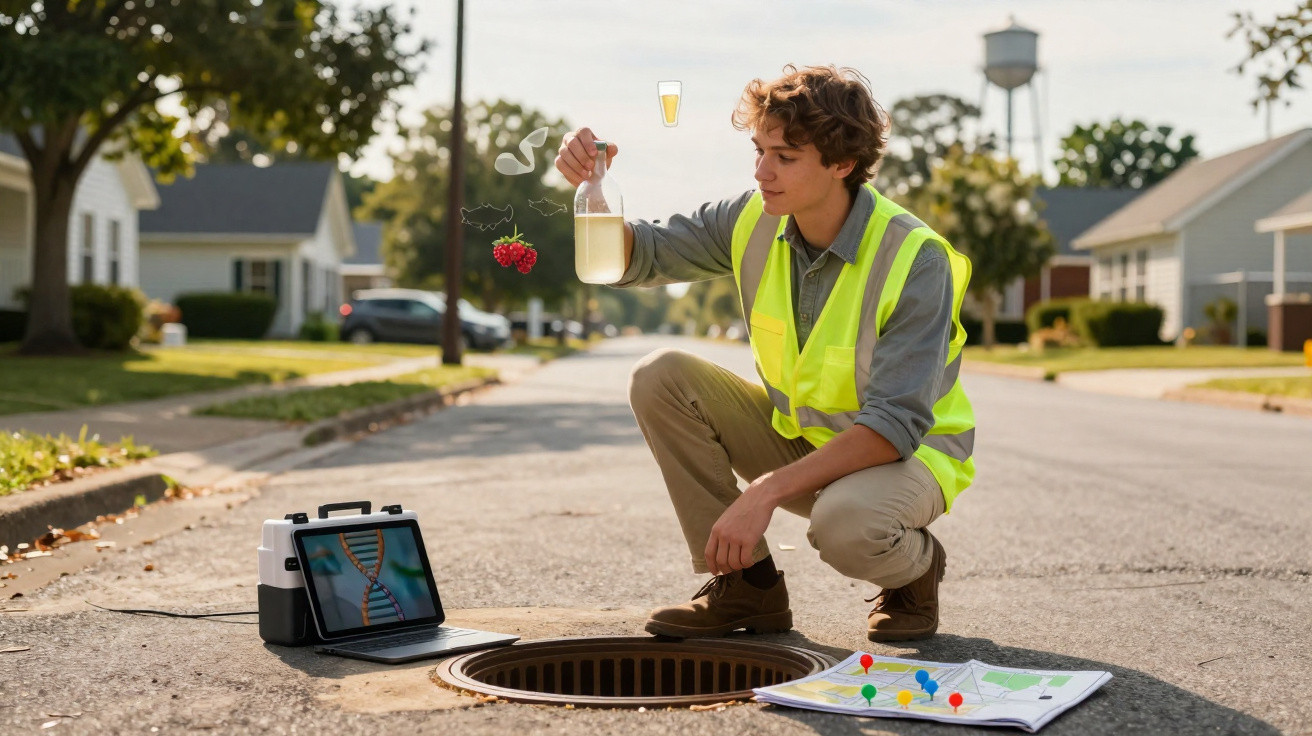
Community wastewater is proving to be an unexpected source of nutritional information. Researchers have shown that they can estimate the diets of whole neighbourhoods without depending on questionnaires or food diaries.
A new study examined DNA fragments in sewage from across North Carolina, finding that material washed into drains closely reflects income levels, immigration patterns and location.
Researchers from Duke University School of Medicine and the University of North Carolina at Chapel Hill led the study.
The team assessed wastewater from 19 North Carolina communities, representing 2.1 million residents. They extracted minute pieces of plant and animal DNA to map broad dietary patterns within each population.
Beer, fruit, and fish tell different stories
The resulting patterns were strongly associated with demographic and economic differences among communities.
More affluent neighbourhoods were likelier to contain traces of hops, an essential beer ingredient. In places with larger foreign-born populations, the researchers found signs of tropical fruit and bean consumption.
In coastal areas, wastewater showed distinct evidence of seafood-rich diets, including locally caught species such as drum, Spanish mackerel and triggerfish.
“Poor diet is one of the world’s biggest drivers of chronic disease, but we’ve never had a fast objective way to measure what people eat,” said senior author Lawrence A. David, a member of the Duke Microbiome Center.
“This study helps fill that gap so we can better connect diet to health.”
A gap in nutrition research
Nutrition researchers have spent decades using food diaries and surveys to understand people’s diets. These approaches are widely known to be costly, slow and unreliable.
People may forget what they have eaten, fail to report less healthy foods, or never be included in a survey at all.
Moreover, communities most affected by illnesses linked to diet are often the very groups that are most difficult to assess through these conventional methods.
To overcome those constraints, Duke researchers created FoodSeq-FLOW, a DNA sequencing platform intended to search wastewater for evidence of the food that communities are genuinely eating and preparing.
Lead author Mengyi Dong carried out the genomic analysis during her time at Duke, converting raw DNA sequences into recognisable plant and animal species.
COVID-era wastewater tracking
This method builds on wastewater surveillance systems that grew rapidly during COVID-19.
Fragments of viruses shed in human waste enabled public health officials to identify and follow outbreaks in real time.
The same systems now monitor various infectious and respiratory illnesses, while researchers continue extending their use well beyond disease surveillance.
With the new sequencing platform, the team studied wastewater collected from eight treatment plants in three North Carolina regions over two separate periods: June to December 2020 and June 2021.
“Wastewater offers an objective way to monitor dietary patterns across entire communities and could help guide more targeted nutrition and food security programs,” said Dong, now an associate professor at Virginia Tech’s Seafood Agricultural Research and Extension Center.
“Food security isn’t just about whether enough food is available. It’s also about ensuring communities can access healthy, nutritious options.”
A tool with real-world applications
The possible uses of the approach are already attracting attention from local communities.
In Durham’s historic Hayti neighbourhood, community leaders are seeking to establish a Black-owned full-service supermarket.
They regard this type of information as a means of showing the measurable difference such a shop could make in an area described as a food desert.
“It would allow us to eat healthier foods more regularly because we wouldn’t have to travel so far to get them,” said Erin Dooley, co-founder of BLK South and resident of the Grant Street Community.
“What’s unique about Dr. David’s research is that it’s not just hard facts and data, but it supports our lived experiences.”
Validating the method
To establish whether the wastewater findings were dependable, the researchers compared the DNA patterns with dietary information from 14 stool samples gathered in Durham in June 2021.
The two sets of data aligned closely, indicating that sewage-based monitoring can accurately represent local diets rather than providing only a broad estimate.
Crucially, the researchers stress that the purpose is not to track individuals, but to assess patterns across communities.
By obtaining dietary details from entire populations without identifying particular people, wastewater analysis could address genuine shortcomings in public health information while safeguarding personal privacy.
“The result is a snapshot of the community that helps understand where resources are needed,” said co-author Rachel T. Noble, a professor of marine sciences at UNC-Chapel Hill.
Implications for local food communities
Noble says the DNA markers created at Duke can identify food sources with notable precision.
For instance, the findings indicated that inland communities depend heavily on only a small number of seafood types, especially farmed fish such as Atlantic salmon, instead of using the wider selection of local or regional choices available in other parts of the state.
“Could we be doing more to support local fisheries and make their seafood more available? It looks like we certainly could,” Noble concluded.




Comments
No comments yet. Be the first to comment!
Leave a Comment