
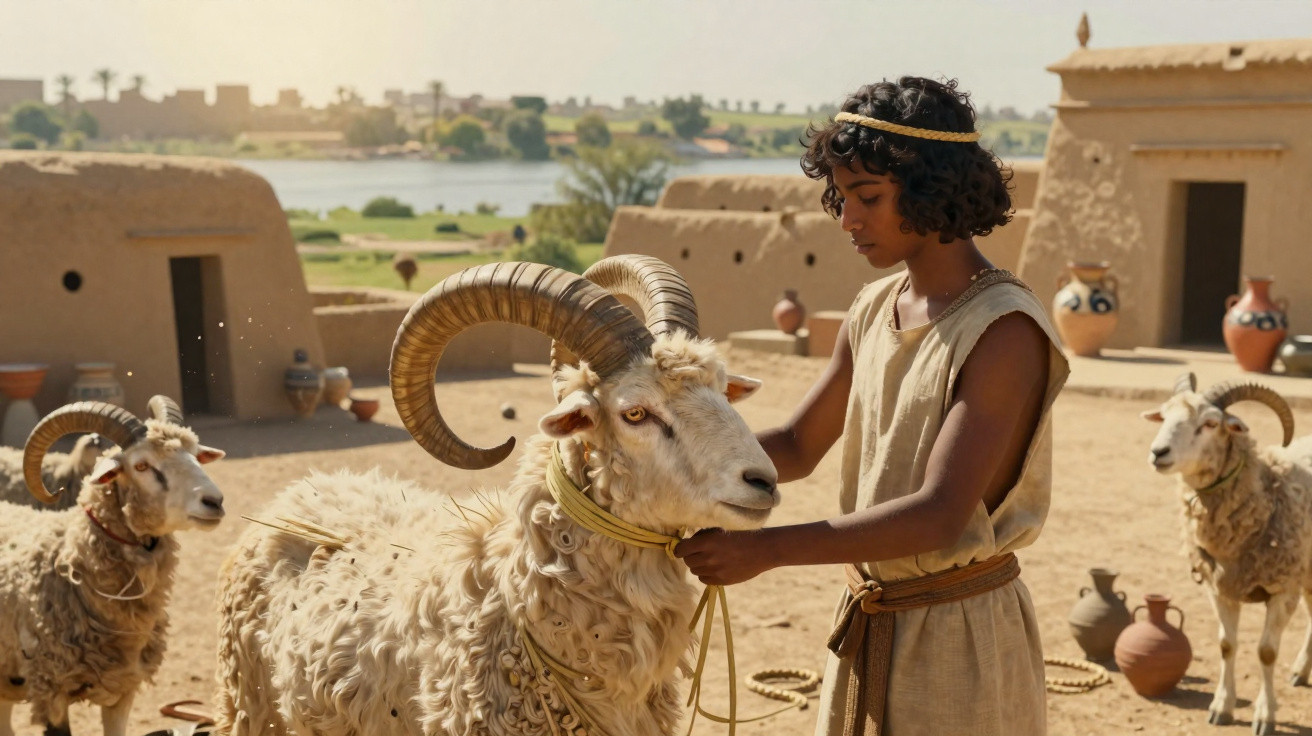
Ancient sheep interred in an elite Egyptian grave provide the earliest known evidence that people deliberately reshaped livestock horns. The precise reason for the practice, however, remains unknown.
At the 5,700-year-old archaeological site of Hierakonpolis in Upper Egypt, researchers found the remains of five male sheep with unmistakable signs that their horns had been artificially altered.
Although horn modification has long been practised on African cattle and continues in some places today, these remains represent both the oldest direct physical evidence of the custom and its first known occurrence in African sheep.
Ancient sheep horn deformation at Hierakonpolis
The animals were an extinct type of sheep whose corkscrew horns would normally have extended sideways from the head. Yet three of the sheep recovered from the tombs had horns that had been changed to grow vertically upwards.
A fourth animal's horns were less upright, but were nevertheless positioned closer together than would be expected, suggesting that deformation had also been attempted. The fifth sheep had its horns entirely removed, while a sixth retained naturally formed horns.
"Notches in the horns suggest that the ancient Egyptians used ropes to bind them together," says Bea De Cupere, archaeozoologist at the Royal Belgian Institute of Natural Sciences.
"Holes in the skull bones indicate that herders also broke the skull of the young animals to force the horns to grow upright. It is a practice that certain African pastoral communities still apply to cattle."
Elite graves and deliberately altered livestock horns
Researchers cannot yet determine why ancient Egyptians carried out this procedure. They suggest that it may have had a ritual purpose, or perhaps served as a demonstration of human control over nature.
By 3700 BCE, roughly a thousand years before the pyramids were constructed, Hierakonpolis had become an important Upper Egyptian city. Its archaeological remains include burials for ordinary people and elites, alongside an unexpectedly broad collection of animal remains, indicating that the settlement contained the earliest known example of what could be described as a zoo.
Based on the material recovered to date, this collection included local and imported wild animals, such as hippopotamuses, crocodiles, elephants, baboons, wildcats and aurochs. It also held domesticated species including cats, dogs, cattle and, naturally, sheep.
Sheep bones have been discovered throughout Hierakonpolis, but the sheep with deliberately modified horns appeared only in the elite burial ground.
There were further distinctions. Analyses of tooth development and bone fusion found that these sheep were substantially older and larger than sheep used as food. Castration may account for this, while also making the animals more manageable.
The researchers propose that making elite-owned sheep appear more striking than those of ordinary people may have been the objective.
"The elite wanted to display their power by keeping wild and exotic animals, and perhaps also by straightening the horns of impressively large sheep," says archaeozoologist Wim Van Neer.
"Maybe they wanted the sheep to look like addaxes from the Sahara? Or perhaps the animals were involved in rituals? For now, we can only speculate."
The oldest known livestock horn deformation
Whatever motivated the practice, the discovery is both the first known instance of horn deformation in sheep and, at about 5,700 years old, the earliest identified example of intentional livestock horn deformation. The previously oldest evidence came from cattle at a Sudanese site dated to at least 4,000 years ago.
Additional research may clarify how and why ancient Egyptians altered animal horns. It could also help address unanswered questions about when and how these corkscrew-horned sheep declined as crescent-horned 'ammon' sheep replaced them.
The study was published in the Journal of Archaeological Science.






Comments
No comments yet. Be the first to comment!
Leave a Comment