
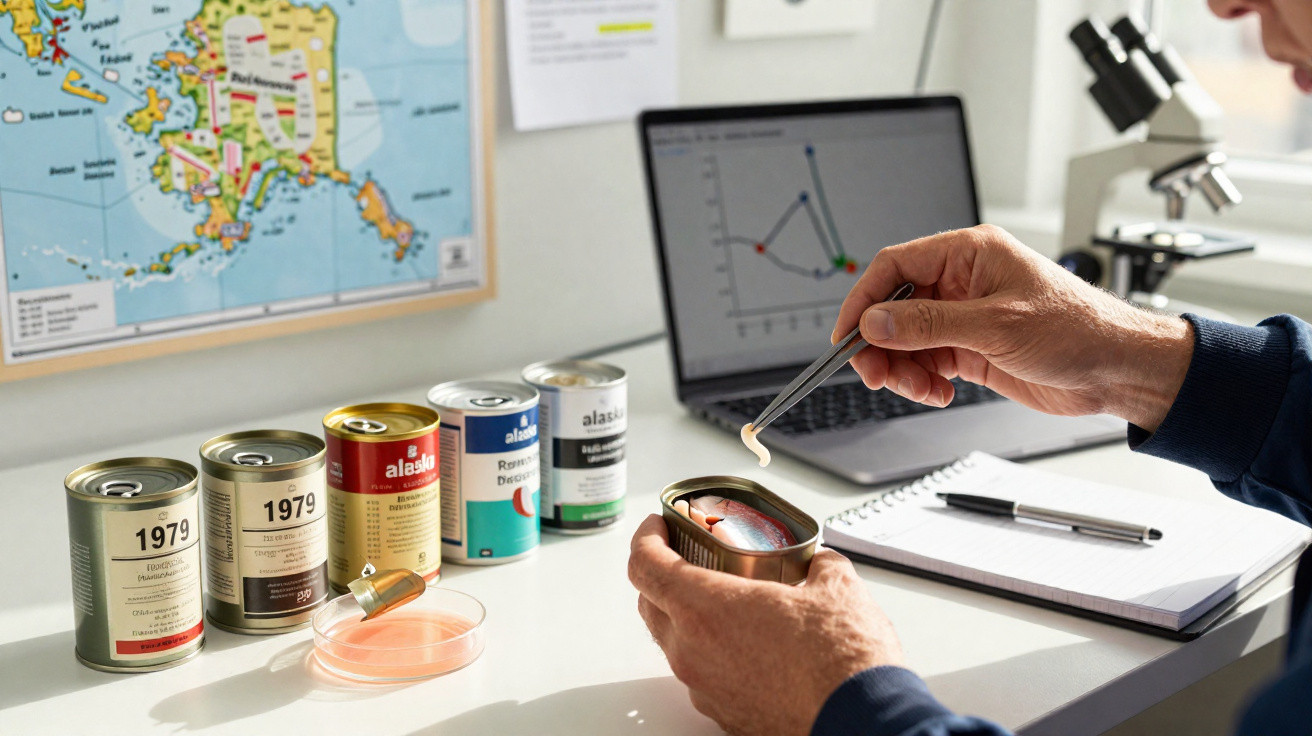
Tins of salmon have become the unexpected stars of an accidental natural history collection at the back of a pantry, preserving decades of Alaskan marine ecology in brine and metal.
Parasites can reveal a great deal about an ecosystem because their lives typically involve several species. Yet, unless they create a serious issue for people, they have historically attracted little attention.
That poses a difficulty for parasite ecologists such as Natalie Mastick and Chelsea Wood of the University of Washington, who were looking for a way to retrospectively examine the effects of parasites on marine mammals in the Pacific Northwest.
When Wood received a call from Seattle's Seafood Products Association offering boxes of old, dusty, out-of-date salmon tins - some dating from the 1970s - she was unequivocally interested.
The association had retained the tins for decades under its quality-control procedures. For the ecologists, however, they formed an archive containing remarkably well-preserved specimens - not of salmon, but of worms.
Anisakid worms in canned salmon
The prospect of worms in tinned fish may be rather unappetising, but these marine parasites, known as anisakids and measuring roughly 1 centimetre long, are harmless to people once the canning process has killed them.
"Everyone assumes that worms in your salmon is a sign that things have gone awry," said Wood when the research was published this year.
"But the anisakid life cycle integrates many components of the food web. I see their presence as a signal that the fish on your plate came from a healthy ecosystem."
Anisakids enter the food web after being consumed by krill, which are then eaten by larger animals.
That is how the worms reach salmon and, ultimately, the intestines of marine mammals. There, they reproduce to complete their life cycle. The mammals excrete the eggs into the sea, beginning the cycle anew.
"If a host is not present – marine mammals, for example – anisakids can't complete their life cycle and their numbers will drop," said Wood, the paper's senior author.
A 42-year archive of Alaskan salmon
The 178 tins in the archive held four salmon species caught in the Gulf of Alaska and Bristol Bay over 42 years (1979–2021): 42 tins of chum (Oncorhynchus keta), 22 coho (Oncorhynchus kisutch), 62 pink (Oncorhynchus gorbuscha), and 52 sockeye (Oncorhynchus nerka).
Although the methods used to preserve the salmon did not, fortunately, leave the worms in perfect condition, the team could dissect the fillets and work out the number of worms per gram of salmon.
They discovered that worm numbers rose over time in chum and pink salmon, but not in sockeye or coho.
"Seeing their numbers rise over time, as we did with pink and chum salmon, indicates that these parasites were able to find all the right hosts and reproduce," said Mastick, the paper's lead author.
"That could indicate a stable or recovering ecosystem, with enough of the right hosts for anisakids."
What stable parasite numbers may mean
Explaining the unchanged worm levels in coho and sockeye is more difficult, particularly because canning made it hard to identify the precise anisakid species involved.
"Though we are confident in our identification to the family level, we could not identify the [anisakids] we detected at the species level," the authors write,
"So it is possible that parasites of an increasing species tend to infect pink and chum salmon, while parasites of a stable species tend to infect coho and sockeye."
Mastick and her colleagues believe this new method - transforming dusty old tins into an ecological archive - could support many further scientific discoveries. It appears they have opened quite a can of worms.
The research was published in Ecology and Evolution.
An earlier version of this article was published in April 2024.


Comments
No comments yet. Be the first to comment!
Leave a Comment