
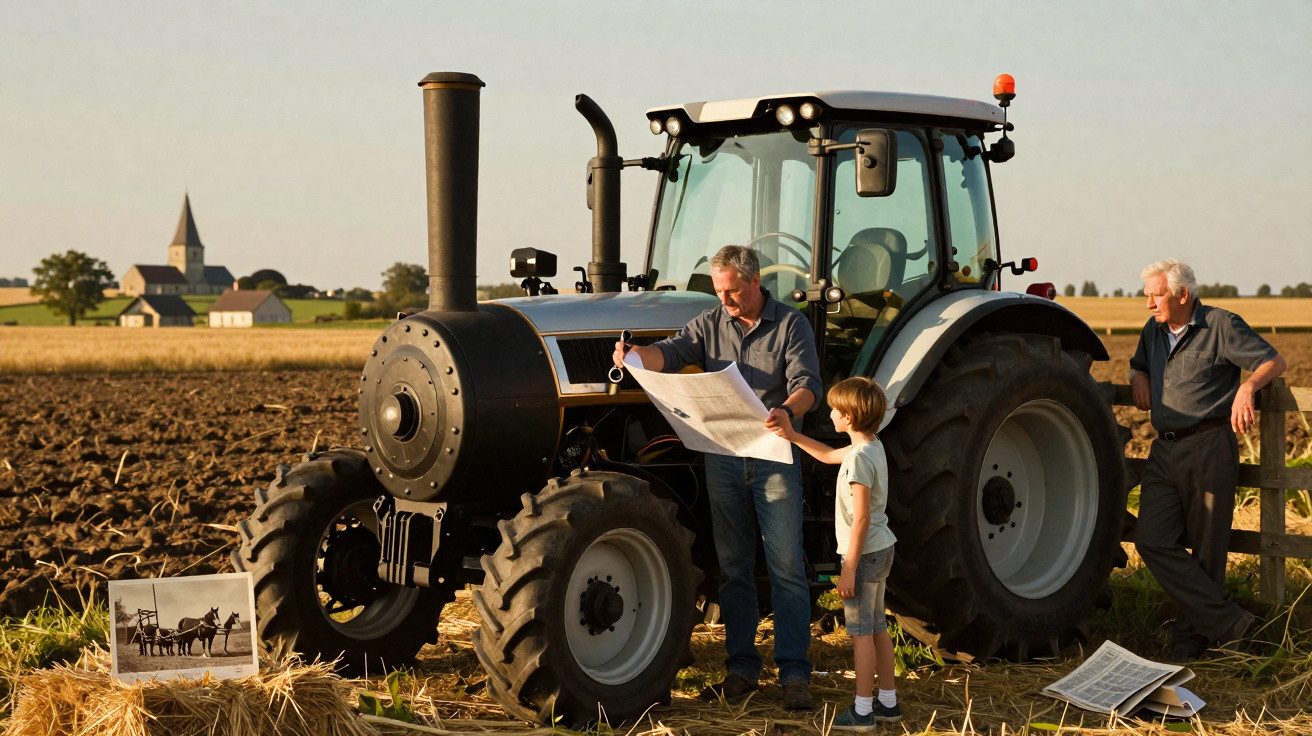
Before it became a familiar sight on farms, the tractor resembled a locomotive that had strayed into the fields. It was heavy, emitted smoke, frightened animals and could sink into the ground. Even so, these contraptions endured accidents, uprisings and restrictive laws before replacing millions of horses and permanently reshaping food production.
Why did the earliest tractors resemble locomotives?
One of the first self-propelled vehicles appeared in 1769, when French engineer Nicolas-Joseph Cugnot built a steam-powered machine to carry artillery parts. It could reach roughly 4 kilometres per hour, proved difficult to steer and had to stop regularly while boiler pressure was restored.
During the 19th century, inventors began adapting steam engines for agricultural work. Some machines could power saws, mills and threshing equipment, yet they were so weighty that horses had to tow them to the field. One farmer joked that a particular machine was about as mobile as a village church.
How did a tragedy lead to the steam plough?
While visiting Ireland in 1849, amid the aftermath of the Great Famine, British engineer John Fowler witnessed poverty and food shortages. The experience prompted him to pursue machinery that could drain land and raise farm productivity, leading to cultivation systems driven by cables and steam engines.
According to the Science Museum Group collection, Fowler’s plough was hauled by cables stretched between two traction engines placed on opposite sides of a field. The system could also cut underground channels to remove water from saturated soil, making previously unproductive land more suitable for cultivation.
Why did the machines cause fear and unrest?
Landowners saw machinery as a way to cut spending on labourers, animals, feed and accommodation. For many workers, however, mechanisation meant unemployment. During the English rural uprisings of 1830, agricultural equipment was smashed and properties were attacked by groups demanding better wages.
- Heavy machines could damage roads and bridges;
- Boilers raised fears of explosions and accidents;
- Noise and smoke frightened horses and other animals;
- Sparks could set crops alight;
- Workers feared losing both income and housing.
Resistance was also written into legislation. The Locomotives Act of 1865 restricted the speed of machines on British roads and required someone to walk in front carrying a red flag. Parliamentary records show that the rule was debated for decades before being repealed in 1896.
Watch the video shared by the Rural Facts YouTube channel about the first tractor ever created.
When did the tractor finally become practical?
The crucial change came with combustion engines, which were smaller and simpler than enormous boilers. In the early 1890s, experiments such as those conducted by John Froelich helped prove that a petrol engine could drive an agricultural machine without the lengthy preparations required by steam power.
Progress reached a wider market with the Fordson F, which entered production in 1917. The Henry Ford museum describes it as the first light, affordable, mass-produced tractor for ordinary farmers. Manufactured on an assembly line, more than 700,000 units had been made by 1928, helping to spread mechanisation.
How did the tractor transform life in the countryside?
The world wars hastened the replacement of horses, as millions of workers were sent to the front lines. Tractors could plough larger areas in less time, pull equipment and sustain food production. A 23-tonne steam machine, for instance, could provide 30 horsepower, whereas the Fordson delivered 20 with a weight of little more than one tonne.
This efficiency carried a social cost: rural jobs declined and families moved to industrial towns and cities. Nevertheless, the tractor made it possible to farm vast areas with smaller teams and helped establish modern agriculture. Understanding this shift shows that every powerful innovation demands urgent choices about productivity, safety and human dignity.






Comments
No comments yet. Be the first to comment!
Leave a Comment