
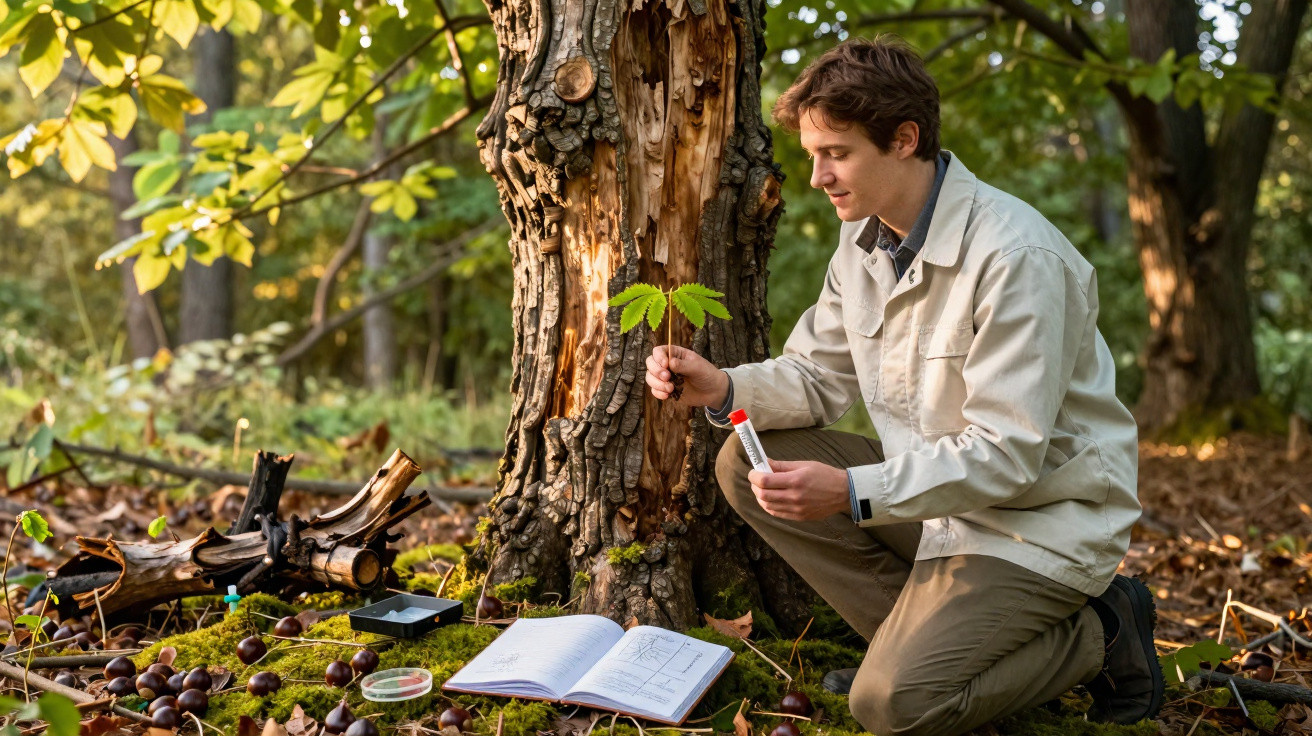
For centuries, the chestnut tree has represented abundance, shade and food across Europe. Yet beneath its striking canopy, a quiet crisis is unfolding: pathogens originating in Asia are weakening trees so severely that entire stands are becoming unstable. Research groups in France, Italy, the United States and, increasingly, German-speaking countries are using modern science to try to change the chestnut’s fate.
A ‘bread tree’ close to collapse
A walk through old chestnut groves in the Auvergne, Tuscany or Ticino still evokes an earlier age. Sweet chestnuts once sustained entire villages, were known as the ‘bread of the mountains’, and shaped the landscape as profoundly as spruce or beech woods do today. In many areas, they were regarded as a safeguard against hunger in difficult years.
For more than a century, however, a combination of diseases and pests has been eroding that legacy. Two diseases caused by introduced organisms from Asia are particularly dangerous:
- Ink disease (caused by fungus-like organisms of the Phytophthora genus)
- Chestnut blight (caused by the fungus Cryphonectria parasitica)
In the United States, chestnut blight virtually wiped out the American chestnut tree during the 20th century. Its European relative, the sweet chestnut, is now fighting for its own future.
“The chestnut is a tree of abundance that has suddenly become a patient with an uncertain prognosis.”
Ink disease and chestnut blight: what lies behind the names
Ink disease: an attack from below ground
Ink disease starts discreetly in the roots. Phytophthora, a fungus-like pathogen, infects the root system and disrupts the tree’s water supply. At first, the visible signs may be limited to yellowing leaves and poor growth; later, the crown dries out.
In the French chestnut-growing area around Montmorency, researchers at the public research organisation Inrae collect root samples and test them for Phytophthora in the laboratory. This targeted diagnosis is intended to identify threatened sites early, before woodland dies back across a wide area.
The term ‘ink disease’ refers to the dark, ink-like seepage that can appear in the soil when infection is severe. For woodland owners, a positive result usually means that tree loss is only a matter of time unless action is taken swiftly.
Chestnut blight: wounds that fail to close
Chestnut blight strikes further up the tree. The fungus Cryphonectria parasitica enters the bark through small injuries, produces orange fruiting bodies and gradually girdles the trunk. Water and nutrient transport then fails, and branches die back one after another.
In American forests, this process has effectively eliminated an entire ‘forest giant’. The disease has spread across Europe since the middle of the 20th century, though at a somewhat slower pace. One reason is that, in some places, a natural opponent has become established: a weakened form of the fungus that can displace its aggressive relative.
“To combat chestnut blight, researchers are increasingly relying on biological weapons – in other words, ‘good’ variants of the same species.”
Why Asian chestnut species are better equipped
European and American chestnuts share a crucial disadvantage: they never had the opportunity to adapt to these new pathogens. The organisms arrived through global trade and plant imports, spread rapidly, and encountered host trees with no genetic defences.
Asian chestnut species, including those from China and Japan, are very different. They have coexisted with these pathogens for thousands of years and have developed protective mechanisms. For instance, they can limit fungal infection or shed infected tissue quickly.
This is where much of the research is focused: how can the resilience of Asian trees be used without simply replacing native chestnut woodland entirely with non-native species?
Chestnut research in the field: samples, tests and data
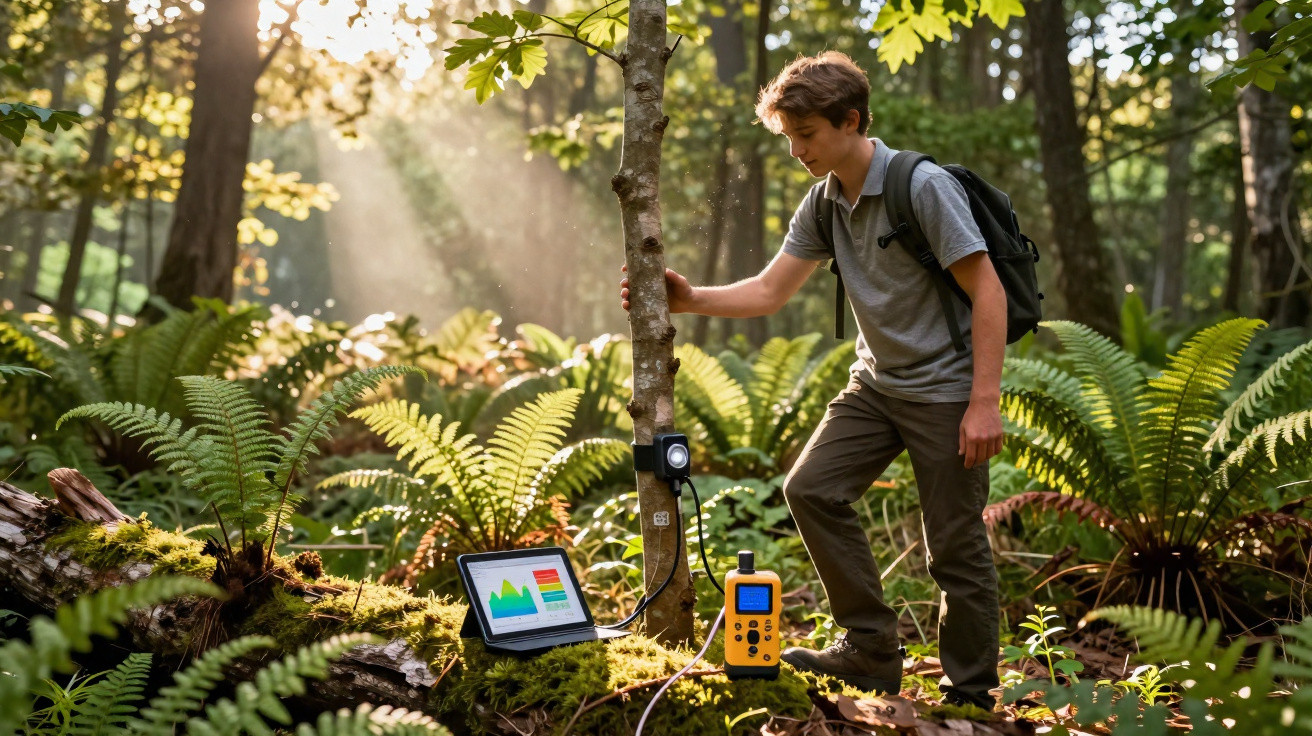
In France, teams from Inrae and universities survey infected woodlands. They take samples from roots, bark and soil, map the damage, and compare site conditions such as moisture levels, soil type and altitude.
Typical fieldwork includes:
- recording affected trees with GPS data
- collecting root and bark sections using disinfected tools
- carrying out rapid on-site tests for indications of specific pathogens
- using laboratory analysis to detect the organisms’ DNA traces
- comparing findings with climate data and historical waves of infection
Gradually, this creates a kind of ‘health map’ for chestnut woods. It reveals where pressure from ink disease is greatest, where chestnut blight is dominant, and where trees remain comparatively stable.
Genetics rather than the axe: developing new chestnut types
Alongside forest diagnosis, breeding programmes are taking place behind the scenes. Their aim is to produce chestnuts that offer both appealing flavour and greater resistance to pathogens.
To achieve this, researchers cross:
- European sweet chestnuts with high-quality fruit
- Asian chestnut species with strong disease resistance
The resulting offspring then face a lengthy selection process. Only trees that develop healthy bark and vigorous roots, while also producing commercially viable nuts, later progress to practical trials.
| Characteristic | European sweet chestnut | Asian chestnut |
|---|---|---|
| Fruit quality | high, traditionally popular | sometimes lower, highly variable |
| Resistance to chestnut blight | usually weak | significantly better |
| Resistance to ink disease | highly variable, often low | generally higher |
| Adaptation to European sites | very good | requires testing |
These crosses are intended to combine the strengths of both groups. The process takes time: 15 to 20 years can easily pass between the first cross and reliable results.
Biological approaches to deadly fungi
Researchers are pursuing biological methods alongside conventional breeding. For chestnut blight, they use weakened forms of the fungus that carry a ‘virus’. This virus reduces the pathogen’s aggressiveness. When these milder forms spread through a woodland, a lethal disease can become a chronic condition that the tree is able to live with.
Foresters may introduce the weakened material into bark wounds on infected trees. With some luck, the harmless fungus displaces the dangerous variant. Comparable approaches are currently being tested for other tree species and diseases.
“The future of the chestnut could lie in a combination of resistance breeding, biological control and adapted forest management.”
What woodland owners and local authorities can do now
While laboratory work continues, woodland owners, councils and private chestnut-grove owners face immediate practical decisions. Several measures are considered useful for reducing risk:
- Assess the site: Chestnuts are sensitive to waterlogging; wet, compacted soils encourage ink disease.
- Diversify variety choice: Rather than planting only one chestnut variety, use a mixture of different provenances.
- Avoid injuries: Damage to the trunk and root collar creates entry points for fungi.
- Monitor infected trees: Do not fell everything immediately; assess whether individual trees remain stable despite infection.
- Seek local guidance: Forestry services and research institutions increasingly provide advice tailored to specific sites.
Pilot projects in some regions are testing new, more tolerant chestnut types alongside practitioners in real woodland settings. This shows whether a variety can perform equally well in an experimental plot and in everyday forestry conditions.
Why saving the chestnut is about more than nostalgia
Preserving the chestnut is not solely a matter of tradition or romance. These trees provide valuable timber, food and habitat for a wide range of animal species. Their deep root systems also stabilise slopes, which is becoming increasingly important in mountainous regions affected by heavy rainfall.
Ink disease and chestnut blight also demonstrate how vulnerable forests can become through global trade flows and climate change. Rising temperatures and more extreme weather events may further encourage the spread of these pathogens. Many researchers therefore regard the chestnut as a test case for how Europe can maintain stable forests over the long term.
Anyone who values chestnuts, whether for roasted chestnuts in autumn, shade in summer or the stories of old avenues, is likely to watch these developments with mixed feelings. The encouraging news is that science is not standing by: researchers are drilling, measuring, crossing, inoculating and analysing data to turn the ailing ‘bread tree’ back into a resilient part of the cultural landscape.
How quickly this can be achieved depends on more than laboratory methods. It also requires political commitment, funding for long-term breeding programmes, and woodland owners willing to take new approaches, from changing varieties to adapting management practices. The chestnut has endured alongside people for many centuries. Whether it survives this chapter will now be decided by the combined efforts of research, forestry and society.





Comments
No comments yet. Be the first to comment!
Leave a Comment