
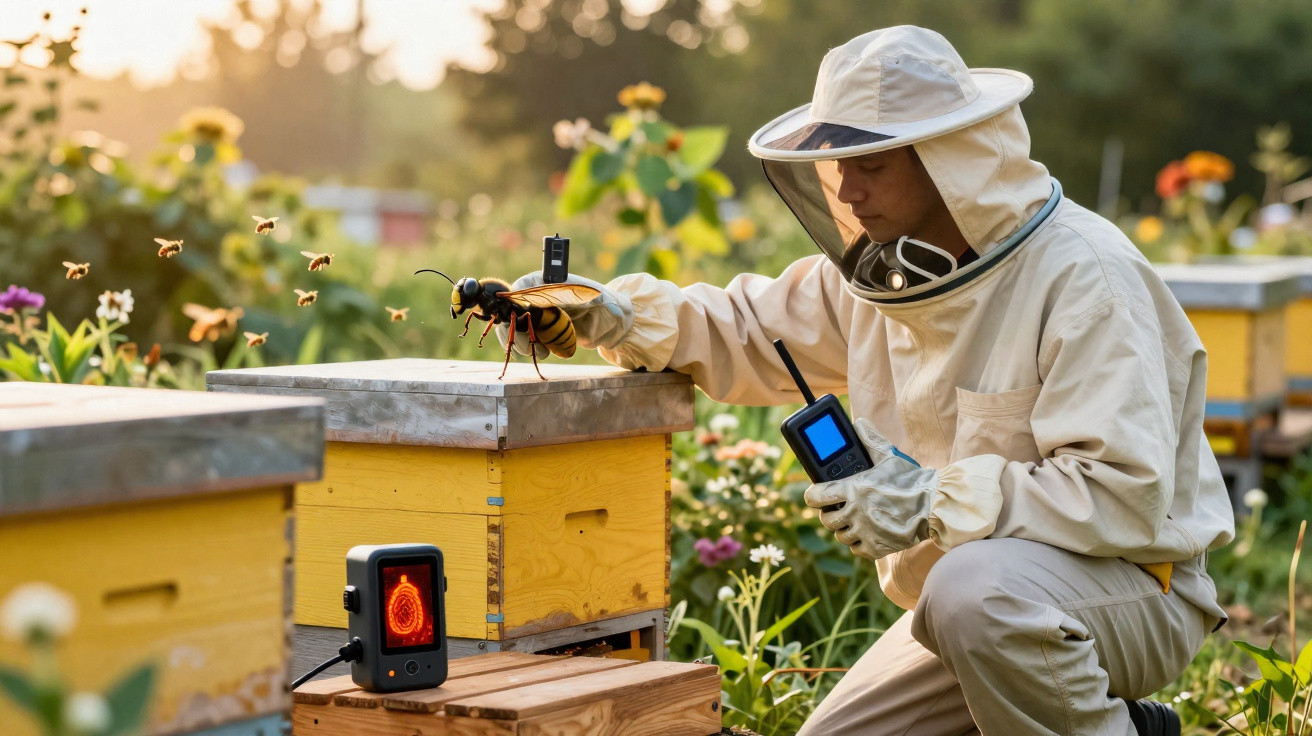
Asian hornets are making life increasingly difficult for beekeepers in Germany and across Europe. They systematically attack bees, weaken entire colonies and consequently put the pollination of fruit trees and wild plants at risk. In Alsace, one beekeeper is demonstrating how modern technology can be used against the insect invasion – with techniques that sound more like espionage than traditional beekeeping.
Why the Asian hornet is so dangerous to bees
The Asian hornet is rightly regarded as a nightmare for bees. Its hunting is far from random; it uses a clear strategy. Workers hover outside hive entrances, waiting for a honey bee to fly in or out.
When a hornet strikes, the outcome is brutal for the bee: its head is removed and the abdomen is generally discarded. The protein-rich thorax is taken back as food for the young in the nest. One hornet can kill dozens of bees in a single day.
“The constant siege outside the hive means foraging bees barely dare to fly out – and that strikes at the very heart of a bee colony.”
Eventually, many bees become reluctant to leave the hive. Colonies collect very little nectar and pollen, while their stores dwindle. This is especially damaging in late summer and autumn, when bees should be preparing for winter. If food reserves remain too low, an entire colony may perish over winter.
A beekeeper turns to technology: radio tracking against hornets
A beekeeper in the French Haut-Rhin department, close to the German border, was unwilling to accept this. Rather than simply setting traps or reporting nests, he developed an approach that tackles the problem at its source: the hornets’ nest.
His aim is to find the original first nest, where the queen raises her first workers after winter. Destroying this so-called primary nest prevents an entire hornet colony from developing.
A miniature transmitter attached to an Asian hornet
The beekeeper uses a remarkably simple yet effective method. First, he catches a hornet near his hives. He then briefly sedates the insect with gas, for example from a small cartridge, so that it remains still.
He then fixes a tiny radio transmitter or circuit board to the hornet’s back. The transmitters are exceptionally light, allowing the hornet to continue flying normally. Once the insect has recovered, he releases it and begins tracking it.
Using a rake-shaped antenna connected to his smartphone or a portable receiver, the beekeeper follows the signal. The nearer he gets to the hornet – and therefore the nest – the stronger the audible or visual signal becomes.
“The passive victim becomes the hunter: the beekeeper uses a marked hornet as a living trail to the hiding place of the entire colony.”
A thermal camera reveals the nest
To make the final stage more reliable, the beekeeper also uses thermal imaging. With binoculars capable of showing heat sources, he scans bushes, hedges and buildings. Hornet nests are usually noticeably warmer than their surroundings because numerous insects are active inside.
This makes it possible to locate a nest even when it is well concealed, such as high in a tree or inside an outbuilding. Once the hiding place has been found, many beekeepers notify the relevant authorities or specialist pest controllers, who can remove the nest in a controlled manner.
Why the first Asian hornet nest matters so much
Asian hornets often build two nests over the course of a year. In spring, the queen creates a smaller, sheltered primary nest, from which only a few workers initially emerge. As the colony grows stronger, it moves on to a larger secondary nest in summer, containing thousands of insects.
It is this second nest in particular that causes the greatest damage. Countless workers set off from it towards apiaries and fruit orchards. Individual beekeepers have very little chance against such a fully established colony.
By contrast, destroying the first nest early addresses the problem at its root. The queen dies, along with the entire future colony. As a result, thousands of workers that would otherwise attack bees and other insects do not emerge later in the year.
“Every removed primary nest means tens of thousands fewer hornets the following year – and far calmer apiaries.”
Beekeepers report that, after a primary nest has been removed, attacks on nearby hives often decline almost immediately. In areas where several nests have been found and eliminated early, colony losses have in some cases stabilised significantly.
What beekeepers and garden owners can do against hornets
The high-tech approach involving transmitters and thermal equipment is demanding and will not be realistic for every hobby beekeeper. Even so, several basic measures can help to reduce the risk.
- Position apiaries in sunny, open locations, where hornets have less cover while hovering.
- Narrow hive entrances when hornet pressure is high, making them easier for bees to defend.
- Do not leave sweet drinks, fallen fruit or leftover food directly beside hives.
- Report suspicious nests early, for instance to the local council, fire service or nature conservation authorities.
- Build networks with beekeepers in the area so sightings and discoveries can be shared quickly.
Some local authorities already have reporting points dedicated specifically to the Asian hornet. Experts assess whether a nest should be removed and how this can be done safely. Private individuals should not intervene themselves, as the insects defend their nests very aggressively.
How the spread is affecting Germany
The Asian hornet originally comes from East Asia and reached Europe through international goods transport. It has spread extensively in France in recent years, and it has now been recorded in many parts of Germany.
These insects favour mild regions, but adapt surprisingly well to different habitats. Wine-growing areas, river valleys and towns offer abundant food sources and nesting sites. This increases the pressure on honey bees, as well as wild bees and other pollinating insects.
| Asian hornet | European hornet |
|---|---|
| smaller, darker, with yellow leg tips | larger, with more yellow on its body |
| strongly focused on honey bees as prey | eats a wide variety of insects and is less focused on bees |
| nests often high in trees, in urban and rural areas | nests commonly in cavities, such as loft spaces |
This specialisation is precisely what makes the Asian species so problematic. While the native European hornet is considered beneficial and eats many pest insects, the invasive species focuses heavily on honey bee apiaries.
Opportunities and limits of high-tech Asian hornet tracking
The method described shows how inventive beekeepers now need to be to protect their colonies. Radio technology, thermal cameras and precise tracking have more in common with wildlife research or police surveillance than conventional farming.
Such techniques require money, time and experience. They are therefore particularly suited to areas where pressure is especially high or where many professional beekeepers operate. The approach appears most useful when several businesses work together and share the equipment.
It remains unclear how the technology will develop. Even lighter transmitters, automated receiving stations or apps that analyse signals and produce maps of suspected areas are all conceivable. Combined with public reporting systems, these could enable authorities to respond more quickly as new areas become hotspots.
At the same time, conservation issues must be considered. Invasive species need to be contained, but broad control measures should not harm native insect populations. Anyone reporting nests or arranging their removal needs trained personnel who can identify the species reliably.
For beekeepers, the Asian hornet remains a serious concern. High-tech nest tracking may be spectacular, but it does not replace daily preventative measures at the apiary, resilient colony management and close co-operation with neighbours, local councils and authorities. One thing is clear: the earlier a nest is found, the greater the chance of protecting bees and pollinators in the area for the long term.






Comments
No comments yet. Be the first to comment!
Leave a Comment