
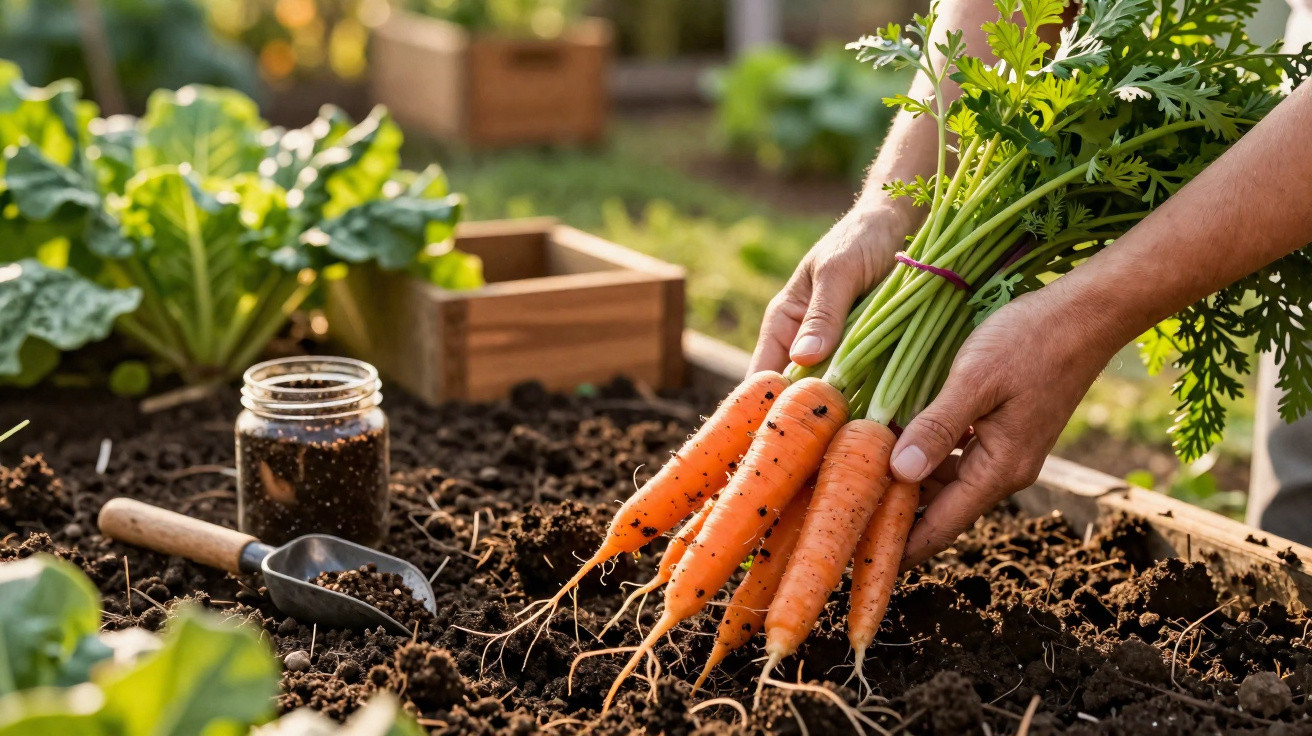
New research suggests that modern agriculture may produce enormous harvests while noticeably depleting the nutrient content of many vegetables. An international team of researchers identifies tiny allies in the soil as a source of hope: specialised microorganisms, combined with organic fertiliser, could offset these losses while also restoring flavour and aroma.
Why today’s vegetables contain fewer nutrients
The study, published in 2025 in the specialist journal “Academia Nutrition and Dietetics”, presents a clear picture: over the past eight to nine decades, the nutrient density of many vegetable crops has fallen sharply. Plant breeding has concentrated chiefly on yield, size, transportability and appearance, rather than their internal nutritional qualities.
The researchers provide specific figures: commercially grown high-yield varieties have lost between 25 and 50 per cent of their original nutrient density. Key minerals have been particularly affected:
- Sodium: around 52 per cent less
- Iron: around 50 per cent less
- Copper: around 49 per cent less
- Magnesium: around 10 per cent less
These figures are based on average comparisons with older data, when traditional varieties and less intensive growing methods were more prevalent. The explanation lies not only in plant genetics, but above all in the way fields are farmed.
How chemical fertilisers ‘starve’ the soil
According to the study, decades of intensive use of synthetic chemical fertilisers are the principal driver. Although they supply plants with nutrients they can use quickly, they impoverish the soil itself. This results in a major decline in the soil microorganisms needed for a living, fertile ecosystem.
“Healthy soil is not a lifeless support for roots, but a complex living system – and it is precisely this system that is collapsing in many places.”
As microbial diversity declines, so does the soil’s ability to retain, convert and make nutrients available to plants. Soil structure also deteriorates. Water drains away less effectively, dry spells have a greater impact, and heavy rainfall washes out more nutrients. Plants may still grow quickly because they are fertilised ‘from above’, but they produce fewer secondary plant compounds and store fewer minerals.
The alternative approach: microorganisms and organic fertiliser
In multi-year field trials, the research team from India tested a different method: largely dispensing with chemical fertilisers and instead using organic sources such as farmyard manure and worm compost (vermicompost), supplemented with so-called plant growth-promoting microorganisms (PGPM).
These microbes, often bacteria around the roots (rhizobacteria) or fungi, form a type of partnership with plants. The principle is simple: the plant supplies sugars from photosynthesis, while the microorganisms provide nutrients, protection and improved growth in return.
What these microorganisms do in practice
- Fix nitrogen: They capture nitrogen from the air and make it usable for plants.
- Release nutrients: They free up poorly available minerals, such as phosphorus and trace elements, from the soil.
- Improve soil structure: Microbial metabolic products ‘bind’ soil particles into stable aggregates, making the soil looser and better able to retain water.
- Reduce stress: Some strains increase plant tolerance of heat, drought or salt stress.
Together with manure or vermicompost, they act as a natural boost to soil fertility. Organic matter feeds the microbes, which in turn release nutrients gradually – a cycle that actively strengthens soil life rather than suppressing it.
More minerals, more secondary plant compounds, more flavour
The field trials revealed marked differences between conventionally grown vegetables, using chemical fertilisers, and vegetables grown with microorganisms and organic inputs. Mineral content improved dramatically in some cases. On average, levels of three important minerals increased as follows:
| Mineral | Increase with organic-microbial fertilisation |
|---|---|
| Zinc | +48.48% |
| Iron | +31.70% |
| Calcium | +23.84% |
The findings are even more striking for so-called nutraceuticals, secondary plant compounds with additional health benefits. The study highlights two everyday staples:
- Potatoes: 45 per cent more flavonoids and 49 per cent more total phenols.
- Onions: 27 per cent more flavonoids and 31 per cent greater antioxidant capacity.
Legumes such as peas and cowpeas also showed substantial gains in vitamins and antioxidants. These compounds are linked with a lower risk of cardiovascular disease, certain cancers and inflammatory processes.
“Vegetables from soils rich in microbes provide not only more minerals, but also more bioactive substances that can support health over the long term.”
Sensory tests: microorganisms make vegetables tastier
This may be particularly relevant to anyone trying to persuade children – or adults – to eat vegetables: plants treated with organic nutrients and PGPM consistently performed better in taste tests. They scored higher in every organoleptic assessment, including aroma, texture and flavour.
In some cases, the measured “flavour score” rose by up to 27.9 per cent. The researchers attribute this to several factors: a slower, more balanced nutrient supply, higher levels of secondary plant compounds, and a more reliable water supply resulting from improved soil structure. Plants experiencing less stress devote more energy to flavour and colour compounds.
‘Hidden hunger’: when the plate is full but the body lacks nutrients
Declining nutrient density intensifies a global problem experts call ‘hidden hunger’. According to the study, it affects more than two billion people. Calorie intake may be sufficient, and can sometimes even be excessive, yet minerals and vitamins are lacking. Typical consequences range from fatigue and poor concentration to greater susceptibility to infections and chronic disease.
When vegetables once again contain more iron, zinc, magnesium or antioxidant compounds, a normal serving can make a significantly greater contribution towards meeting nutritional needs. The researchers therefore view organic-microbial strategies not as a niche trend for organic-food enthusiasts, but as a means of tackling nutrient deficiencies and improving food security.
Climate protection and environmental effects: more than a nutrition issue
Moving away from purely chemical fertilisers has further effects. Organic fertilisation that builds high levels of humus and supports stable microbial communities stores carbon in the soil. This reduces the concentration of CO₂ in the atmosphere and can lower greenhouse-gas emissions.
At the same time, fewer nutrients are lost through leaching. Where chemical fertilisers are applied in large quantities, nitrates and phosphates can more easily reach groundwater or waterways, encouraging algal blooms. Organic systems release nutrients more slowly and bind them more firmly to soil particles and organic matter.
What this means for farming and home gardens
For farmers, the key question is whether this approach can be commercially viable. The Indian study indicates that yields for many crops remain stable or vary only slightly, while nutritional quality rises substantially. In markets where quality, local produce and sustainability increasingly matter, this could become a selling point.
Home gardeners can also benefit from the findings. Some practical examples include:
- Use compost and vermicompost consistently instead of relying mainly on mineral fertilisers.
- Use ready-made soil amendments containing beneficial mycorrhizal fungi or rhizobacteria.
- Dig the soil as little as possible so that microbes and soil structure remain intact.
- Sow cover crops and green manures to supply the soil with roots and organic matter throughout the year.
Such measures can be introduced gradually, without immediately changing the entire system. Many gardeners report that vegetables develop a more intense flavour when the soil has been built up with compost over several years.
Terminology and unanswered questions
The term PGPM (Plant Growth Promoting Microorganisms) covers several groups: bacteria that fix nitrogen, fungi that expand root networks, and microbes that influence plant hormones. They rarely work in isolation, instead forming part of complex communities. For agriculture on a broad scale, one challenge remains the development of stable, practical products that work reliably under differing climatic conditions.
It is also still unclear how such systems will perform over very large areas and across different climate zones. The Indian findings provide strong evidence that this is the right direction, but they are not yet definitive proof for every region of the world. Future studies could examine European soils, local vegetable varieties and local weather extremes in greater detail.
One thing is clear: anyone concerned with nutrition, climate and agriculture cannot avoid the question of soil biology. Attention is shifting away from what grows above the ground and towards the invisible network below it – billions of microorganisms that determine just how nutrient-rich the food on our plates ultimately is.






Comments
No comments yet. Be the first to comment!
Leave a Comment