
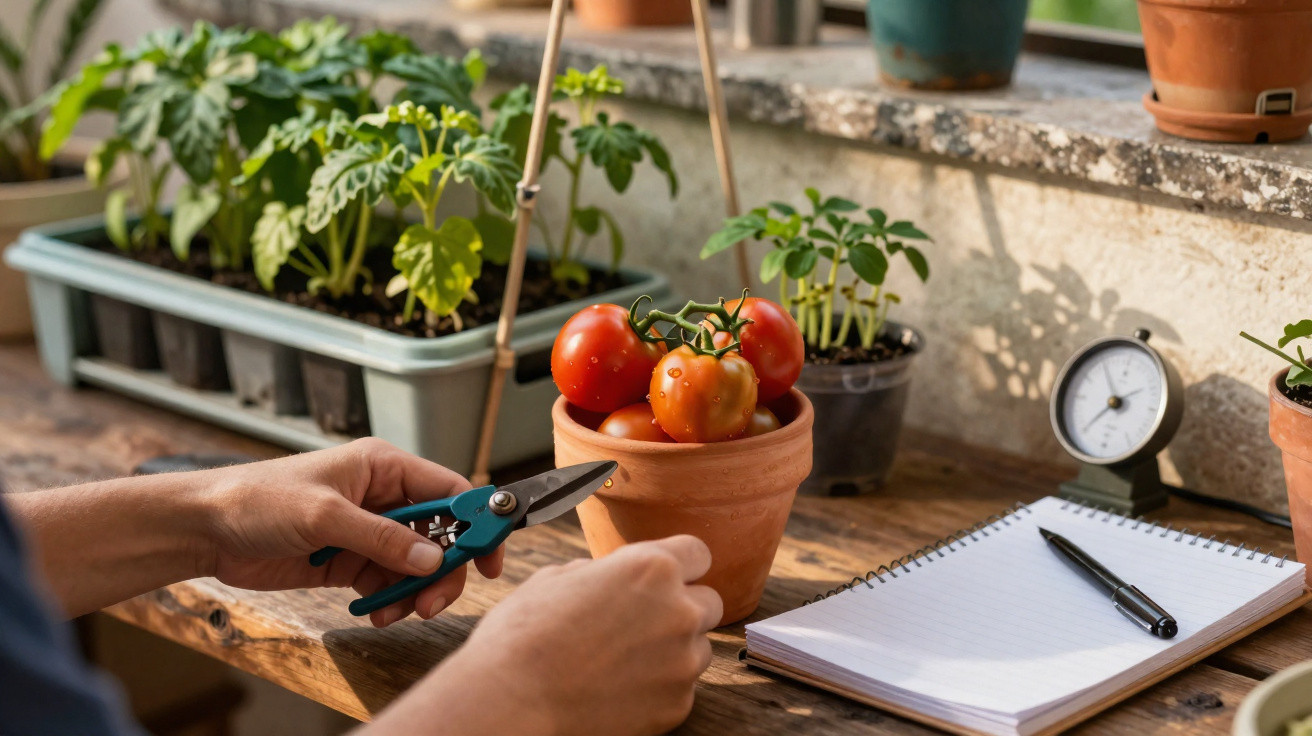
On a Saturday morning, high up in a grey city block, a set of French doors opens onto a tiny balcony.
There are three pots of basil, a planter of cherry tomatoes and an old stool repurposed as a stand for lettuces. Buses rumble past, neighbours scrape chairs across their floors and a dog barks somewhere nearby. Yet the air smells of damp soil and bruised tomato stems. A couple shift the pots around as if they were Lego bricks, chasing every sliver of sunlight. Their neighbour looks up, smiles and asks: “Do you really manage to harvest anything from that?”. The question hangs in the air. But what if this tiny balcony could gradually become a genuine vegetable garden with harvests all year round?
Look at your balcony like a gardener, not a tenant
The turning point often begins with simply seeing the space differently. As long as a balcony is treated as an outdoor storage area, it will grow little more than empty boxes and a wobbly folding chair. Once you view it as a small plot of land in the air, your imagination shifts. You start noticing where sunlight falls, where wind whips through and where the rain stops abruptly. It can become almost a game: following the sun with a coffee, watching shadows climb the wall and estimating which corners hold on to warmth.
Most of us have watched a basil plant die on a windowsill within a week without really knowing why. One evening in Lyon, I saw a young woman step onto her balcony holding her phone, with the weather app open, and a builder’s tape measure. She was recording the hours of direct sunshine, matching them against the needs of her future tomatoes and nodding to herself. Her balcony was no bigger than a picnic blanket, but she had already identified three “zones”: a very warm area for tomatoes and peppers, a partially shaded strip for herbs, and a cool corner beside the wall for mint. Nothing had been planted, yet the garden already existed in her mind.
From a practical perspective, everything starts here: light, wind and access to water. Without this modest investigation, you will stack pots at random and mainly harvest disappointment. A north-facing balcony can support lettuces, spinach and herbs such as chives, but sun-hungry tomatoes will struggle there. A south-facing balcony can heat up like a hotplate, making it ideal for Mediterranean herbs and cherry tomatoes, provided you allow for regular watering and sufficiently deep planters. Understanding this microclimate is like reading the map of a tiny territory, but it will determine everything that grows in your home.
Choose suitable plants and containers for a year-round balcony vegetable garden
The most dependable way to harvest from a small balcony throughout the year is to think in terms of “overlapping seasons”. Do not plant everything in April only to watch it all die by October. Spread your crops out. Keep one area for winter lettuces, one planter for summer tomatoes and one deep pot for successive sowings of carrots or radishes. Fast-growing crops such as radishes, rocket and coriander can fill gaps between longer crops. Perennial herbs, meanwhile, provide a permanent backdrop and a quiet, reliable food store.
To be honest, nobody truly maintains this flawless professional-gardener routine every day. The key is to automate some of the thinking just once. You could make a simple list: spring = radishes, lettuces, young spinach. Summer = cherry tomatoes, basil, climbing beans. Autumn = lamb’s lettuce, rocket, dwarf kale. Mild winter = parsley, chives, thyme and a few lettuces beneath a cloche. I visited a south-facing balcony in Marseille that worked this way with only five large planters. Tomatoes gave way to potted spinach, and its owner picked something almost every week, even in January.
The depth and capacity of your containers matter just as much. A cherry tomato in a 10 cm pot will have a miserable life, whereas a compact variety in a 30 cm planter can produce whole trusses. Lettuces cope with shallow containers, while root vegetables such as carrots need height. Three large planters filled properly with quality compost are better than ten small pots that dry out in a single morning. Drainage, saucers and the quality of the growing medium all directly affect your chances of harvesting all year round without spending every evening reviving dying plants.
Getting started: practical steps, common mistakes and realistic routines
The first practical job is to prepare a “soil” that is not really soil at all. In a container, compost does not look after itself. Begin with a straightforward mix: good vegetable compost, a little mature compost and, if the balcony gets very hot, a few handfuls of coconut coir to retain moisture. Fill planters almost to the top because the compost will settle. Always leave drainage holes and place a saucer underneath, so that every downpour does not turn the neighbour downstairs into collateral damage.
The next tasks are nearly automatic. Plant closely, but do not overcrowd: use one cherry tomato plant per large planter, edged with basil, lettuces or edible flowers. Sow radishes and rocket in rows, or scatter them over spare spaces. Put stakes in place immediately, even if they look ridiculous next to stems only 10 cm tall. Keep a “hospital” pot too: an empty container ready to isolate a declining plant while you work out what is wrong. This small habit prevents a single issue from spreading across the whole balcony.
The same mistakes crop up repeatedly, usually alongside the same slightly disheartened expressions. There is overwatering out of guilt, pots that are not deep enough and plants smothered amongst bulky furniture. We can all recognise the basil drowned “with love” or the tomato plant wedged behind the barbecue. A little self-compassion helps: nobody begins with a gardening qualification, and a balcony quickly becomes a place to learn. The best approach is to set gentle routines: a proper watering in the morning, a quick look when you get home in the evening and an adjustment of the pots every Sunday. If a plant dies, treat it as an experiment rather than a personal failure.
“My balcony was 1.20 m wide. At first, all I could see was what I could not do. The day I stopped dreaming about a country vegetable garden and placed three large planters in a row, everything changed. I picked my first cherry tomatoes on the sixth floor, and they tasted like a holiday.”
- Start small: one planter of lettuces, one pot of herbs and one cherry tomato plant.
- Observe the light over a full day before buying plants.
- Choose rich vegetable compost and do not skimp on planter depth.
- Plan fast crops, such as radishes and rocket, between seasons to fill empty spaces.
- Keep a notebook or notes on your phone with sowing dates and small successes.
Share, adapt and pass it on: a balcony that becomes a living story
A balcony vegetable garden producing all year round does not look like a shop display. Leaves yellow, tomato plants tire, seedlings fail and a slug can devastate a planter of lettuces. Real life is a little messy. Paradoxically, that is where a quiet sense of pride begins. You learn to accept that one corner is resting while another bursts into greenery. You swap plants with a neighbour, tuck a small bunch of parsley into a friend’s shopping bag or post a photograph of your first wonky radish harvest.
Three sprigs of chives will not transform your daily life. Instead, they create a thread running through it: returning to the balcony several times a week with a different purpose. Sometimes to water, sometimes to observe and sometimes simply to smell a tomato leaf and remember that something is growing there despite the concrete and noise. This balcony vegetable garden becomes a reason to slow down for five minutes, chat with neighbours and enjoy finding a tiny red tomato one October morning when you thought it had been lost. The story never truly ends; it is rewritten with every new season, every opened packet of seeds and every hand plunged into a bag of compost.
| Key point | Details | Why it matters to readers |
|---|---|---|
| Map your balcony’s microclimate | Monitor sun exposure for one full day, identify windy corners and heat-retaining walls, and mark areas as “full sun”, “partial shade” and “cool & sheltered”. | This stops you buying plants that cannot thrive in your particular conditions, saving time, money and disappointment. |
| Choose compact, balcony-friendly varieties | Select dwarf tomatoes, bush beans, cut-and-come-again lettuces and perennial herbs such as thyme and chives, all of which grow well in containers. | You will achieve greater yields in a smaller space, with fewer plants outgrowing the railing or snapping in the wind. |
| Use deep, shared containers instead of many tiny pots | Choose planters 30–40 cm deep, allowing roots to spread and moisture to remain stable, and combine several compatible plants in one box. | A larger volume of compost means fewer watering emergencies and stronger plants, which is essential if you are busy or away on some weekends. |
FAQ
- Can I grow vegetables on a north-facing balcony? You can, but concentrate on crops that tolerate shade. Choose leafy greens such as lettuce, spinach and lamb’s lettuce, alongside herbs including parsley and chives. Fruiting crops such as tomatoes and peppers generally struggle in these conditions, so it is wiser to make the space a salad and herb bar.
- How often should I water a small balcony vegetable garden? During hot weather, containers may need watering once a day, preferably early in the morning. In spring and autumn, watering every two to three days may be sufficient. The most reliable test is to push a finger 3 cm into the compost: if it feels dry at that depth, water slowly until excess runs into the saucer.
- Which vegetables are easiest for complete beginners on a balcony? Begin with cut-and-come-again lettuces, radishes, cherry tomatoes in a large pot and robust herbs such as thyme, rosemary and mint. Keep mint in its own container because it spreads. These crops forgive minor mistakes and produce quick, visible results, helping you stay motivated.
- Do I need special fertiliser for vegetables in containers? Most balcony gardens benefit from a slow-release organic fertiliser mixed into the compost at planting, followed by a light liquid feed every two to three weeks during the growing season. Containers lose nutrients more quickly than ground soil, so this gentle replenishment keeps plants productive without scorching their roots.
- Can I harvest anything from a balcony in winter? Yes, in many climates you can continue picking crops. Winter-suitable choices include lamb’s lettuce, spinach, kale and hardy herbs such as parsley and thyme. Covering containers with a simple cold-frame lid or horticultural fleece can shield plants from frost and extend the harvest by several weeks.



Comments
No comments yet. Be the first to comment!
Leave a Comment