
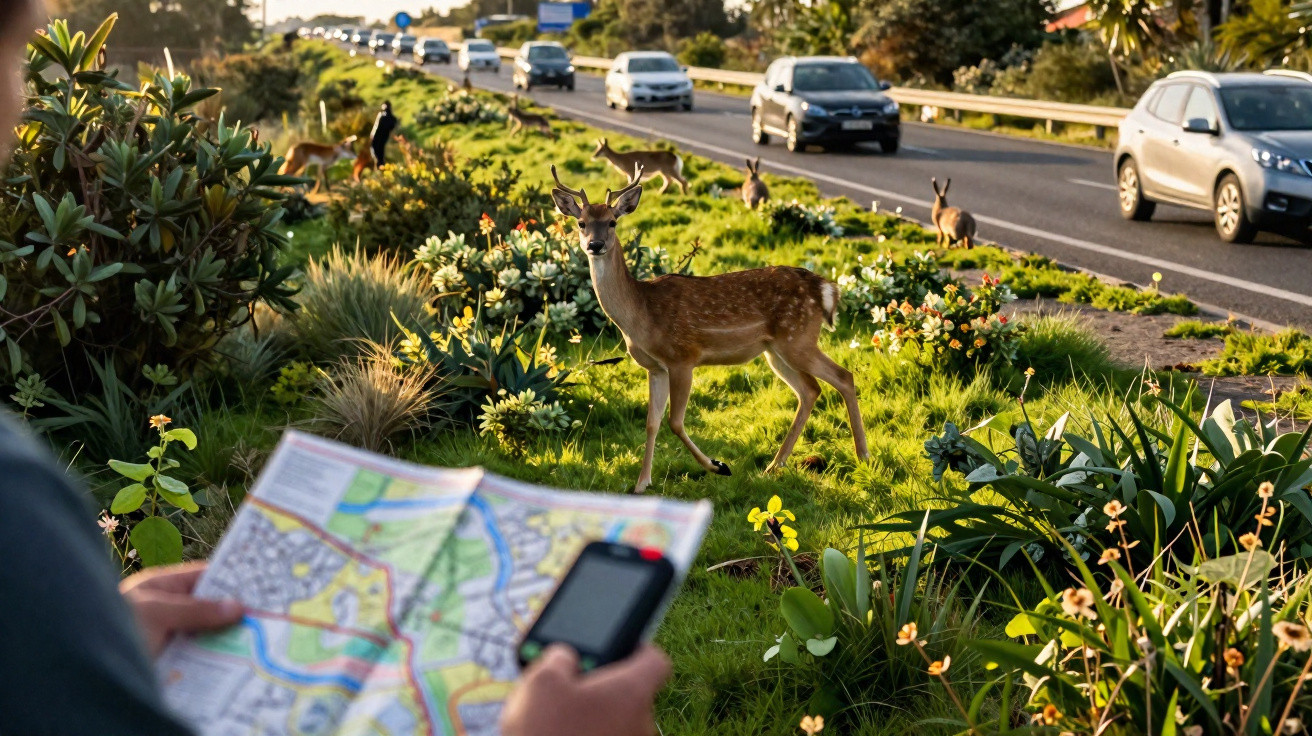
We stood on a motorway bridge in the first light of day, with lorries thundering below and cameras trained on a carefully planted ribbon of grass and shrubs between concrete barriers. For weeks, nothing had used the route. Then, one morning, an anxious doe stopped at the woodland edge, tested the air and set one hoof onto the new green corridor. It was a small gesture, but its implications were enormous.
When broken landscapes start to breathe again
Seen from above, the modern landscape resembles a broken mirror: roads carve through forests, suburbs confine wetlands, and farmland divides grassland into orderly blocks. Wildlife that once travelled freely with the seasons is increasingly marooned in isolated habitat islands that no longer connect.
Ecologists describe this as fragmentation. In practical terms, it means animals encounter concrete where trees once stood. A hedgehog reaches a motorway, a lynx comes up against a fence, and a frog turns away at a drainage channel. Migration rarely ends in an instant; instead, it gradually becomes more fragile, like a thread pulled too tight.
That can begin to change when those separated islands are deliberately joined again: a restored woodland strip linking two reserves, a culvert enlarged into a calm, dark passage beneath a country road, or a broad planted bridge draped across a multi-lane motorway. What seemed permanently lost can start moving again, initially at a very slow pace.
The moment species begin to move back
The Netherlands was among the earliest countries to commit to the idea that wildlife needs its own routes as well. During the 1990s, it began constructing “ecoducts” - broad wildlife bridges covered in native vegetation and spanning expressways that are rarely quiet. At first, local people joked about “deer flyovers”. Then the camera traps started recording activity.
At an ecoduct on the N332 near the Veluwe, red deer, wild boar, badgers, foxes and even pine martens were documented within the first few years after opening. These were not merely individual animals that had lost their way, but family groups, including young animals that had never previously crossed the road. Later genetic research confirmed what the footage suggested: populations on both sides were mixing once more. Previously isolated bloodlines began to merge.
Comparable results appeared in Canada’s Banff National Park, where more than 40 wildlife structures - 6 overpasses and dozens of underpasses - now cross the Trans-Canada Highway. Cameras have captured grizzly bears, cougars, wolves, elk and moose using routes made specifically for them. Wildlife-vehicle collisions fell by more than 80%. Migration paths severed for decades gradually began functioning again. In a very real way, the landscape remembered how to reconnect.
There is no magic involved. It is simply an opportunity for movement. Many animals hold an ancient behavioural map, shaped by seasonal routes handed down over generations. Once these routes are blocked, some species cease attempting them, while others repeatedly investigate the obstacle for a possible way through. When a safe crossing is provided, the boldest animals are often the first to try it.
In time, their success alters the population’s shared mental map. Young animals follow scent trails, predators follow prey along the same routes, and plants travel as seeds caught in fur or carried in droppings. The corridor becomes more than built infrastructure: it becomes a living artery, carrying life between places that had become disconnected despite lying only a few hundred metres apart.
How we actually stitch habitats back together
Reconnecting fragmented habitats may sound like a grand, theoretical ambition, but it often begins with a map, a coffee and a pencil. Conservation planners study satellite imagery and consider one straightforward question: where are animals trying to travel, and what is blocking them?
They identify river valleys, woodland edges and ridgelines - the routes wildlife naturally favours - then map the damage caused by roads, railways, dams and housing developments. Their aim is to locate “pinch points”: narrow places where one crossing could restore access to a large area. It may mean a bridge in one location, a culvert in another or a carefully positioned opening in a fence.
A commonly applied technique, “least-cost path analysis”, views the landscape as a board game in which every terrain type carries a cost for movement. Crossing a peaceful meadow has a low cost, whereas a busy motorway is close to impossible. Algorithms can then identify the simplest and most likely routes for particular species.
This approach is not limited to large, appealing animals. Across Europe, engineers are adapting roadside ditches so that small amphibians can safely follow moisture gradients during mass spring migrations. In the United States, desert tortoise underpasses feature gentle slopes and natural soil, because a frightened tortoise will not enter an exposed concrete tunnel.
Projects fail if their human dimension is ignored. Farmers may be concerned about fences and grazing, drivers may fear more animals entering roads, and urban residents may worry about coyotes in their gardens. Effective reconnection schemes therefore spend as much time in village halls and council meetings as they do in woodland and wetland.
People raise concerns about expense, about “nature getting priority over people”, and about another layer of regulation. Then someone refers to the number of deer collisions on that road last winter, or remembers hearing frogs in a marsh that has since fallen silent. The atmosphere shifts slightly - not dramatically, but enough to matter.
An uncomfortable truth sits beneath these conversations: fragmentation was not accidental. It resulted from choices considered ordinary, including wider roads, straighter canals and tidier fields. Undoing it requires accepting a landscape that is a little less neat, somewhat less efficient on paper and much more alive in reality. That trade-off is where most debates really live.
What we can learn - even far from the forest
Few of us will design a wildlife bridge over a motorway. However, the principle behind reconnecting habitats applies remarkably well to the smaller spaces we manage ourselves. A garden enclosed by fences is an island, as is a balcony planted with exotic species that local insects scarcely recognise.
A useful first step is to think in terms of small corridors rather than separate green patches. This might be a hedge row connecting two gardens, a band of native wildflowers beside a fence leading towards a nearby park, or a small opening at the base of a wooden barrier for hedgehogs and frogs. Every measure may be modest, but the network they form is not.
Within towns and cities, balconies and rooftops can act as stepping stones. A mixture of native nectar-rich plants flowering from early spring until late autumn can turn one building into a stopping point for pollinators crossing a sea of concrete. Shallow, clean water dishes can also help birds and insects endure heatwaves that are becoming harsher each year.
At a personal level, the greatest obstacle is the belief that only flawless efforts are worthwhile. We picture needing a vast garden, a detailed permaculture scheme or an uncomfortably large budget, and consequently do nothing. Let us be honest: hardly anyone really does that every day.
Quiet, imperfect consistency is far more effective: one less patch of lawn and one more untidy, buzzing, slightly wild corner. It could mean asking a neighbour to leave a shared hedge denser, or questioning why the local council cuts a roadside verge to the ground every two weeks rather than once a season.
At a broader level, residents are beginning to demand wildlife crossings in much the same way they once campaigned for cycle lanes. They use petitions, local media coverage and carefully selected photographs of dead animals near collision hotspots. It is unpleasant, but it affects people. No council wants to be known for overlooking a danger that could have been addressed, whether to motorists or wildlife.
“The moment you give animals a safe way across, they take it,” says a Canadian road ecologist I interviewed beside an underpass. “We don’t have to teach them. We just have to stop making movement a death sentence.”
Several practical measures repeatedly emerge in places where connectivity projects genuinely work:
- Begin with evidence: collision maps, camera traps and local sightings
- Focus on pinch points where a single structure can assist many species
- Combine approaches: overpasses, underpasses, fence guides and culverts
- Engage local people early - farmers, drivers, walkers and schools
- Monitor outcomes and adjust, rather than assuming the original design is perfect
On a more personal scale, most of us know the horrible sound of a bird striking a window and lying dazed on the pavement. It is a small collision in a world filled with much larger ones, yet it conveys the same lesson: the lines and edges we build are invisible barriers to most other species. Reconnection begins when we choose to soften even a few of those boundaries.
When a landscape remembers how to move
Walking through a restored corridor after several years can feel oddly familiar, as though you have encountered an older version of the same place. Saplings planted along its edge have become young trees. Deer prints criss-cross muddy ground. Berry bushes emerge where nobody planted them. You may find droppings containing seeds from woodland several kilometres away.
Migration routes do not return in precisely their former form. Climate change is altering seasons and food availability: snow melts earlier, droughts become more severe and storms can reshape riverbeds overnight. A route that suited a generation of caribou fifty years ago may no longer match today’s ice and vegetation.
Even so, the urge to travel, search and leave one patch of land for another is deeply embedded in countless species. By reconnecting habitats, we are not attempting to restore an untouched past. We are giving that instinct space to adapt again - to locate new routes, establish new timings and find new resting places.
A quiet but radical thought lies at the heart of this work: landscapes are not merely scenery; they are negotiations between roots and asphalt, instinct and infrastructure, and generations that will never meet. Each crossing constructed, and every field edge left as a rough strip rather than cut cleanly, shifts that negotiation in a new direction.
Perhaps this is why standing on a wildlife bridge at dawn feels so unusual. Below, lorries roar past carrying the latest products through a just-in-time economy. Above, among grass and shrubs, a fox walks along an old yet newly restored route, tail lowered and ears alert. Two realities exist only a few metres apart, both entirely modern and both stubbornly alive.
We live in an era that breaks things into parts: tasks, timelines and territories. In that sense, reconnecting habitats resists this instinct. Long after funding periods end and headline photographs disappear, unseen traffic continues to flow - paws, hooves, claws and wings. Knowing this movement has quietly returned changes how you look at a map, a roadside ditch or your own small piece of land.
| Key point | Detail | Why it matters to the reader |
|---|---|---|
| Reconnecting works | Wildlife crossings and corridors restore migration routes and genetic exchange | Shows that practical action can reverse fragmentation trends |
| Design is species-specific | Different animals use different types of crossings and habitat links | Avoids one-size-fits-all ideas and inspires smarter local projects |
| Small actions matter | Gardens, verges and balconies can form urban “micro-corridors” | Gives concrete ways to participate, even in dense cities |
FAQ:
- How long does it take for species to start using new crossings? Often within weeks or months for adaptable animals like deer and foxes, while more cautious species such as large carnivores can take several years of quiet, consistent conditions.
- Are wildlife bridges really worth the cost? Studies from places like Banff show massive drops in wildlife-vehicle collisions, saving lives and money on healthcare, repairs and lost work time, alongside the ecological benefits.
- Do small animals benefit as much as big ones? Yes, when structures are designed for them: amphibian tunnels, hedgehog gaps, vegetated verges and water-filled culverts can be game-changers for tiny, overlooked species.
- What can a city dweller realistically do? Plant native species, reduce hard barriers in gardens or on balconies, support local corridor projects, and speak to councils about less aggressive mowing or better-connected green spaces.
- Isn’t climate change making all this pointless? On the contrary, connectivity is a key climate adaptation tool, giving species the freedom to move as conditions shift, instead of trapping them in patches that are becoming unliveable.



Comments
No comments yet. Be the first to comment!
Leave a Comment