
Many amateur gardeners are itching to get started in March: the soil is gradually thawing, yet borders still look bare and bleak. Choosing the right flower now can create months of blooms, without the need for constant watering, cutting back and feeding.
The flower that blooms almost by itself from June to August
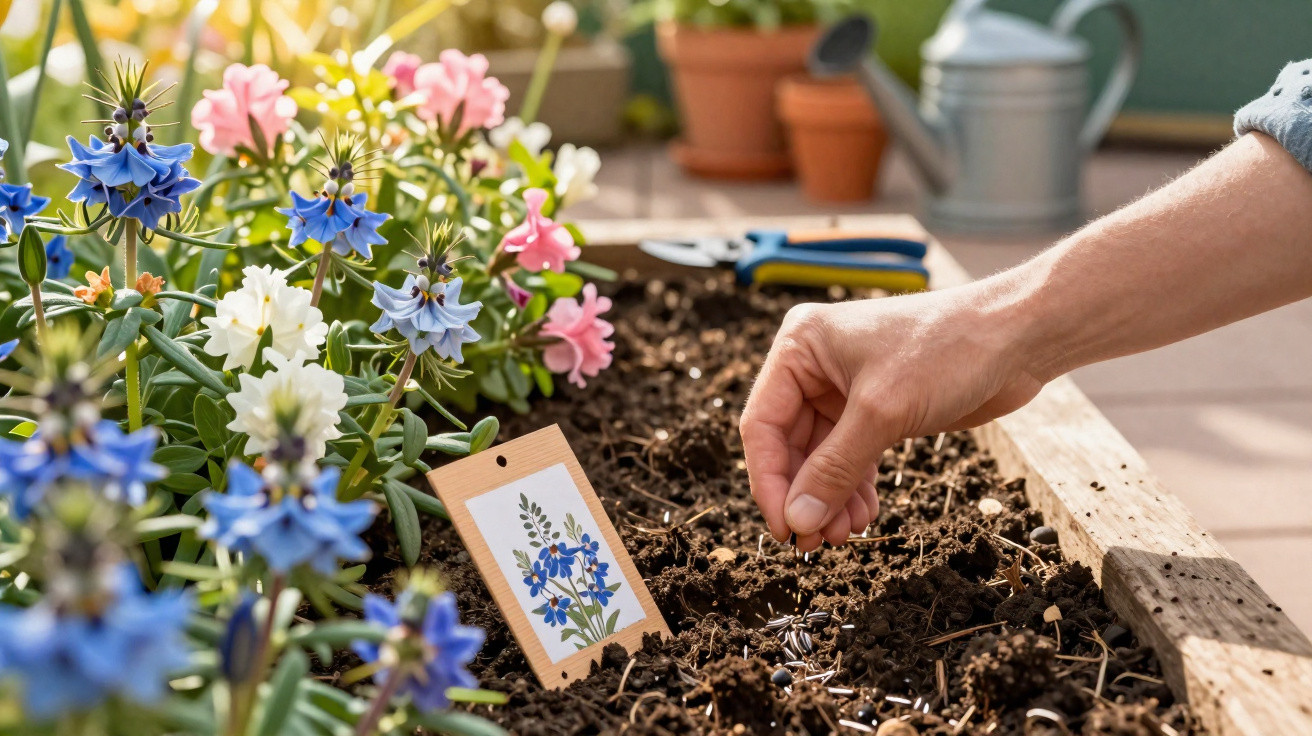
The understated star of this gardening trick is love-in-a-mist (botanical name: Nigella damascena). This annual summer flower has delicate, star-shaped blooms and fine foliage that is almost fern-like. In a border, it creates the effect of a light blue veil – precisely why so many gardeners fall for it.
Love-in-a-mist generally reaches 40 to 60 centimetres in height. Its flowers come in soft sky blue, pure white or with a subtle pink tinge. It is perfectly suited to a natural garden style, as it looks more like a meadow plant than part of a meticulously planned border.
Sowing directly into the border in March – or as soon as the hardest frosts have passed – brings lasting rewards: flowering usually begins in mid-June and continues until the end of August, sometimes even into September in mild years. This neatly fills the period when many spring flowers have faded and perennials are only beginning to get going.
With one simple sowing in March, love-in-a-mist fills empty borders for months – with hardly any care required.
This species is particularly appealing to gardening beginners: it grows quickly, forgives plenty of mistakes and rewards even small areas with remarkably dense flowering.
Why March is the ideal time
Love-in-a-mist is among the hardy annuals that cope well with cool conditions. That is exactly what makes early sowing so worthwhile:
- It makes use of spring moisture: In March, the soil is still well supplied with water. Seeds germinate reliably without requiring continual watering.
- It tolerates light cold: Cool nights do not usually harm seedlings, provided there are no extreme late frosts.
- It has a long growing period: An early start enables the plant to form strong roots, resulting in longer and more abundant flowering.
Garden experts have highlighted the value of such “hardy annuals” for years. They cope with ordinary, relatively poor garden soil and do not need costly specialist fertiliser. So, if complicated care schedules are not for you, this flower is an excellent choice.
Step by step: sowing love-in-a-mist in a border
The good news is that neither a greenhouse nor seed trays are necessary. Love-in-a-mist is sown directly where it is to grow.
Prepare the site and soil
You can begin once prolonged hard frosts are no longer expected and the ground is no longer soaking wet. A sunny position is best; partial shade also works, but will generally produce fewer flowers.
The soil needs to be loose and free-draining. This plant does not tolerate waterlogging at all. Brief preparation is entirely sufficient:
- Thoroughly clear the area of weeds.
- Loosen the soil with a rake or cultivator and break up any clumps.
- If desired, work in a thin layer of mature compost to improve the soil slightly.
Sow correctly and allow enough space
Scatter the seeds thinly across the prepared area. There is no need to bury them deeply; on the contrary, light helps them germinate.
Then proceed as follows:
- Spread the seeds sparingly over the soil.
- Cover them with only the lightest layer of soil or fine compost – a few millimetres is enough.
- Press them down gently with your hand so the seeds make contact with the soil.
- Water using a fine spray, so that the seeds are not washed away.
Many amateur gardeners sow too densely. Once the seedlings have formed a few true leaves, it is worth thinning them out. A spacing of 20 to 25 centimetres between plants is ideal. For especially strong, lush plants, 30 centimetres is even better.
Those who thin love-in-a-mist rather than letting it grow in crowded conditions are rewarded with taller, sturdier plants and more flowers.
How love-in-a-mist flowers throughout the summer
Once established, this plant is very easy to care for. During an average summer, occasional watering is quite enough. Only during extended hot spells should you reach for the watering can in the evening.
There is no need for a fertiliser marathon. Overly rich soil encourages lots of foliage but fewer flowers. Preparing the ground with a little compost once is generally all it needs.
Remove faded blooms to extend flowering
For the longest possible display, use secateurs regularly: simply cut faded flower heads off just above the leaf joint. This encourages the plant to produce new buds instead of directing its energy into seed production.
Many gardeners think of their plants as falling into two groups:
| Aim | What to do |
|---|---|
| Long flowering in the border | Consistently deadhead faded flowers |
| Self-seeding for next year | Allow some flowers to mature fully into seed |
This mixed approach works well: one group provides continuing colour into late summer, while the other self-seeds.
Perfect for bouquets: how it lasts in a vase
Love-in-a-mist does not only look good in a border. Its fine stems, romantic blooms and, later, its inflated seed pods make it ideal for bouquets.
- For fresh summer bouquets: Cut stems when the flowers have just fully opened.
- For dried arrangements: Cut the pods once they are plump and well coloured.
In a vase of fresh water, the flowers typically last around ten days. Changing the water regularly and recutting the stems at an angle can extend this period a little further.
Self-seeding: the garden decorates itself almost on its own
If some flowers are left untouched, they develop decorative seed pods that dry out in late summer. At the latest when the wind catches them, they split open and scatter their seeds through the border.
Many gardeners report that love-in-a-mist reappears “as if by itself” the following year – often in places nobody had anticipated.
If you do not want this to happen, cut off the pods in good time. If spontaneous carpets of flowers are welcome, let nature take its course. This creates a particularly lively effect in naturalistic gardens with perennials and ornamental grasses.
Plants that pair particularly well with love-in-a-mist
Love-in-a-mist works well alongside many classic summer flowers and perennials. It fills gaps and brings an airy quality to heavier plantings.
Reliable companions include:
- Delphiniums and lupins, whose upright habit creates an attractive contrast.
- Summer asters or cosmos, which have similar requirements for sun and soil.
- Ornamental grasses, which enhance its airy appearance even further.
- Roses, in front of which the delicate flowers resemble a blue veil.
Particularly in a front garden or along paths, the plant creates a relaxed, almost Mediterranean feel without much planning.
Practical advice for beginners and small gardens
Those without a large garden can also try love-in-a-mist in a larger pot or window box. The important thing is to use a sufficiently deep container with drainage holes and free-draining soil that is not too heavy.
A few extra tips for getting started:
- Watch out for slug damage during the first few weeks – after that, most slugs show little interest in the plant.
- Do not plant neighbouring perennials too closely, so that the fine stems are not crowded out.
- If you have children, sowing can be used as a small experiment – its rapid growth is highly motivating.
Love-in-a-mist is also an excellent introduction to “self-seeding flowers”. Anyone who has seen blue splashes emerge again the following year without any effort soon feels like trying more of these uncomplicated species.
This turns an otherwise grey March gardening task into a small promise: a few simple actions, a handful of seeds – and by high summer the border looks as though a professional had spent hours planning and planting it.
Comments
No comments yet. Be the first to comment!
Leave a Comment