
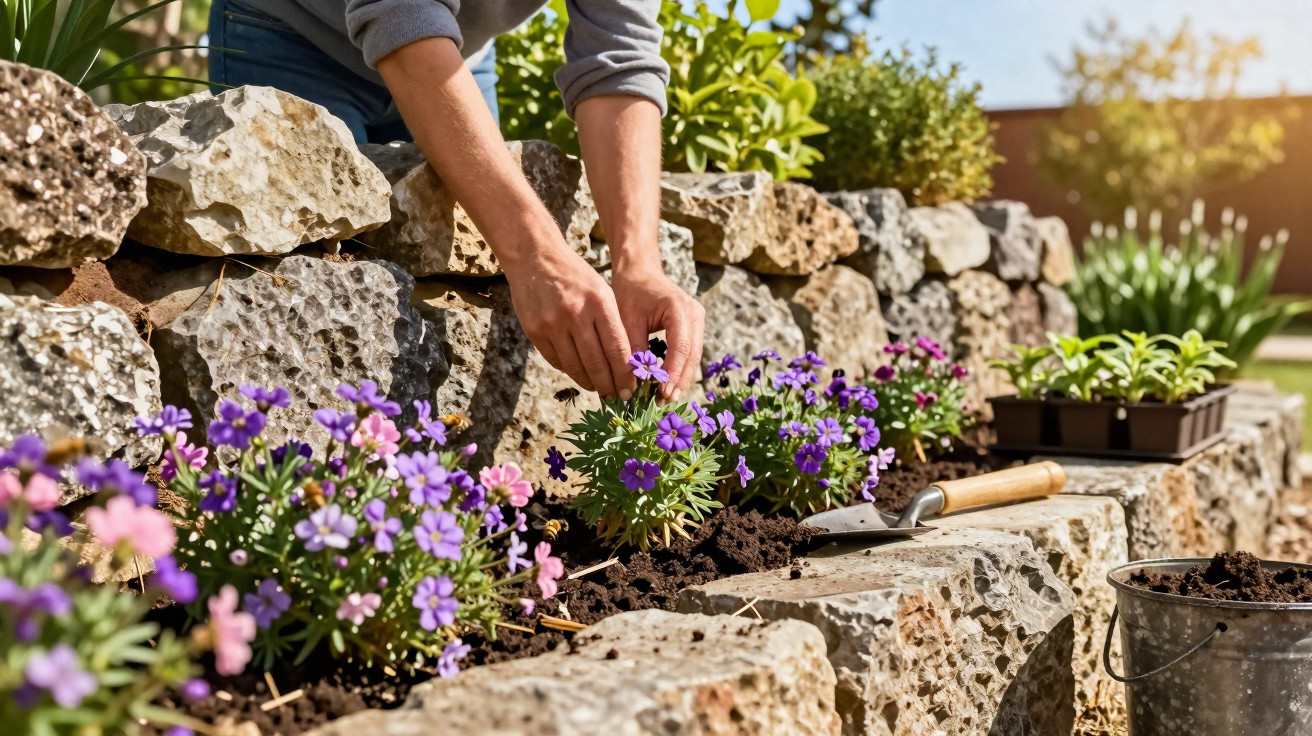
Many homeowners face the same issue: a retaining wall may be essential, yet it can look completely out of place in the garden. Grey, angular and often marked with moss, it sits right at eye level. Choose the right plant, however, and this troublesome area can quickly become a vibrant splash of colour, resembling a naturally established rock garden.
Why retaining walls are so difficult to plant up
From a gardening perspective, retaining walls are challenging. Their soil is usually poor, stony and quick to dry out. Above the wall, the sun beats down relentlessly on its top, while below it, the stone heats up and radiates warmth back out. Many conventional garden perennials soon fail in these conditions.
Water also simply drains away through the gaps between stones. What may work reasonably well in a flower bed can be deeply frustrating on a wall. Ordinary flowering plants may look attractive briefly, but then struggle and leave behind brown, dried-up remains.
“Anyone who wants to succeed here needs plants that regard heat, drought and very little soil not as stress, but as their favourite setting.”
This is precisely where certain cushion-forming alpine perennials excel. In their native habitats, they grow in rock crevices with only a thin layer of soil, plenty of wind and intense heat – making them perfect for transforming a retaining wall.
The purple-flowering cushion perennial: perfect for demanding sites
The focus is a low, mat-forming perennial with small purple flowers that creates a dense covering across the stones in spring. It reaches only around 15 centimetres in height, but spreads horizontally and cloaks the wall in an unbroken carpet.
From the second half of April through to early summer, it produces countless tiny blooms. Depending on the variety, their shades range from soft violet to rich purple, sometimes with a hint of pink. At peak flowering, the foliage is almost invisible and the wall appears to have been drenched in colour.
- hardy and resilient in many regions
- highly drought tolerant once established
- a suitable height for narrow wall tops
- a long-lasting, usually evergreen mat
Its soft shoots work their way into the smallest crevices, anchor themselves among the stones and then spill downwards in loose cascades. This creates the appearance of a flowering curtain without placing structural strain on the wall.
The best position on the retaining wall
The most striking effect is achieved when the plant is positioned along the upper edge of the retaining wall. From there, its shoots can fall freely over the side. A south- or west-facing aspect, where the surface receives many hours of sun, is ideal.
Key site requirements:
- free-draining, fairly stony soil with no waterlogging
- a low-nutrient growing medium – too little is preferable to excessive fertility
- no permanently damp shade, as the mats may otherwise develop fungal problems
Creating small pockets of soil between the stones produces an even stronger result. The plant can root from above into these spaces and, over time, form a continuous cover that keeps spreading.
Planting step by step: turning stone into a flowering curtain
Preparing the growing medium
First, add loose growing medium along the wall edge or into any gaps. An ideal blend consists of:
- around 50% garden soil that is not too heavy
- 30–40% coarse gravel or grit
- 10–20% well-rotted compost
The substantial mineral content prevents waterlogging, which is vital to the survival of this cushion perennial. Too much compost encourages soft growth but also makes the plant more vulnerable, so use it sparingly.
Young plants rather than seed
For retaining walls, small potted plants are far more worthwhile than sowing seed. Young plants can be placed accurately into gaps and soil pockets, where they establish quickly.
The best planting period is spring after the last frosts, or a mild autumn. Set the plant with its growth angled slightly towards the wall edge, so that the shoots naturally grow towards the drop from the outset.
“After planting, water thoroughly once to remove air pockets in the growing medium – then allow the surface to dry well between watering.”
This perennial copes better with too little water than with too much. Frequent watering risks root rot.
Care for the purple-flowering cushion perennial: minimal effort, maximum impact
Once the mat has established, it needs very little attention. The plant requires neither regular fertiliser applications nor complicated pruning methods.
Pruning after flowering
Immediately after the main flowering period in May or June, it is worth cutting it back firmly. Trim the mats by around half. Although this may seem drastic, it works like a rejuvenating treatment.
- old shoots that have finished flowering are removed
- dense, fresh green growth develops afterwards
- the plant stays compact instead of becoming loose and sprawling
In late winter, when the mats look somewhat untidy, a light shaping trim is generally enough. Remove faded and brown tips, while leaving green sections intact.
Winter protection and pests
In typical locations, this cushion perennial does not need special winter protection. In particularly exposed regions, a light covering of spruce branches can be useful, especially on newly planted walls.
Slugs and deer generally cause little damage to the carpet, making it especially appealing for slopes near woodland. Problems with disease are more likely where conditions are too wet or neighbouring plants are too dense.
How a stone surface becomes a small habitat
A broad carpet of purple flowers changes more than the appearance of the wall; it also changes the life it supports. Honeybees and solitary bees gather plentiful nectar, while butterflies use the flowers as a refuelling stop.
The result becomes even more interesting when this perennial is combined with other drought-loving species. Suitable companions include:
| Plant | Growth habit | Special feature |
|---|---|---|
| various stonecrops | upright, succulent | strong structure, good late flowering |
| houseleeks | rosette-forming mats | almost no maintenance, graphic forms |
| thyme species | creeping | fragrance, suitable for use as a culinary herb |
Together, they create changing displays throughout the year: first the purple spring flowering, followed by sculptural leaf rosettes and later the flower stems of the other species.
Practical tips for fast results
Anyone wishing to transform a retaining wall noticeably in the shortest possible time should use several small clumps rather than a single plant. Three to five specimens per linear metre of wall top will ensure that the mats soon meet.
There is another useful trick: work some pale grit into the top layer of soil. The stones reflect light and warmth, accelerating the growth of the heat-loving perennial and enhancing the impression of a genuine rocky landscape.
One further point is often underestimated: flower colour appears different depending on the backdrop. Against very dark basalt, violet tones shine much more intensely than they do against pale concrete. Where there is a choice, this contrast can be considered when building the wall.
The combination of an undemanding care routine and a powerful visual effect makes this plant a classic “problem-area solver” in the garden. A functional construction becomes a living design feature that signals even from a distance: someone has thought it through – and turned stone into a stage.

Comments
No comments yet. Be the first to comment!
Leave a Comment