
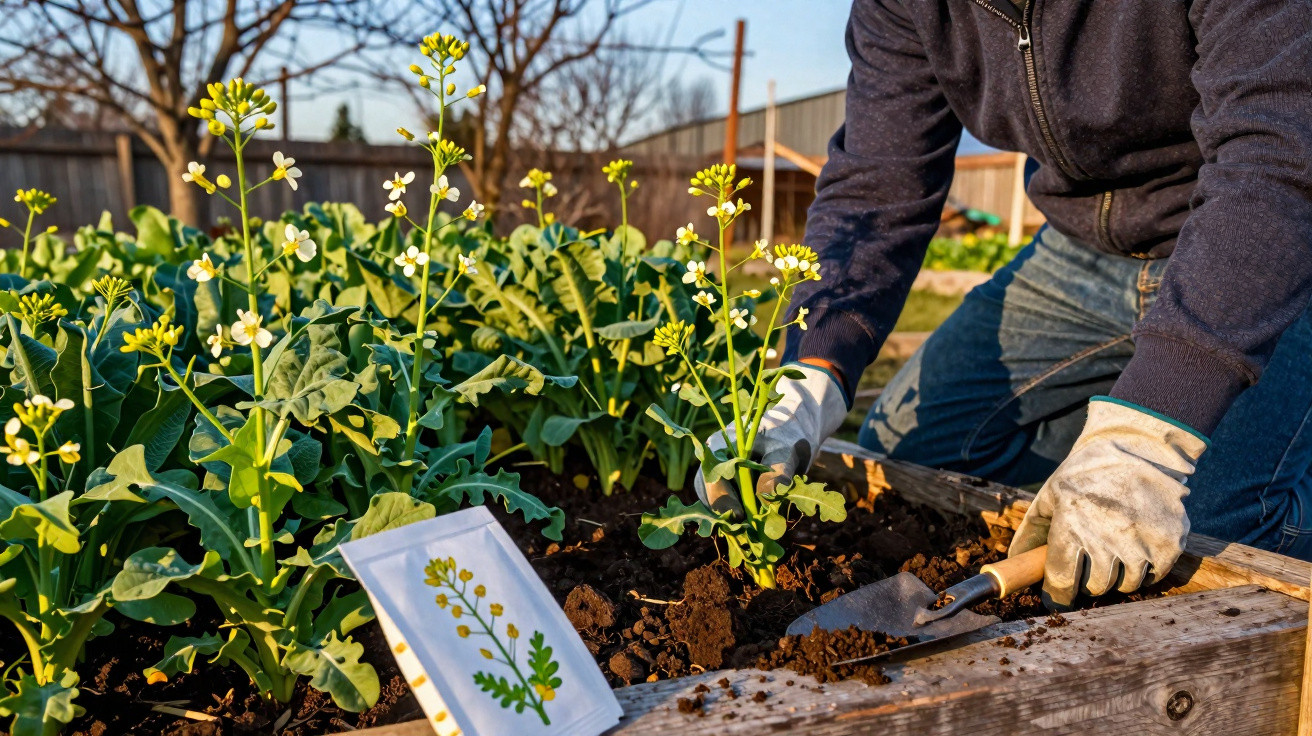
If, in late winter, you look at bare beds and assume nothing is happening in the vegetable garden, you are missing a huge opportunity. Uncovered soil is exposed to rain, freezes, dries out again and, in the process, loses both structure and nutrients. Yet there is an exceptionally simple way to get the ground into excellent condition as early as February: a plant that few people deliberately use, but which loosens the soil, enriches it with nutrients and gives spring sowings a real boost.
The cold-weather trick: one seed that starts at 5°C
Most vegetables simply will not grow in cold conditions. Below 8 to 10°C, virtually nothing happens: their seeds remain in the soil and wait. This is where white mustard, Sinapis alba-usually called white mustard or green-manure mustard in the garden-comes into its own.
It can germinate once the soil reaches around 5°C. In many areas, this happens in February, and sometimes even earlier. While tomatoes, peppers and courgettes should not even be near the vegetable plot at this point, mustard gets going, making use of the remaining warmth in the soil and the winter moisture.
Sowing mustard in February starts the gardening season beneath the soil-weeks before the vegetables themselves move in.
This head start is precisely what makes the plant so useful. It covers the ground early, stimulates soil life and prepares beds for more tender crops planted later, including tomatoes, pumpkins, cucumbers, beans and salads.
A green carpet in ten days that holds back weeds
Its second major advantage is speed. Mustard grown as green manure develops remarkably quickly. When it is sown onto lightly loosened soil, a visible, dense green covering often appears across the bed within just ten days.
This living carpet performs several jobs at once:
- it deprives weeds of light and space
- it takes up nutrients before they can be washed away
- it shields the soil from heavy rain and erosion
- it keeps the surface open rather than sealed, compacted and hard
When a bed is left bare towards the end of winter, weeds are usually the first to take advantage of the first mild spell and begin germinating. Mustard gets in ahead of them because it forms a closed cover far faster than many wild plants.
The six-week countdown: the ideal time to cut it down
Timing is particularly important if the green carpet is to become a genuine fertiliser booster. Roughly six weeks after sowing, the plants are close to flowering or are just starting to show delicate yellow blooms. At this exact stage, most of the nutrients are held in the stems and leaves.
The golden rule: cut mustard before it flowers properly and sets seed-then it works like a natural turbo fertiliser.
If the crop is left standing for too long, its stems become woody. The plant then directs energy into producing seed, drawing nutrients from the soil to do so-the opposite of what gardeners want.
The ideal process is:
- broadcast mustard seed when soil moisture is suitable
- allow it to grow for around six weeks, until the first flowers appear
- cut the crop just above ground level with a scythe, sickle or grass trimmer
- work the cut material in shallowly or leave it in place as a mulch layer
When incorporated near the surface, the still-soft plant material breaks down quickly. Soil microorganisms process it and gradually release nitrogen-just as the first vegetable plants begin their hungry spring growth.
More air, more life: how mustard opens up your soil
Alongside its nutrient benefits, mustard offers another advantage that is often overlooked. Its roots act like a free soil aerator. The main root penetrates deeply, branches out and creates numerous small channels through the ground.
The effects are immediately noticeable when digging in spring:
- the soil crumbles instead of breaking into heavy clods
- watering soaks away quickly rather than pooling on the surface
- the roots of tomatoes, cabbage and other crops can more easily grow downwards
- oxygen reaches the soil more effectively, which matters for earthworms and soil bacteria
Anyone who has worked with heavy soil compacted over winter knows how laborious the task can be. After growing mustard as green manure, preparing the bed in March becomes noticeably easier-spade and garden fork glide through it almost by themselves.
How much do harvests really benefit?
Trials on working plots carried out between 2018 and 2022 show that, when mustard is sown as winter green manure and incorporated before flowering, yields from the following crops rise by an average of around 18 percent. This is not a minor effect but a clearly measurable one, especially for nutrient-hungry crops such as cabbage, tomatoes and pumpkins.
A few handfuls of mustard seed in February can mean noticeably more vegetables on the plate in summer.
The result comes from several factors working together: more nitrogen in the soil, improved structure, less competition from weeds and more active soil life.
Step by step: how to use mustard effectively in the home garden
For home gardens, only a modest quantity of seed is needed; 100 to 200 grams is often enough for a standard bed. Even distribution matters more than the exact number of grams.
| Step | What to do |
|---|---|
| 1. Prepare the soil | Lightly loosen the surface, break up large clods and remove stones. |
| 2. Sow | Scatter mustard seed evenly by hand, avoiding sowing too densely. |
| 3. Cover in | Rake it in briefly or cover it lightly with soil, then firm it down. |
| 4. Maintain moisture | Water during dry weather; otherwise, winter moisture is usually sufficient. |
| 5. Monitor growth | Over the following weeks, watch for germination and the formation of a dense cover. |
| 6. Cut | Cut before full flowering, then incorporate it shallowly or use it as mulch. |
Important points: where mustard is unsuitable and what it can be combined with
Useful as it is, there are a few considerations for home gardeners. Botanically, mustard belongs to the brassica family, as do cabbage, radishes, rocket and kohlrabi. Anyone dealing with severe clubroot or other brassica diseases should not use mustard on areas where brassica crops will be grown again shortly afterwards.
As a rule of thumb, use mustard before tomatoes, cucumbers, pumpkins, beans, peas or salads rather than before brassicas. This helps break disease cycles and supports sensible crop rotation.
It is also interesting to combine it with other green manures, for example:
- with phacelia to provide additional forage for bees in spring
- with winter rye for strong rooting in deeper soil layers
- with clover species, which also fix nitrogen from the air
Such mixes stimulate the soil even more and use different rooting and nutrient strategies. In a home garden, a simple combination of mustard and one other species is often enough to deliver visible results.
Why this “invisible” helper makes such a difference in February
At its heart, using mustard as green manure requires a change of perspective: the garden does not rest during winter; it works unseen. Those who let the months before March or April pass unused begin from scratch every year. Those who reach for mustard in February are, quite literally, building ahead.
The plant does soil work that would otherwise require considerable effort by hand or with heavy equipment. It replaces some of the fertiliser that would later come from a bag. It also ensures that the first young vegetable plants are not placed into depleted, waterlogged or compacted ground, but into a living, crumbly growing medium with ample nutrient reserves.
At a time when many home gardeners want to use fewer chemicals and garden more sustainably, mustard is ideally suited as a winter starter: little seed, little work and a clear benefit. Anyone who tries it consistently on one bed will notice the difference when planting and watering-and ultimately in the harvest.
Comments
No comments yet. Be the first to comment!
Leave a Comment