
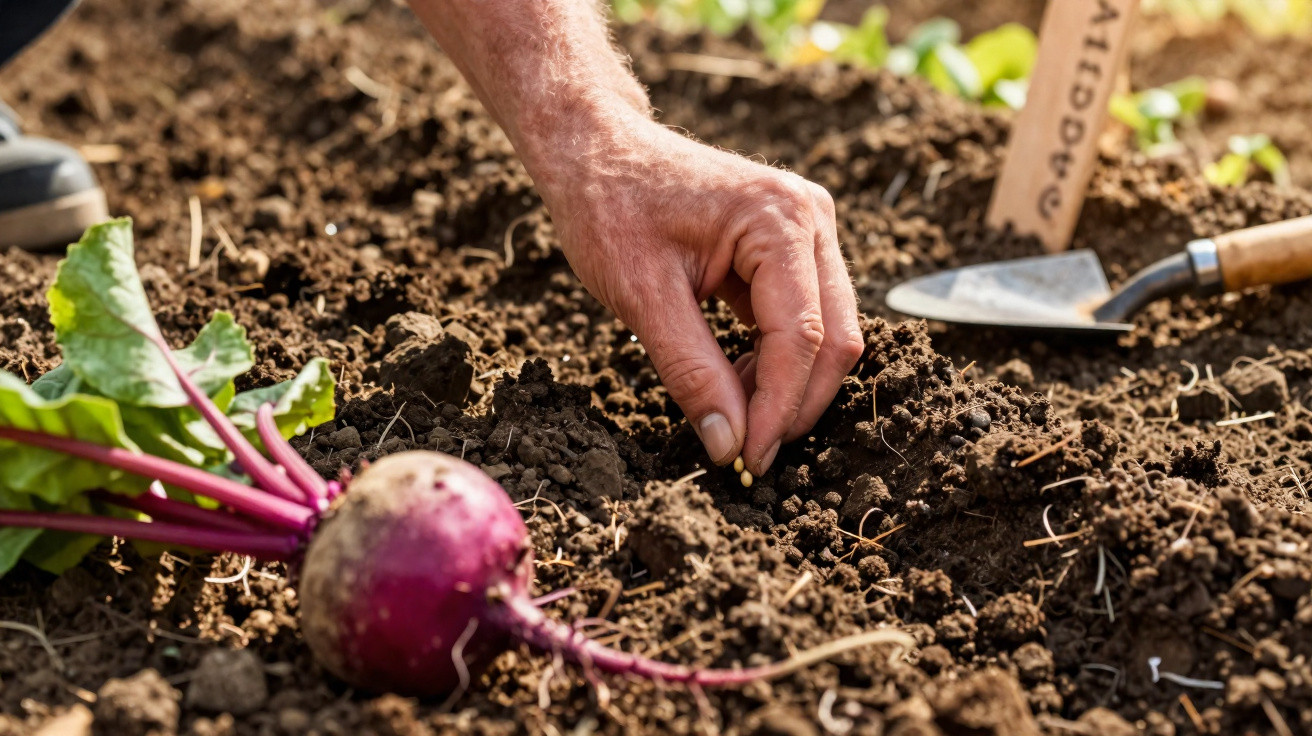
Many gardeners diligently sow beetroot in spring, only to be surprised later by long, misshapen roots instead of attractive round bulbs.
The sowing time is right, the soil appears loose, yet the bulbs still stay small or become pointed. Perfectly round beetroot roots often depend not on a secret fertiliser, but on an almost forgotten step in the seed drill that costs nothing and takes only a few seconds.
Why beetroot often fails to grow round
Beetroot is one of the hardier vegetables to grow in a bed. Sowing in April is generally the correct timing. Even so, the results are often disappointing: elongated beets, bent roots, splits or knobbly shapes.
The shape of the bulb is determined in the first few weeks after sowing – especially in the area directly beneath the seed.
At first, the taproot grows vertically downwards. Where the soil beneath it is deeply loose, it simply continues descending. The plant then directs its energy into depth rather than width. The result is a more spindle-shaped root instead of the hoped-for round storage bulb.
This is precisely where the “forgotten” technique comes in: deliberately firming the soil at the base of the seed drill.
A good seedbed: the first step towards attractive bulbs
Before moving on to the actual trick, the crop needs a properly prepared seedbed. Even the best technique will achieve little without it.
Preparing the soil correctly
Loosen the soil only in the top few centimetres; do not dig it over deeply. Surface cultivation with a garden fork or cultivator is usually entirely sufficient.
- Prepare the upper 5–10 cm into a fine, crumbly texture, ideally like fine semolina grains
- Carefully remove stones and large clods
- Work in mature compost, but do not overdo it
- Wait until the soil has warmed after a few sunny days
Cold, wet soil encourages seed rot. Those who are patient are often rewarded with more even germination and strong young plants.
The almost forgotten beetroot trick: pressure at the bottom of the seed drill
Now comes the key action for directing the root to grow wider.
How firming the seed drill works
First, draw a seed drill around 2 to 3 cm deep. Normally, you would simply place the seeds in it – but this is where the method changes: before sowing, deliberately firm the soil in the bottom of the drill.
Use the back of a rake, the edge of a wooden board or simply the heel of your shoe, and press the base of the drill down firmly. This creates a kind of solid “floor” beneath the seed.
When the taproot reaches this compacted layer, it stops growing deeper – and the beet begins to expand sideways.
The plant diverts sideways, no longer putting its energy into a long taproot but into a more compact, rounder bulb. This is what produces the desired shape.
Common mistakes at this stage
- Tapping the soil only lightly instead of pressing it down firmly
- Compacting the whole bed rather than only the narrow strip in the drill
- Firming the surface after sowing as well – this makes emergence more difficult
Important: make only the bottom of the drill properly firm. Keep the soil above loose so that seedlings can emerge easily.
Correct sowing distances: less is more
Beetroot seeds are contained in small clusters known as glomerules. Each cluster produces several seedlings. If seeds are sown too closely, the roots later become tangled and obstruct one another.
One simple rule helps:
| Step | Spacing |
|---|---|
| Placing the seed clusters in the drill | approx. 5 cm between glomerules |
| Final spacing after thinning | approx. 20 cm between plants |
After placing the glomerules, cover them with fine, crumbly soil. Draw it over only lightly; do not press it down. A gentle smoothing with your hand is enough for the seedlings to emerge in around ten days.
Thinning: the painful but necessary cut
As soon as the young plants have three to four true leaves, space becomes limited in the bed. This is when thinning is needed. Many home gardeners hesitate because every seedling looks so healthy. However, leaving them all in place ultimately sacrifices yield and quality.
Only those who consistently remove weaker young plants create space for strong, well-shaped bulbs.
Leave around 20 cm between the remaining plants. Do not simply pull out the removed seedlings; gently twist them out or cut them off with a small knife to avoid damaging the neighbouring roots.
Care during the growing period
Consistent moisture rather than a heavy drenching from the hose
Beetroot reacts sensitively to major swings between drought and waterlogging. Irregular watering often causes splitting and tough flesh.
- Water regularly but moderately during dry periods
- Apply water directly to the root zone rather than sprinkling a wide area
- Keep the foliage as dry as possible to prevent fungal diseases
A thin mulch of dried lawn clippings or shredded leaves retains moisture in the soil, reduces surface capping and protects against severe drying out.
Remove weeds consistently
Weeds compete with the crop for water and nutrients. During the first few weeks in particular, many weeds grow faster than beetroot.
It is better to hoe or pull weeds briefly every few days than to struggle later with densely rooted mats. A well-kept bed makes a noticeable difference to bulb formation.
How to recognise the right time to harvest beetroot
Depending on the variety and weather, harvesting takes place two to four months after sowing. Looking at the “shoulders” of the bulbs reveals a great deal about their condition.
- The upper part of the bulb is pushing slightly out of the soil
- The surface looks smooth, without deep splits or pronounced woodiness
- The skin has an even colour, without glassy patches
This is the ideal time to carefully lift the root with a garden fork and pull it out. Waiting too long can result in woody flesh and a loss of flavour.
What the compacted seed-drill base does
The pressure at the bottom of the drill acts like an invisible barrier. Specialists refer to this as an interrupted taproot. The plant responds to this obstacle by producing side roots and increasing bulb growth in the upper soil layer.
Farmers have used this principle for a long time with various root vegetables. In home gardens, however, it has often been forgotten because soils are now usually loosened deeply. This is exactly where a deliberate contrast is worthwhile: deep loosening around the crop, with targeted compaction only along the narrow line in the seed drill.
Further practical tips for even better results
Anyone wanting to optimise bulb shape can also consider variety choice and companion planting. Naturally round varieties are more compact by nature. Combined with a compacted seed-drill base, they create an especially harmonious result in both the bed and the kitchen.
Beetroot grows well alongside onions, lettuce or dwarf French beans. Near heavily feeding brassicas, it often suffers from competitive pressure. Rotating the growing position every few years reduces disease pressure and helps maintain healthy crops.
With finely prepared soil, a firmly pressed seed drill, restrained sowing and consistent thinning, a simple trick becomes a reliable method. Many unsuccessful beetroot harvests depend less on having “green fingers” than on this small, inconspicuous step in the seed drill – the step that ultimately determines whether you get thin roots or plump, round bulbs.

Comments
No comments yet. Be the first to comment!
Leave a Comment