
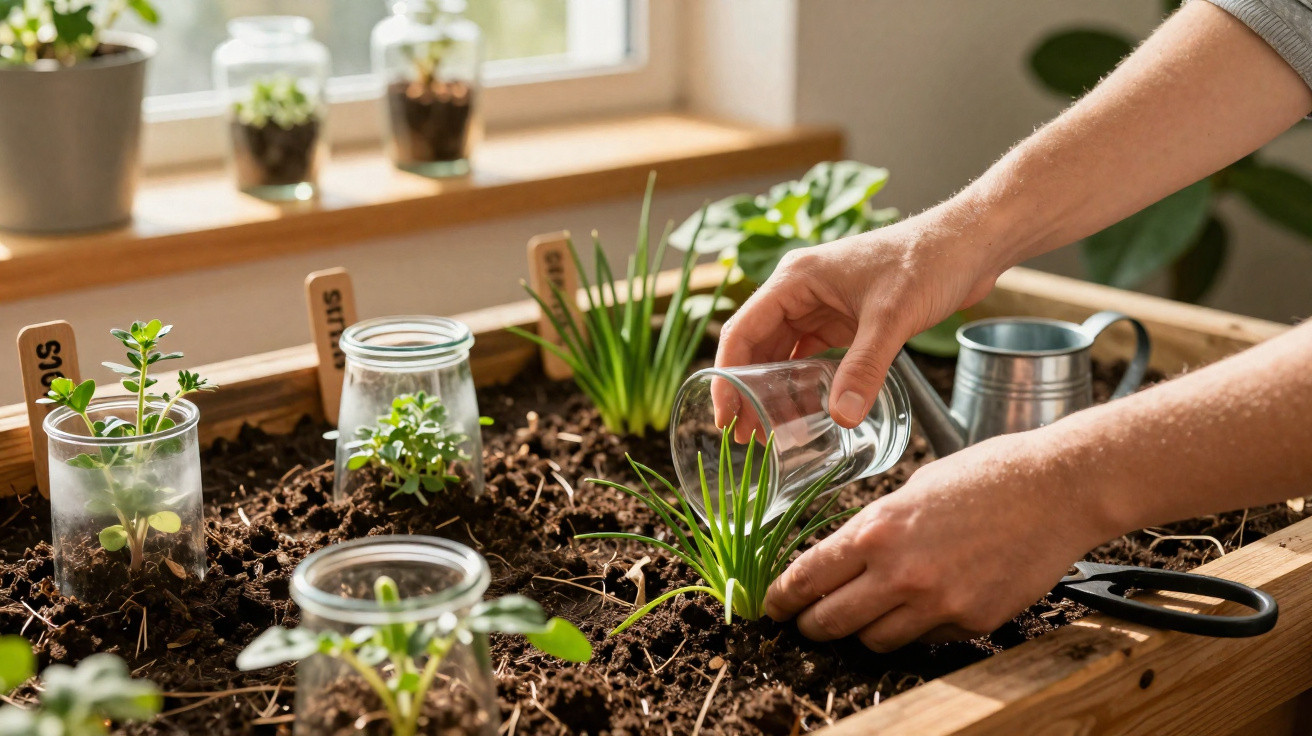
Many hobby gardeners eagerly await the first fresh herbs from the garden in March. Chives, parsley and similar plants can, however, be given a noticeable boost with a simple trick: an ordinary glass jar becomes a miniature cloche, retaining warmth and moisture while turning your bed into a kind of mini cold frame – without any need to buy expensive equipment.
How a drinking glass becomes a turbo greenhouse
The idea sounds almost too straightforward: place a large glass jar upside down over your young herbs – and that is it. Yet it relies on a clear physical effect that has been used in greenhouses for centuries.
The glass trick creates a small, enclosed climate: warmer, more humid and sheltered from wind – ideal for delicate herbs in March.
As soon as the sun sits higher in late winter or spring while nights remain cool, the following takes place:
- The sun warms both the soil and air beneath the glass far more than it would without it.
- Warm air rises, meets the colder glass and moisture condenses on the inside.
- This creates a humid, protected environment, much like a small greenhouse.
- Wind and cold draughts stay outside, so the plant does not cool down as quickly.
As a result, hardy herbs begin growing sooner, produce stronger shoots and develop more intense flavours. Anyone wanting to scatter fresh chives over scrambled eggs in March can often gain two to three weeks.
Which glass jars work particularly well?
In theory, nearly any clear glass jar will do. In practice, though, there are some clear favourites:
- large supermarket gherkin jars
- old preserving jars with wide openings
- large kitchen storage jars
The design is not what matters; the diameter is. The wider the opening, the more room the plant has and the better the air can circulate.
| Type of jar | Advantage | Disadvantage |
|---|---|---|
| Gherkin jar | often free, sturdy, good height | sometimes has a narrow opening |
| Traditional preserving jar | very robust, wide opening | can be heavy and needs a firm base |
| Sprouting jar | already has a perforated lid | opening is often too narrow for larger clumps |
One important rule applies: the glass must be transparent. Tinted or heavily textured jars admit less light, which slows growth.
The glass trick: ideal herbs to cover
This trick is especially suitable for perennial or hardy plants that overwinter in the soil and start shooting again in early spring.
Chives and parsley respond especially strongly to the glass cloche – the first green shoots emerge from the soil noticeably earlier.
Reliable choices for the herb bed
- Chives: emerge early, enjoy the extra warmth and become nicely tender and aromatic.
- Parsley: usually takes a little longer, but benefits from protected warmth and consistent moisture.
- Rhubarb: although it is not a herb, it responds very well to this kind of “early start” and produces thicker stalks sooner.
Other robust herbs, including Chinese chives, lovage and tarragon, can also be encouraged into growth earlier this way. What matters is that the plants have made it through winter in the bed – tender summer herbs such as basil are too frost-sensitive for this trick in March.
How to use the glass trick step by step
To prevent the jar from becoming a pressure cooker for your plants, a few details are important. The process itself remains simple.
Preparing the bed
- Check the position: the herbs should be in a spot that is as sunny as possible but not fully exposed to wind.
- Loosen the soil slightly: carefully break up compacted soil with a small hand cultivator so that water can drain more easily.
- Clean the jar: thoroughly remove food residues to prevent mould forming.
Positioning the glass correctly
- Place the jar over the young plant without its lid.
- Press the edge lightly into the soil so wind cannot get underneath it.
- In particularly windy places, put small stones or clods of soil around the rim to weigh the jar down.
On frost-free days with plenty of sunshine, it is worth lifting the jar briefly from time to time to allow the air to circulate. Otherwise, it may become too warm inside and put the plant under stress.
When the glass cloche needs to come off
As useful as this mini greenhouse is in March, removing it at the right time is just as important. If the jar remains in place for too long, heat build-up, rot or soft, “leggy” growth can result.
As soon as the shoots touch the bottom of the glass or the nights become noticeably milder, the herb needs open air again.
Good signs that it is time to stop include:
- Night-time temperatures generally remain above 5°C.
- The plant touches the top of the jar or clearly fills much of its interior.
- A great deal of condensation forms during the day and dries only slowly.
For maximum caution, do not remove the jar abruptly. Instead, take it off during the day for several days and replace it at night. This allows the plant to adapt to cooler air and more wind.
A glass cloche benefits lettuce and vegetables too, not just herbs
The trick is not limited to the herb bed. Young vegetable plants also get a much more stable start to the season under glass.
Helping young plants through cold weather
Particularly suitable are:
- lettuce seedlings in a bed or raised bed
- young kohlrabi plants
- delicate cabbage or Savoy cabbage plants
Alongside the warmth boost, the glass cloche offers another benefit here: slugs cannot reach the young plants as easily. Those gardening in a slug-prone garden can often avoid using the controversial slug pellets.
No garden? Recreate the effect on a windowsill
Anyone with only a balcony or windowsill can use similar principles. You may not necessarily place jars over herbs growing in a bed, but you can still make purposeful use of warmth and moisture.
- Place small ceramic bowls or seed trays on a bright windowsill.
- Sow mini vegetables such as cress, radish leaves or broccoli sprouts.
- Use a transparent cover, such as a glass lid, bowl or glass sheet, until the seedlings are a few centimetres tall.
This creates an effect very similar to that in a garden bed: a stable temperature, high humidity and protected seedlings. Especially in city flats, fresh, vitamin-rich greens can be grown this way in five to seven days.
Risks and limitations of the glass trick
As clever as this approach is, it is not entirely risk-free. Keep an eye on a few points:
- Overheating: on very sunny days, the air inside the jar can heat up to well over 30°C. Ventilate it temporarily in these conditions.
- Risk of mould: if the soil stays wet all the time and there is hardly any air exchange, fungi can develop. In that case, remove the jar more often.
- Storms and hail: large jars can topple over in strong winds and damage plants. In storm-prone locations, it is better to remove them in the evening.
Anyone taking these points seriously can achieve noticeably earlier and healthier plants with minimal effort – without chemicals, electricity or a plastic cover from the garden centre.
Why herbs become more aromatic under glass
The effect is not limited to appearance. Many gardeners report that chives and parsley taste more intense when grown under glass. This is because plants produce more essential oils in slightly higher temperatures and consistently humid conditions. These oils provide fragrance and flavour – precisely what you want on the plate.
There is another interesting point: using glass in March encourages plants to produce early but strong new growth. If the first shoots are cut regularly, the plant branches more and delivers a larger harvest throughout the season. The glass is therefore not merely an early starter; it also lays the foundation for a long, productive herb season.



Comments
No comments yet. Be the first to comment!
Leave a Comment