
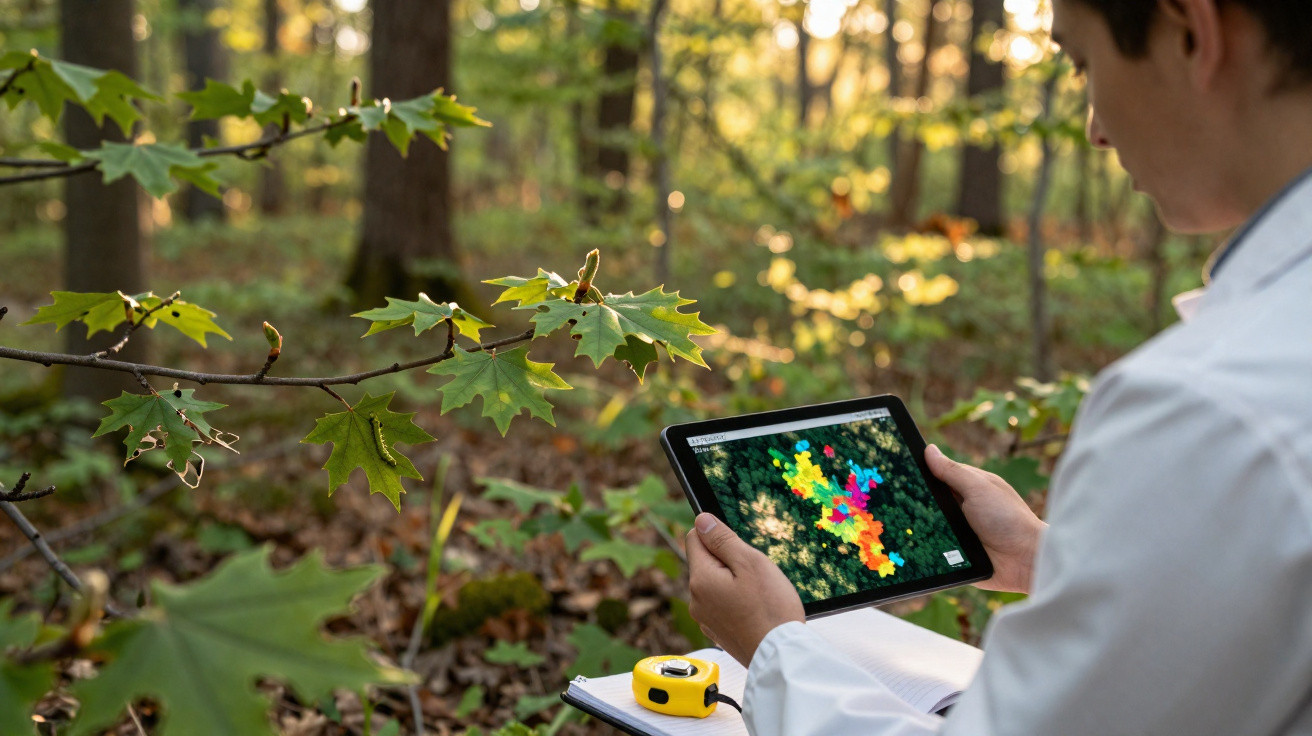
Spring should be a banquet in the forest. For caterpillars and other insects that feed on leaves, it is the point when every condition appears to align.
They emerge from their eggs just as young oak leaves begin to unfurl: tender, newly grown and full of nutrients. Under normal circumstances, the timing is so precise that the insects can start feeding almost at once.
Yet oak trees are not simply passive targets waiting to be consumed.
New research has found that, after oaks experience severe caterpillar damage in one year, they alter their behaviour the following spring. Rather than producing leaves at the usual time, they postpone the process by around three days.
Although that may seem a minor shift, it can entirely upset the plans of starving caterpillars. They hatch in anticipation of food, only to discover that the leaves remain enclosed within their buds.
The new study reports that this brief postponement has a major effect. It substantially reduces caterpillar survival and lowers the harm inflicted on the tree by roughly 55 percent.
A less costly delaying tactic
The study's lead author, Soumen Mallick, is a postdoctoral researcher at the University of Würzburg.
“The delaying tactic is more effective for the oak than a chemical defense, such as bitter tannins in the leaves,” said Mallick.
For a tree, boosting tannin production would require a substantial energy investment.
Put simply, delaying growth proves less expensive than mounting a chemical defence.
Responding to biological pressure
Trees are commonly assumed to react chiefly to temperature, rainfall and daylight. However, this research indicates that a more active process is taking place.
Oak trees are responding not only to weather conditions, but also to biological pressure.
“This discovery fundamentally changes our previous understanding of the onset of spring in the forest,” Mallick said. It shows that trees respond flexibly to biological threats.
This substantially changes how springtime in a forest can be understood. Rather than being driven by climate alone, it is also influenced by a subtle exchange between plants and the insects that attempt to feed on them.
Watching the forest from space
To demonstrate this, the researchers adopted an approach far larger and more advanced than the conventional practice of observing individual trees from the ground.
Rather than manually following a small number of trees, they used Sentinel-1 satellite data to monitor an area of 2,400 square kilometres in northern Bavaria.
These radar satellites are particularly valuable because they can identify changes in tree canopies even under dense cloud cover, a significant benefit during spring.
Across five years, from 2017 to 2021, the team examined 137,500 observations. Each satellite image had a resolution of 10 by 10 metres per pixel, approximately the area covered by one tree crown.
In total, the researchers assessed 27,500 of these pixels across 60 forest sites.
That scale was important, as it allowed them to examine the response of whole landscapes rather than only a small selection of trees.
Caterpillar outbreak reveals the strategy
One particular year provided an ideal natural experiment. In 2019, the region experienced a major gypsy moth outbreak.
The caterpillars defoliated large numbers of trees, producing the level of stress needed to reveal whether oaks would alter their seasonal timing in response.
“The radar sensors recorded exactly which trees were stripped bare and how they reacted in the following year,” said co-senior author Jörg Müller.
The result was unambiguous: the oaks subjected to the heaviest attacks were those that postponed leaf emergence the next spring.
This helps account for a question that has perplexed scientists for some time. Forests can occasionally remain brown longer than increasing temperatures alone would indicate.
What forest models are missing
The findings carry significant implications for ecology and conservation.
Many forest models still concentrate largely on what the researchers call “lifeless” factors, including temperature and rainfall, while giving far less weight to interactions among living organisms.
However, if trees are changing their seasonal timing in response to insects, such models omit part of the picture. As the climate changes, that missing element may become increasingly important.
The researchers characterise the situation as an evolutionary tug-of-war. Warming temperatures, on one side, are encouraging trees to produce leaves ever earlier. On the other, insect pressure provides a reason for trees to wait.
That conflict may determine how spring appears in forests of the future.
A smart, flexible strategy
The oak's approach is particularly ingenious because it is temporary. Rather than permanently altering its schedule, the tree delays leaf emergence only after a genuine infestation.
As a result, insects cannot readily adjust to a fixed revised timetable, since the response remains flexible.
“This dynamic interplay is an example of the forest’s high resilience and adaptability in a changing world,” said Andreas Prinzing from the University of Rennes.
Perhaps the most remarkable aspect is that, while forests may appear motionless from the outside, they contain countless small negotiations of this kind.
It offers a different view of spring: not merely a season that unfolds on schedule, but a living contest shaped by weather, memory and the unrelenting pressure to survive.
The research was published in the journal Nature Ecology & Evolution.



Comments
No comments yet. Be the first to comment!
Leave a Comment