
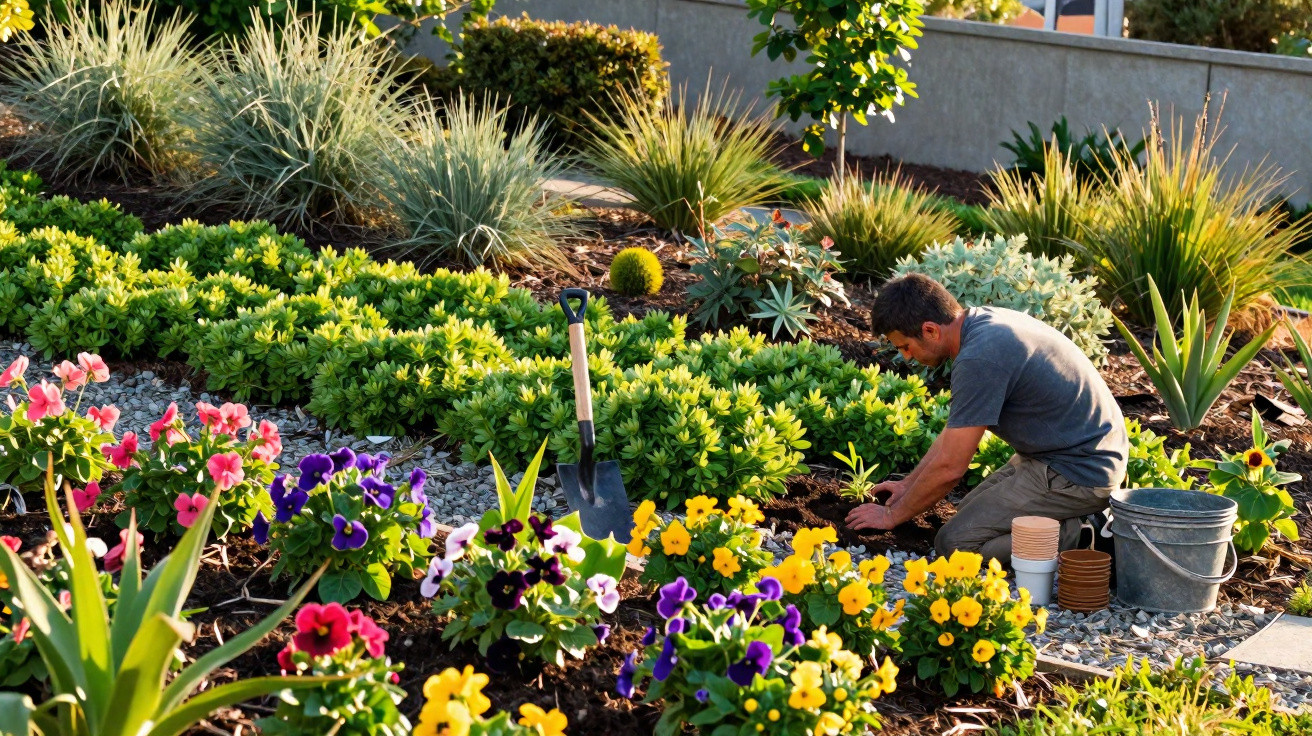
Many homeowners face the same issue: a steep slope that loses soil with every spell of heavy rain, grows moss rather than flowers and drags down the appearance of the entire garden. Rather than relying on costly concrete, there is a surprisingly affordable approach increasingly used by gardening professionals: carefully planned planting that both stabilises the slope and turns it into a tiered cascade of flowers – for less than €20 per square metre.
Why plants outperform concrete
Building a conventional retaining wall can readily cost €150 to €300 per square metre. In many cases, that exceeds the available budget – and can look stark and out of place in a garden. For this reason, landscape gardeners are increasingly choosing bioengineering methods: plants with roots that function as a natural net.
“With the right selection of plants, a slope can be secured, greened and visually enhanced at the same time – at a fraction of the cost of a wall.”
The technical term is “phytostabilisation”. Dense, extensively branching root systems run through the soil and anchor it over the long term. Foliage softens the impact of raindrops, while water can soak into the ground instead of flowing away as a dirty torrent of mud. This also creates a habitat for insects, birds and soil organisms.
How to plan your slope for under €20 per square metre
The cost advantage comes from keeping the project straightforward: limited materials, tough plants and a clear layout. Three elements matter most: preparing the soil, planting density and creating a clever tiered structure.
Step 1: Prepare the slope
- Clear the slope of unwanted growth and deeply rooted weeds.
- Lightly roughen loose soil instead of smoothing it out – this gives plants and mulch a better hold.
- Remove stones or larger roots only where they genuinely get in the way; much of this will later look natural.
On particularly steep sections, it is worth forming small steps or planting pockets, where larger stones or especially vigorous plants can later be placed.
Step 2: Plant correctly – this is the magic number
Professionals follow a simple rule of thumb: use 4 to 5 plants per square metre, arranged in staggered rows. The gaps then fill quickly, leaving very little bare soil that could be eroded.
“Plant in groups of 6 to 7 specimens of the same variety – the eye appreciates repetition, and the area appears calmer and more refined.”
Apply a heavy mulch layer immediately after planting; coarse woodchip or BRF (woodchip made from fresh prunings) is ideal. This material is less likely to slip, protects the soil and retains moisture.
Step 3: Securing steeper slopes
Once a slope reaches roughly 15 per cent, additional stabilisation is advisable. Jute or coir matting provides a straightforward biodegradable option.
- Roll out the mat from the top of the slope downwards.
- Secure it using wooden pegs or metal anchors.
- Cut cross-shaped slits into the mat.
- Plant through these openings.
After one to two years, the matting will generally have rotted away – by then, the roots will have taken over the job.
Three planting levels for the perfect flower cascade
To ensure the slope does more than simply hold together, professionals divide it mentally into three areas: top, middle and bottom. Each area receives plants suited to its particular conditions.
Upper zone: Drought-tolerant plants and structural features
The upper area is the driest and is often exposed to wind. It is best planted with hardy species that cope with heat and a lack of water. Suitable choices include:
- Grasses such as feather grass or fountain grass
- Low ornamental shrubs such as cotoneaster, broom or spindle
- Heat-loving subshrubs such as germander-like perennials
These provide height, structure and a framework that visually supports the rest of the planting. In terms of maintenance, pruning every one to two years and occasional watering during dry spells are sufficient.
Middle zone: Powerful ground cover against erosion
Nature works most strongly against you in the middle section: this is where erosion is at its greatest. It therefore needs dense, resilient ground cover.
Reliable options include:
- Stonecrops and other Sedum varieties
- Heuchera in a range of leaf colours
- Baby’s breath for airy veils of white flowers
- Mexican fleabane (Erigeron) for a long flowering period
- Creeping St John’s wort varieties for yellow carpets
For an especially low-maintenance option, low-growing shrubs can also be included, such as compact privet varieties or creeping cotoneaster. Over time, they develop a dense network of roots.
Lower zone: Moisture-loving flowering plants
More moisture collects at the bottom, where the soil is usually richer in nutrients. This is where more appreciative flowering plants can spread:
- Alyssum for cushions of yellow or white flowers
- Bellflowers in a range of heights
- Violets and other early-flowering plants
- Sedum and Erigeron again, to tie the planting together
Large stones or small boulders serve two purposes here: they visually break up the slope, help retain soil and create small habitats for lizards and insects.
When to plant: the best calendar for a slope
Timing plays a crucial part in helping plants establish without stress. There are two ideal planting windows:
- Autumn: from mid-September to the end of November, before the ground freezes
- Spring: from March to the end of April, as soon as the soil is open and workable
Plants set out in autumn use the wetter season to establish roots and gain a head start in spring. Specimens planted in spring require a little more water initially, but will establish just as reliably with good care.
Practical example: a problem slope made safer in two years
A typical example is a private driveway with a side slope of around 30 degrees, exposed to intense rainfall and repeatedly shedding soil. Instead of constructing a retaining wall, the owner chose to plant robust ground covers such as periwinkle and ground ivy, combined with jute matting and coarse woodchip.
“After two growing seasons, the slope was fully rooted, green and stable – at a cost of under €20 per square metre.”
Rainwater now soaked into the soil rather than running towards the house in a dirty rush. At the same time, the entrance area looked noticeably more welcoming without changing the character of the property.
Where the limits are – and when a professional is needed
Naturally, the power of plants cannot solve every problem. Planting alone is not enough for extremely steep slopes, very large areas or ground at risk of slipping. In these cases, it helps to combine planting with light terracing, dry-stone walls, gabions or timber steps.
On very sandy soils or soils that readily form a surface crust, stabilising matting is almost essential during the early phase. If cracks, settlement or damage to neighbouring buildings are already visible, a structural engineer should assess the situation. In these instances, concrete may genuinely be the safer option – but it should be used selectively and can be combined with planted ledges or planting pockets.
What amateur gardeners should also consider
Many people underestimate how intensely the sun can dry out a slope. Regular watering during dry periods is especially important in the first two years after planting. A basic irrigation hose or drip hose makes this task much easier.
It is also sensible to consider the ecological aspect: choosing mainly native or site-appropriate species attracts more wild bees, butterflies and birds, reduces maintenance and saves fertiliser and water in the long run. Mixed planting schemes of flowering perennials, grasses and individual shrubs look more natural than uniform areas planted with just one species.
For amateur gardeners with limited time, it can be useful to plant only part of the slope at first and learn from the results: which species establish well? Where does water collect, and where does the soil dry out severely? These observations gradually create a slope that is not only safe but also full of character – and, at best, resembles a chance wild flower cascade that formed all by itself.



Comments
No comments yet. Be the first to comment!
Leave a Comment