
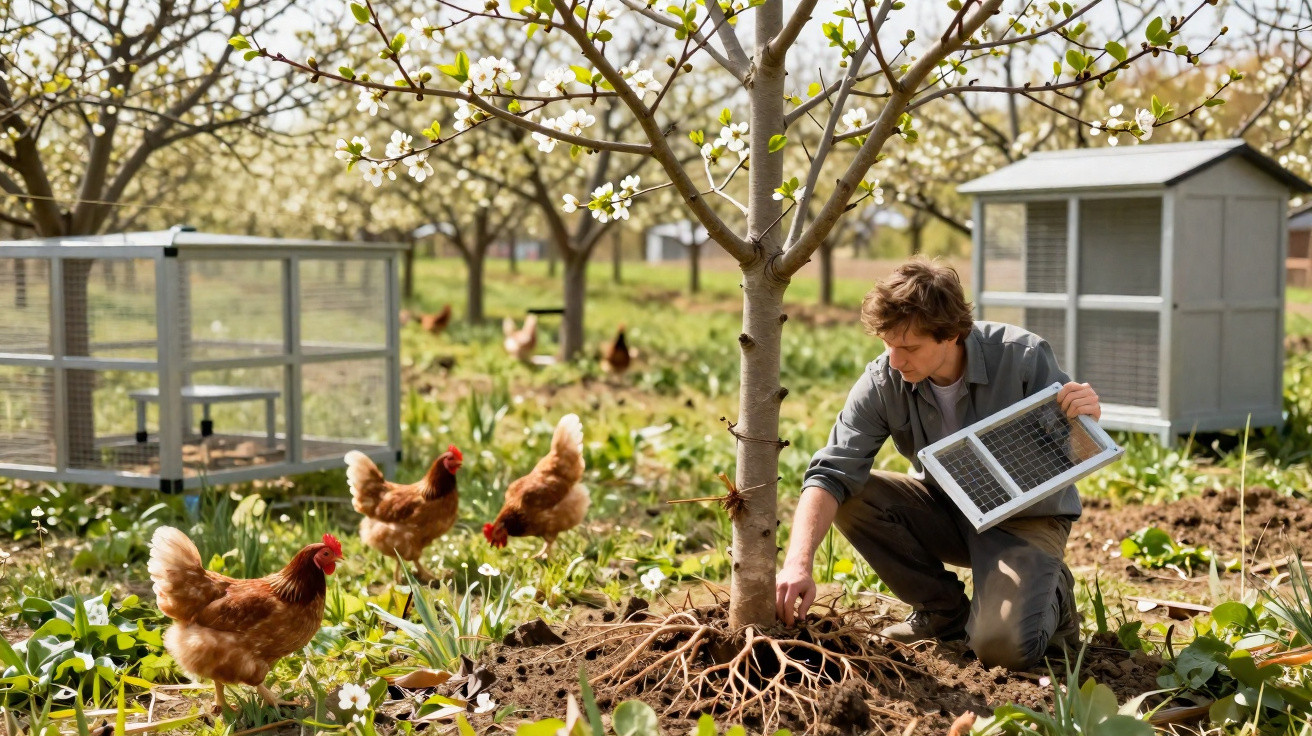
Standfirst: A fruit enthusiast happily lets chickens roam beneath apple and cherry trees – until one simple beginner’s mistake wrecks the entire harvest.
What begins as a smart organic idea ends in utter frustration for many gardeners: chickens in the orchard are meant to eat weeds, reduce pests and fertilise at the same time. Yet this supposedly ideal arrangement often turns into a nightmare in practice because one key, rather strict rule is overlooked.
Why chickens in an orchard initially seem like a perfect match
At first glance, the pairing appears ideal: fruit trees provide shade and fallen fruit, while chickens keep the grass moving and scratch over the soil. They clear vegetation around the trunks, eat insects, slugs and larvae, and loosen the top layer of soil.
For many home gardeners, this removes the laborious task of weeding and avoids the need for chemical treatments. Rather than using herbicides, chickens simply patrol the grass – it is difficult to get more environmentally friendly than that. There is also their manure: chicken droppings supply plentiful nitrogen and phosphorus, precisely the nutrients fruit trees need for growth and leaf production.
In moderate quantities, chicken manure in an orchard acts like a natural boost for soil life – earthworms, micro-organisms and trees all benefit equally.
Especially during autumn and winter, this combination of soil cultivation, insect hunting and natural fertilisation can be extremely valuable. Many trees emerge from dormancy visibly stronger, put on more vigorous spring growth and produce more blossom.
The turning point: when spring changes everything
The trouble starts just as the orchard is looking its best. Once the first buds begin to open and the trees come into flower, chickens reveal a side that many keepers had not anticipated.
Chickens are curious and highly motivated eaters. They can jump surprisingly high, flutter onto low branches and peck at anything that seems tender, fresh and easily reached. Flower buds, young leaves and newly formed fruitlets can all quickly end up in their beaks.
The consequences only become apparent months later, when the boxes should really be ready for harvesting:
- many flowers on the lower branches disappear entirely;
- far fewer fruits develop;
- some of the still-small fruits are pecked or fall prematurely.
Once the first unripe fruits drop to the ground, the situation becomes worse. What began as minor losses turns into an invitation to an all-you-can-eat buffet directly beneath the trees. Chickens peck at damaged fruit, scatter the remains and attract wasps and other insects with the sweet smell.
The strict basic rule that almost nobody knows
Anyone wanting to combine chickens and fruit trees successfully cannot avoid one clear requirement: chickens must be removed from the orchard during the sensitive period.
From the point at which the first buds are visibly swelling, chickens must no longer have unrestricted access to the fruit trees – and this remains the case until after the final harvest.
In practical terms, this means:
- no chickens in the tree area while the trees are flowering;
- no chickens during fruit formation and ripening;
- return them only once every fruit has been harvested or removed.
Applying this seasonal separation consistently protects blossom and young fruit without giving up the benefits the birds bring during the rest of the year. The calendar determines the approach: autumn, winter and the early part of late winter are ideal times for chickens to work in the orchard. As soon as nature signals that it is ready to start, the area needs to be fenced off.
How to manage chickens and fruit trees without stress
The good news is that there is no need to choose between keeping chickens and having an orchard. With some planning, both can work together permanently without sacrificing the harvest.
How many chickens per tree make sense
Alongside choosing the right time, the number of birds is also crucial. Too many chickens in a small space create heavy trampling, excessive manure and a veritable lunar landscape beneath the trees.
A practical recommendation:
| Number of fruit trees | Recommended number of chickens in the orchard area |
|---|---|
| 1–3 trees | 2–6 chickens |
| 4–8 trees | 6–16 chickens |
| larger traditional orchard | based on area, not solely on the number of trees |
As a broad guideline, two to four birds per tree are entirely sufficient for an ordinary garden. This allows the trees and soil to benefit without the ground becoming scorched or turning into a muddy patch.
Mobile runs: guide chickens rather than ban them
Rather than barring chickens from the orchard completely for months, it is worth using a flexible system. A mobile fence or moveable run gives you control over both the areas used and the timing.
- Lightweight fence posts and poultry netting can be moved in minutes.
- Shift the run slightly every one to two weeks so that the ground can recover.
- Exclude areas containing fruit trees consistently in spring, then reopen them only after the final harvest.
This keeps the chickens occupied, gives them continual access to new feeding areas and stops the garden becoming overgrown. At the same time, it makes it possible to prevent them from nibbling blossom and fruit exactly where needed.
Practical tips for less trouble and a better harvest
Anyone wanting to limit damage should watch the orchard more closely in spring. Bud development and flowering progress at different speeds depending on the tree species and region. Even a delay of a few days can be enough for the birds to leave visible damage behind.
Anyone who checks the trees twice a week will spot the critical moment in good time – and keep the chickens out before the first flowers disappear.
Small everyday routines are useful too:
- collect fallen fruit regularly, so it never becomes a constant food source;
- feed chickens more often in their alternative run during the critical months;
- plant shrubs or herb strips that provide shade and enrichment away from the fruit trees.
Common mistakes that ruin the dream of a natural garden
The same difficulties arise repeatedly in gardens containing chickens and fruit trees. Three pitfalls are especially common:
- Chickens permanently in the orchard area: The birds have year-round access beneath the trees. Blossom, young shoots and fallen fruit suffer continuously.
- Overstocking in a small area: Too many chickens compact the soil, droppings accumulate, grass dies back and even robust fruit trees become stressed.
- No rotation of areas: The same corner is used repeatedly until not a blade of grass remains. Disease and parasites can persist more easily.
Those who keep these points in mind and assess their flock honestly can take action before damage to trees and soil becomes irreversible.
When the system works: from problem to a genuine win-win situation
Once the timetable is right and the flock size is appropriate, surprisingly stable routines develop. Chickens reduce pests, make use of fallen fruit in the later phase, return nutrients to the ground and support living soil. The trees repay this with vigorous growth and dependable harvests.
This combination is particularly appealing in nature-friendly gardens: less plastic netting, fewer sprays and more living cycles. Anyone prepared to set up a mobile fencing system gains lasting flexibility and can respond according to the year and the start of flowering.
Beginners are best advised to start small: first test how soil, trees and animals respond with only a few chickens and one or two fruit trees. Later, both the number of trees and perhaps the size of the flock can be adjusted. This keeps everything manageable, rather than ending in a muddle of bare tree canopies, muddy areas and disappointing harvest baskets.
Anyone who accepts the strict separation between flowering time and chicken access will suddenly see the orchard differently: the birds work in the background, the soil visibly comes to life, and picking fruit in late summer reveals whether the plan has genuinely worked.
Comments
No comments yet. Be the first to comment!
Leave a Comment