
A walk around almost any garden centre is likely to reveal decorative pieces modelled on the classical world.
Concrete figures inspired by the Venus de Milo, terracotta planters fashioned after Greek urns and herb gardens arranged in the style of 2,000-year-old bas-reliefs are all favoured by landscapers with traditional tastes.
For one garden, however, this vision of antiquity was ultimately more than an imitation.
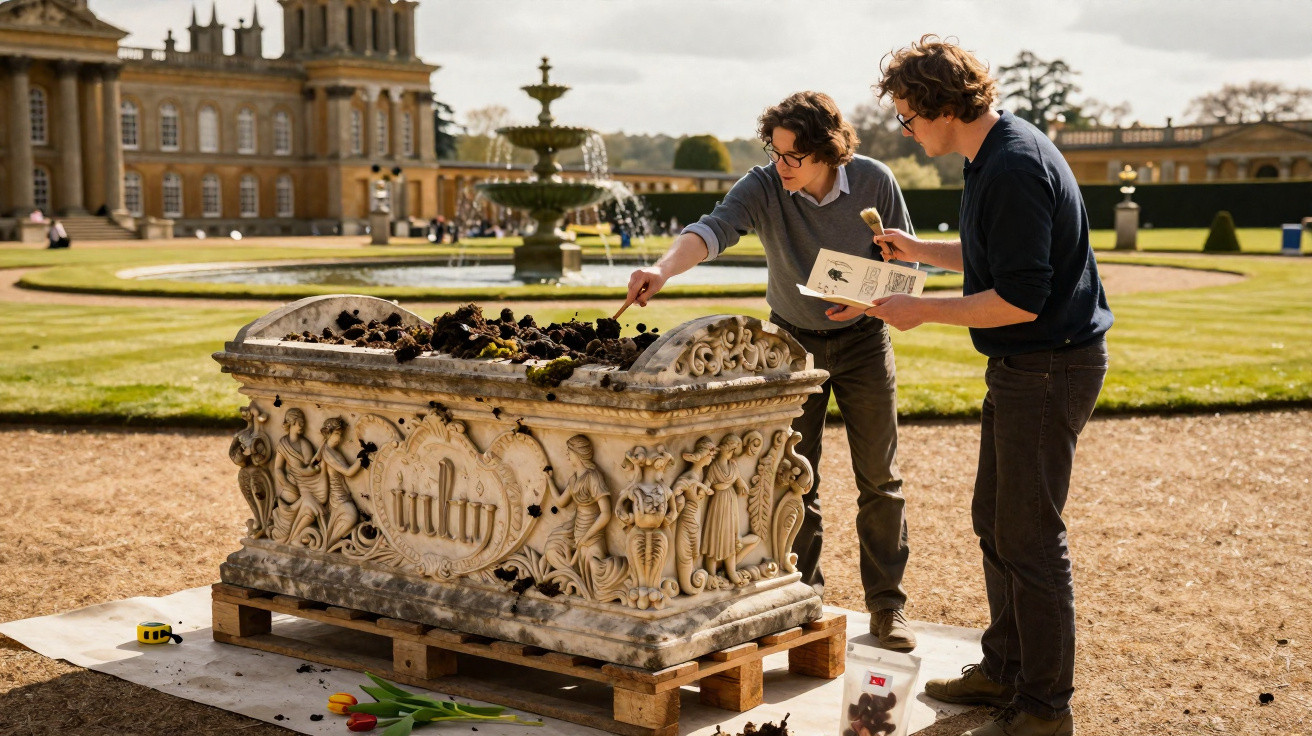
An ancient Roman sarcophagus at Blenheim Palace
Within the grounds of England's 18th-century Blenheim Palace, a marble-faced trough used as a tulip planter proved to be much older than it initially appeared.
In 2017, palace staff and conservators announced that its marble front was genuinely ancient: a Roman sarcophagus dating from around the third century CE.
For almost two centuries, the carved marble slab had functioned as a garden decoration, initially as part of a water feature and later as a planter. Despite this modest use, it had originally formed part of an elaborate stone coffin made for a wealthy Roman at the height of the empire.
The surviving piece has since been meticulously restored and moved indoors for display.
"The piece is actually in remarkable condition considering it has withstood seemingly aggressive environments; particularly that of a fountain receptacle," said Nicholas Banfield, a conservator at Cliveden Conservation who led the restoration.
"Following an initial in-situ inspection, we were able to unbolt it from the lead cistern to which it was attached and take it back to our workshops for full cleaning, repair, and stabilization."
At first, this might seem to be the story of an unusual, overlooked object finally being recognised for its significance. The history of this particular artefact, though, is considerably stranger.
Known as the Blenheim Sarcophagus, it had never truly been either unknown or obscure.
A garden ornament recorded for centuries
Zahra Newby, a classicist at the University of Warwick in the UK, examined the artefact in a book chapter about portraiture on Roman sarcophagi.
Its bas-relief shows a drunken Dionysus celebrating alongside Hercules and Ariadne, with lion heads on either side.
"An example in Blenheim shows the drunken Dionysus standing in the center of the sarcophagus…" she wrote.
References to the sarcophagus extend back several centuries.
Before 1530, Italian artist Battista Franco Veneziano made a sketch of its scene; that drawing is now held by the Städel Museum in Germany.
The Metropolitan Museum of Art in the US also holds a 16th-century drawing of the sarcophagus, credited to an unidentified artist.
Adolf Michaelis included it in his 1882 book Ancient Marbles in Great Britain.
In 2010, an unnamed visitor uploaded a photograph of the object in the Blenheim grounds to TripAdvisor, captioning it, "a flower bed that looks like a Roman lenos sarcophagus". A lenos sarcophagus is shaped like a bathtub.
The object appears to have been concealed in plain sight. Yet media reports in 2017 stated that Blenheim Palace had not known its provenance until 2016, when an antiquities specialist visiting for unrelated reasons encouraged staff to investigate it.
The marble panel, the sarcophagus's only surviving portion, had been fixed to a trough for use as a garden feature. After being detached, it measured about 2 metres (6.6 feet) long and weighed nearly 400 kilograms (880 pounds).
Experts reportedly valued it at £300,000 (US$400,000 at current exchange rates at time of writing).
Why, then, had it gone unnoticed for so long while so many visitors passed it regularly?
Many people probably believed it was a replica, like those found across countless gardens and country estates.
But Christopher Dickenson, an ancient historian and archaeologist at the University of Oxford in the UK, suggested that many others had simply assumed, as he had, that Blenheim staff already understood what they possessed.
"The truth must surely be that everybody who saw it and recognized it simply assumed that the people at Blenheim were fully aware what it was," Dickenson wrote. "That was certainly my assumption."
Restoration and an unresolved mystery
Visitors to Blenheim can now view the artefact in a setting better suited to it, and recognise it as what it is: a surviving relic of ancient funerary practice rather than a container for tulips.
"Now it is in a consistent indoor climate away from the natural elements, we are hoping it will remain in good condition and survive for many more centuries to come," said Kate Ballenger, House Manager at Blenheim Palace.
One major question nevertheless remains unanswered.
The artefact is known only to have entered the possession of the 5th Duke of Marlborough, who owned the palace at the time, at some point during the 19th century.
How, or when, he obtained it may never be known.






Comments
No comments yet. Be the first to comment!
Leave a Comment