
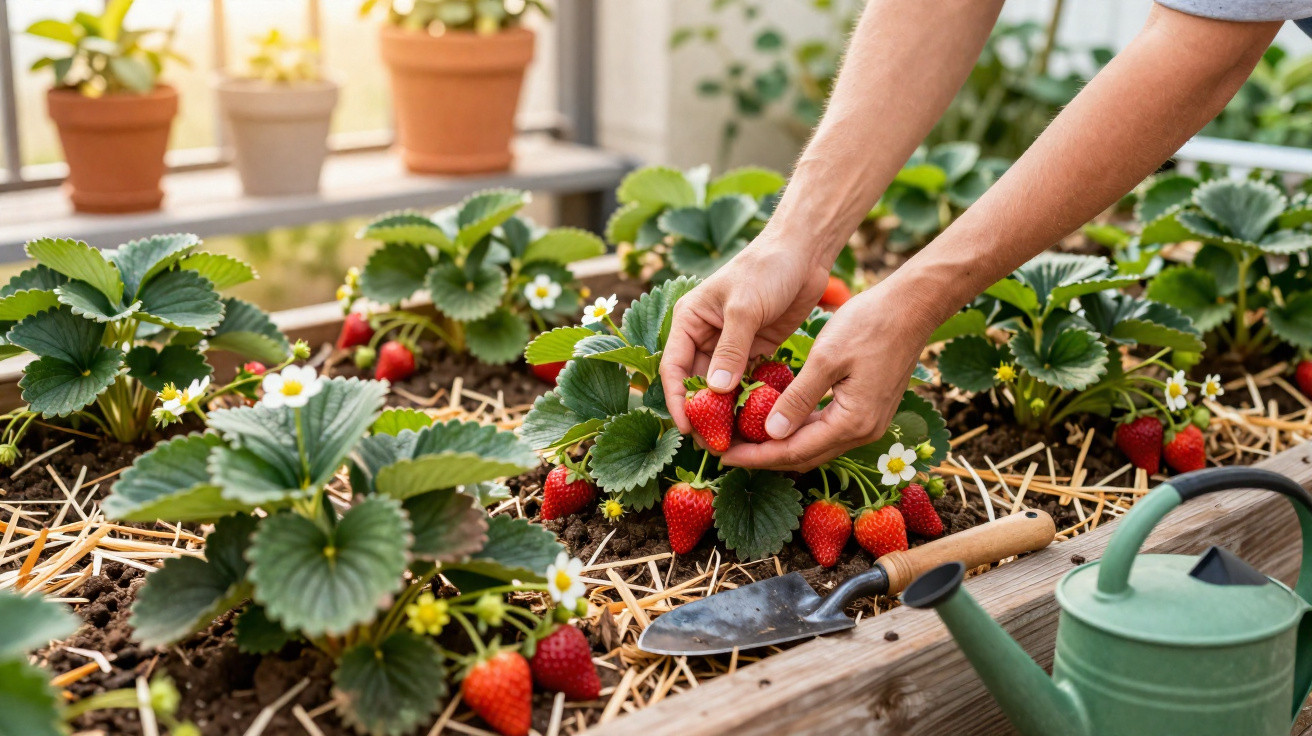
Many gardeners know the frustration: the first strawberries have barely ripened when the season is already over. Yet one type of strawberry plant will produce fruit for virtually the entire summer – provided its position, soil and care are right. Start in March and you can enjoy an almost uninterrupted harvest in the same season.
Why everbearing strawberries are the gardener’s secret professional trick
A term regularly appears in shops that many people simply overlook: everbearing strawberries. Behind this slightly unwieldy name lies a genuine game changer for gardens designed for picking and eating.
“Everbearing strawberries do not produce just one flush of fruit; they continue to form new flowers, and therefore new fruit.”
Unlike traditional June-bearing strawberries, which offer one large but brief main crop in late spring, everbearing varieties create a constant battle with the bowl in the kitchen: just when you think you have picked everything, fresh red berries are already hanging from the plants.
A typical garden schedule looks like this:
- the first worthwhile harvest from June
- further flushes in high summer, when many other berries have finished
- final fruits often continuing until the first autumn night frosts
Popular everbearing varieties that have proved successful in many gardens include:
- ‘Charlotte’ – fragrant, sweet and particularly popular in gardens for grazing
- ‘Mara des Bois’ – with a flavour reminiscent of wild strawberries
- ‘Toscana’ – decorative pink flowers and also ideal for containers
If you have room for only a few plants or are growing on a balcony, one of these everbearing varieties will usually serve you better than conventional June-bearing types.
Why planting in March makes such a difference
Ideally, the strawberry season begins early in the year. Gardeners who plant in March give their plants a clear head start.
At this point, the soil is beginning to warm while the usual spring rainfall still keeps it sufficiently moist. Strawberries benefit from precisely this combination:
- warmer soil encourages rapid root development
- consistent moisture prevents stress while the plants establish
- moderate temperatures protect young leaves and flowers
“Planting in March means the plants can establish calmly before the first major summer heat arrives – and reward you with an earlier, more generous crop.”
By contrast, delaying planting until late May or even summer risks exposing young strawberries to drought stress, meaning they may not crop fully until the following year.
The soil is decisive: preparing a strawberry bed properly
Strawberries prefer loose, humus-rich soil that is lightly moist but drains freely. They do not tolerate waterlogging at all, nor bone-dry, heavy clay soil.
The perfect strawberry soil, step by step
- Clear the area thoroughly: Remove perennial weeds, stones and old plant material. A weedy bed severely holds strawberries back.
- Loosen the soil: Use a spade or garden fork to work to a depth of 20–30 cm. Break up compacted layers so water can drain away.
- Add nutrients: Mix in mature compost or an organic berry fertiliser. Strawberries respond well to potassium and phosphorus; too much nitrogen makes them leafy rather than productive.
For very heavy soil, it is worth incorporating some sand as well as extra compost. On particularly wet plots, slightly raised beds or mounded rows help ensure that the roots never sit in water.
Planting everbearing strawberries correctly: spacing, depth and water
Once the bed is prepared, it is time to plant. Mistakes made at this stage can affect the plants for years.
The key planting rules at a glance
| Aspect | Recommendation |
|---|---|
| Plant spacing | about 30 cm between plants |
| Row spacing | 40–50 cm between rows |
| Planting depth | the crown or leaf rosette exactly at soil level |
| Watering | water in thoroughly immediately after planting |
Planting depth is crucial: the crown, where the roots meet the leaves, must neither be buried deeply nor left sitting above the soil.
“Strawberries planted too deeply are prone to rotting; those planted too high dry out – the middle position is essential.”
When buying plants, look for strong, healthy specimens with well-developed roots, no dark leaf spots and no soft, mushy root sections.
Care after planting: keeping plants in top condition
After the plants are in the bed, proper care determines whether harvesting really continues into autumn.
Mulch: a protective layer for soil and fruit
One useful technique from professional vegetable growing is mulching. Spread a loose layer of organic material around the plants:
- straw
- wood chips
- leaves or grass clippings, once dried slightly
Mulch performs several roles at once:
- it keeps the soil moist for longer
- it greatly reduces weed growth
- it prevents fruit from resting directly on the soil and rotting
Watering properly and feeding with purpose
Strawberries like soil that remains evenly moist, but they do not want “wet feet”. Watering less often but deeply is better than frequent light sprinkling. Ideally, apply water directly to the root zone rather than over the foliage.
“Wet leaves in warm weather are an invitation to fungal diseases – so water close to the soil instead.”
After the first large flush of fruit, a light top-up of nutrients is worthwhile. An organic berry fertiliser or a little compost helps the plants produce more flowers and fruit instead of only more leaves.
Control runners so the plant’s energy goes into fruit
Many strawberry varieties produce runners, also known as stolons. These develop into new young plants. However, too many runners are counterproductive when you want a long, plentiful harvest, as they significantly weaken the parent plant.
- trim runners back regularly
- retain only a few especially vigorous runners for propagation
- guide these into small pots, then plant them out later
This keeps the planting young and productive without compromising the ongoing harvest.
Keep an eye on diseases and pests
Strawberries are on the menu for a range of pests and fungal diseases. Regular checks can prevent considerable damage.
Common problems in home gardens include:
- Powdery mildew – a white coating on leaves and shoots
- Grey mould – rotting fruit covered with grey growth in wet weather
- Aphids – feed on young shoots, causing leaves to curl
- Slugs – eat into fruit and leaves
“The earlier you spot the first symptoms, the more gently strawberries can be protected – often, simple organic measures are then enough.”
Beneficial insects such as ladybirds, or nettle feed, can help against aphids. For slugs, use barriers, slug fences or collect them early in the morning. An airy site, adequate spacing and mulch that does not touch the leaves will greatly reduce fungal problems.
Everbearing strawberries in pots or on the balcony
Even without a garden, you do not have to miss out on months of strawberry harvesting. Many everbearing varieties grow very well in pots, window boxes or hanging baskets.
- a large pot holding at least 10–15 litres of compost
- high-quality, loose potting compost, preferably mixed with a little compost
- a drainage layer of expanded clay pellets or gravel in the bottom of the container
Containers dry out faster on a balcony, so watering needs to be even more consistent. An automatic watering system can make the task much easier, particularly during holidays.
Why switching to one everbearing variety is worthwhile
Out of habit, many home gardeners mix several strawberry varieties together – early, mid-season and late types. This may extend the harvesting period somewhat, but it also creates more planning work and often leaves gaps during the summer.
“Choosing one dependable everbearing variety consistently simplifies the bed – and in return provides fresh fruit over many months.”
There is another advantage: care, pruning and feeding can all be planned in the same way. There is no need for complicated charts showing what each variety needs and when. Everything in the bed follows the same rhythm.
This approach is also appealing for families with children. Children do not care whether a variety is labelled “early” or “late” in a catalogue – they simply want to snack as often as possible. A bed of everbearing strawberries does exactly that: from the first warm day in June to cool autumn afternoons, there is almost always something red hanging there to eat straight away.




Comments
No comments yet. Be the first to comment!
Leave a Comment