
Can they legally do that?
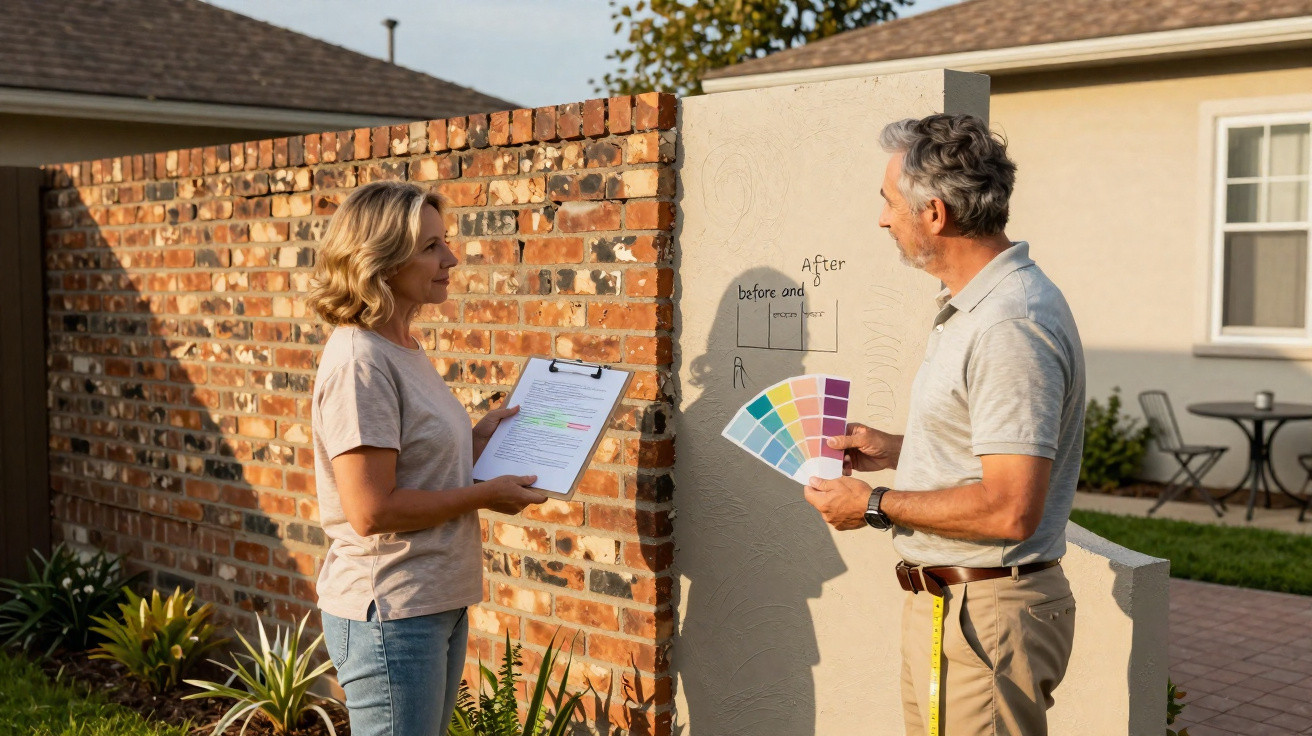
Anyone who owns a house with a garden will recognise the situation: as soon as a new wall goes up somewhere, tensions can start. This is especially true when the raw concrete surface faces directly into your living room or across your patio. The key question is whether a neighbour can simply refuse to render your side of the wall, or whether you can compel them to do so legally.
First question: do you share ownership of the wall, or does it belong solely to your neighbour?
Before contacting a solicitor or the local planning authority, take an objective look at the facts: who legally owns the boundary wall? Your rights and responsibilities depend entirely on the answer.
- Shared boundary structure (similar to “mitoyen”): Both property owners own the wall.
- Your neighbour’s private wall: The wall stands predominantly on their land and belongs exclusively to them.
In many legal systems, including Germany, a boundary wall is initially treated as a shared structure where it sits precisely on the boundary and separates both properties. However, there are exceptions that need careful consideration.
Indicators of who owns the wall
Certain visible features may provide an initial indication:
- If the wall runs exactly along the property boundary, potentially as shown on a survey plan, that strongly suggests joint ownership.
- Where the wall stands entirely on your neighbour’s land, set back from the boundary, it will normally be their private structure.
- Any provisions concerning walls and fences in Land Registry documents, the purchase contract or an old neighbour agreement take precedence.
Anyone who knows the ownership position of a wall also knows whether they have any right to be involved – or not.
Once matters become serious, it is worth checking the survey plan, Land Registry records and historic agreements. No one wants to rely on “I thought we both owned the wall” during legal proceedings.
Shared wall: can your neighbour shift the rendering obligation onto you?
Where both parties legally own the wall, they will generally share the cost of maintaining and repairing it. That includes cracks, structural stability and essential repairs.
What counts as joint maintenance – and what does not
Purely cosmetic improvements carry different legal weight from matters affecting safety or the fabric of the structure. Typical examples include:
- Necessary works: Structural stability, crack repairs and waterproofing are joint concerns.
- Aesthetic preferences: The fact that one side looks “ugly” will not normally create an obligation to share costs.
- Luxury upgrades: Elaborate cladding and costly designer renders are a private matter for whoever wants them.
This is the crucial point: an exposed concrete or stone finish may be irritating, but it is usually regarded as a visual issue rather than damage. A neighbour can therefore often say: “If you want it to look better, pay for it yourself.”
Can you simply render it yourself?
The position is more nuanced with a shared wall:
- Your side of the shared wall: Many legal systems allow you to finish your own side as you wish, provided nothing is damaged and no danger is created.
- No structural alterations: Drilling, openings, heavy attachments or recesses require the co-owner’s consent.
- Costs: Anyone arranging rendering for purely visual reasons will normally bear the full cost themselves.
Visual improvements are usually considered a private indulgence – if you want it to look better, you pay for it yourself.
So, if you wish to render your side of a shared boundary wall, you can often do so without consent as long as you do not cause your neighbour any harm. However, you will generally have no right to ask them to contribute to the cost.
Your neighbour’s private wall: do not touch it without permission
The legal position is clearer still when the wall plainly belongs only to your neighbour. They then have full control over its appearance, use and upkeep – on both sides.
What you must not do to someone else’s wall without permission
Even impeccable taste does not override property rights. Without your neighbour’s agreement, you will generally not be allowed to:
- apply render or paint to their wall;
- fix panels, timber cladding or trellises to it;
- drill holes or attach hooks;
- install advertising or lighting.
Even so, in everyday life people often decide to quickly paint the grey wall visible from their garden. That can prove costly. The owner may demand that the original condition is restored and may, in some circumstances, seek damages.
Anyone who alters someone else’s property without consent risks legal trouble – even if it objectively looks better.
If you no longer want to see the unattractive side of your neighbour’s wall, there are usually only two legally safe options: either your neighbour agrees, preferably in writing, or you install a separate screening solution on your own land.
When a neighbour can be required to improve a wall
You are not completely powerless, however. In certain circumstances, a neighbour may be obliged to keep their wall visually presentable. This is less about personal taste and more about significant interference.
Visual nuisance and “ugly” walls
If a wall stands close to the neighbouring property and its appearance causes substantial disturbance, two possible routes may arise:
- Neighbour law and nuisance provisions: Extremely neglected, weathered or crumbling walls may be classified as an unreasonable nuisance.
- Local building rules and design codes: In many municipalities, regulations specify the colours, materials or finishes of walls, particularly in historic town centres or protected areas.
Where the wall is close to your land and appears from your side as an unfinished, patchy structure, authorities may intervene in some cases. This may happen, for example, if local rules require a rendered or uniformly painted external finish.
A practical first step is to contact the local planning authority. It can clarify whether the local development plan or a design code sets requirements for the appearance of boundary enclosures. If such rules exist, your neighbour must comply with them too, regardless of who owns the wall.
When safety becomes an issue
Safety also matters alongside appearance. If render is falling away, stones are coming loose or part of the wall could collapse, the issue is no longer merely aesthetic. It becomes a genuine hazard.
In these circumstances, neighbours may ask the owner to put the wall into a safe condition. If they fail to respond, the relevant authority can intervene in serious cases and order protective measures.
The more a wall deteriorates, the sooner an “unsightly view” becomes a matter for the planning authority and liability law.
Practical ways to avoid a lasting dispute over the garden fence
Legally, the outcome is often straightforward: you will rarely have a right to require your neighbour to render “your” side of the wall. Nevertheless, there are ways to break the deadlock.
An agreement with your neighbour – preferably in writing
An honest conversation will often achieve more than any legal provision. Possible arrangements include:
- You cover the entire cost of rendering your side, while your neighbour gives express permission.
- You divide the costs if the wall needs refurbishment anyway at some point.
- Your neighbour instructs their building contractor, while you pay a share or provide the materials.
To prevent either party remembering matters differently later, put any agreement in writing. It should clearly state which work will be carried out, where it will be done, who pays and who is liable.
Your own solutions on your own land
If no agreement can be reached, alternatives remain that are entirely within your own property:
- freestanding privacy screening, such as timber panels, gabions or planters;
- hedges or climbing plants on your own trellises;
- visual distraction through planting and landscaping in front of the wall.
If you choose climbing plants, ensure that they do not grow directly onto your neighbour’s wall and potentially damage it. A separate trellis with a small gap provides an elegant solution.
Background: why disputes over walls are becoming more common
Denser development, smaller plots and stricter requirements all mean that neighbours are building walls closer together and higher than before. At the same time, expectations of appearance and outdoor living quality are increasing.
In addition, many new builds initially use simple exposed concrete or calcium silicate brick walls to save money. The treatment of rear-facing surfaces is then easily overlooked – until a neighbour realises months later that they are looking at a grey expanse every day.
Anyone planning a new wall themselves can avoid later conflict by settling, during the construction stage, how both sides will look and who will pay for which work. A straightforward written agreement between the property owners costs nothing and can prevent years of discussion.






Comments
No comments yet. Be the first to comment!
Leave a Comment