
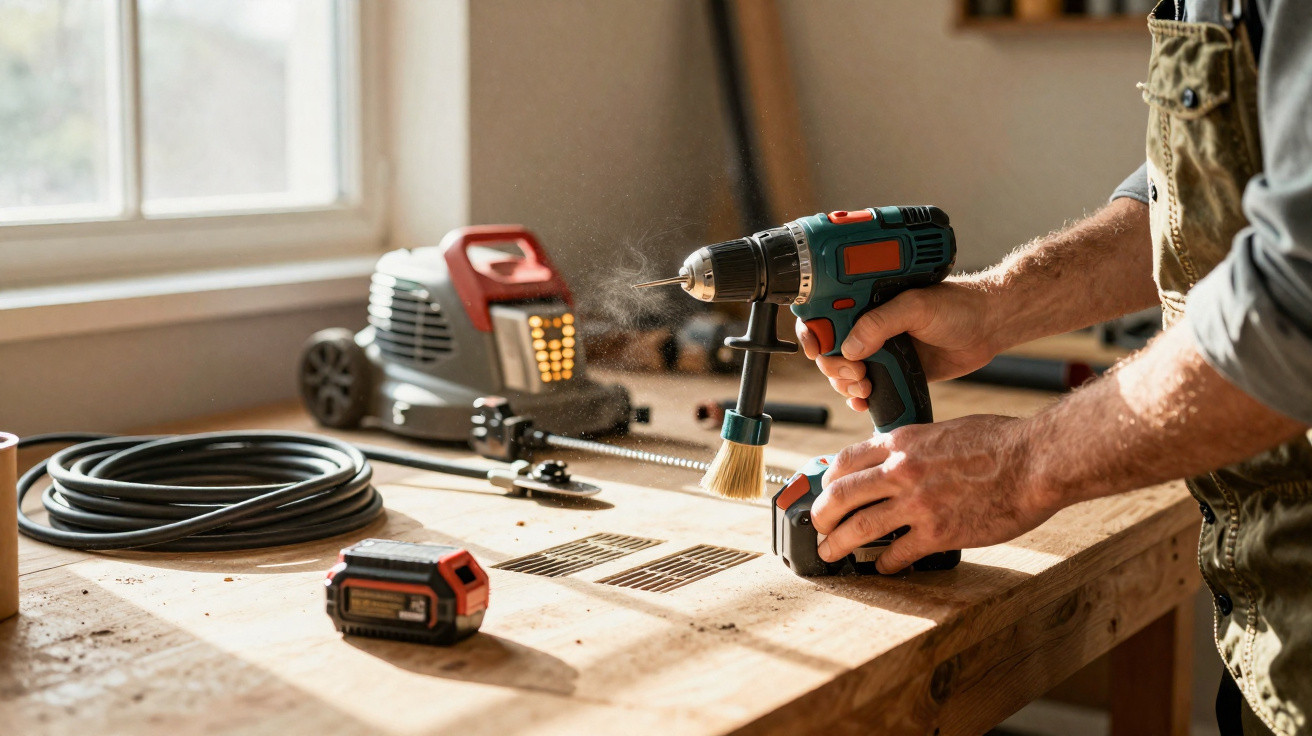
Drills, lawnmowers, hedge trimmers… In Switzerland, a simple maintenance oversight often sends them to the tip far too soon, although one basic action can make all the difference.
Drawing on advice from tradespeople and specialists interviewed by a Swiss media outlet, this article highlights a shared weakness affecting many corded and battery-powered tools that end up being discarded prematurely. A quick, virtually cost-free maintenance task can significantly extend their working life, with clear financial and environmental benefits.
A worrying trend: tools thrown away far too early
According to the professionals quoted by the Swiss outlet, many households replace their DIY or garden tools every two or three years. Drills, screwdrivers, sanders, lawnmowers and blowers are frequently swapped for new models as soon as they appear to lose power or start overheating.
For the repairers interviewed, this replacement cycle cannot be attributed solely to worn internal parts or planned obsolescence. It also stems from a widespread lack of maintenance, despite these machines being designed to last much longer.
“Most of these tools could work ten times longer if their owners adopted a simple, regular maintenance habit,” the Swiss professionals insist.
Faced with this waste, repair specialists describe machines that are sometimes still mechanically sound but are sent for disposal because of avoidable build-up or one neglected component.
The essential maintenance step: clean the tool and let it breathe
The central issue comes down to one specific factor: an electric tool’s ability to “breathe” properly. Motors and batteries need to release heat and clear dust in order to operate without overheating. In everyday use, however, this often does not happen.
Ventilation grilles that are too often overlooked
Swiss specialists point out that almost all portable power tools have ventilation grilles and small cooling openings. Yet these areas quickly become blocked by:
- wood dust from drills and sanders;
- grass and leaf debris from lawnmowers and hedge trimmers;
- fine dust from workshop vacuum cleaners;
- shavings, splashes and dried grease around motors.
The repairers cited by the outlet explain that this build-up causes the motor and electronic components to heat up. The tool may then lose power, give off a hot smell or even shut down.
“The decisive step is to clean all ventilation grilles, slots and openings regularly, allowing the motor to stay cool.”
How to carry out this task at home
The Swiss professionals recommend straightforward maintenance that requires no technical expertise:
- Always unplug the tool or remove its battery.
- Locate every air outlet, grille and ventilation slot.
- Blow away dust using a can of compressed air or a compressor set to a moderate pressure.
- If this is not possible, gently brush the area with a soft brush and wipe it with a dry cloth.
- Repeat the process after particularly messy jobs, or at least after every few uses.
This cleaning applies both to the outside of the machine and, where access allows, to areas around the motor or internal fan. Some appliances even have removable covers specifically designed for periodic cleaning.
Batteries, blades and gears: other vulnerable areas that are often ignored
Ventilation is not the only consideration. The experts interviewed in Switzerland also identify several other factors that determine how long a tool will last.
The battery: the key component in cordless tools
Battery-powered tools have become commonplace in homes. According to Swiss professionals, a substantial share of apparent breakdowns is caused by poorly treated batteries rather than by the tool itself.
They highlight several simple rules:
- avoid leaving a battery completely flat for months at a time;
- do not store a battery-powered tool in a very damp place or in freezing conditions;
- recharge the battery when it begins to run low, rather than repeatedly waiting until it stops completely;
- clean metal contacts with a dry cloth to maintain a reliable connection.
A tool that appears to be “dead” can sometimes start working perfectly again with a battery in good condition, the repairers consulted by the Swiss outlet note.
Sharp blades protect the motor
The same observation applies to garden machinery: a blunt blade puts the entire system under strain. A lawnmower that cuts poorly has to work harder, runs hotter and uses more energy. Hedge trimmers with worn blades vibrate, jam and place excessive demand on the motor.
“Regular blade sharpening reduces mechanical strain, limits heat and therefore extends the life of the entire tool.”
Swiss professionals advise having blades sharpened by a specialist or, for models designed for it, using the kits supplied by the manufacturer while following the safety instructions.
Why this simple maintenance makes a difference to both budgets and the environment
For the experts interviewed by the Swiss outlet, the issue goes beyond the lifespan of a single tool. It affects household spending as well as waste management.
| Without maintenance | With regular maintenance |
|---|---|
| Tool replaced every 2 to 3 years | Tool kept for many years |
| Repeated cost of buying a new appliance | Fewer purchases and better-controlled spending |
| Frequent electronic and plastic waste | Less waste and a reduced environmental impact |
| Risk of overheating and sudden failure | More stable and safer operation |
Swiss repairers mention cases of tools abandoned at the tip when the only problem was a clogged cooling system. Thorough cleaning would have allowed them to return to use.
What does this mean for DIY and garden tools in France?
In France, repair professionals largely reach the same conclusion as their Swiss counterparts. Repair workshops, as well as reuse and recycling networks, regularly receive tools that appear to be “beyond repair” but can be given a second life after thorough maintenance.
The advice remains the same for readers in France:
- check that ventilation grilles are in good condition and keep them free from dust;
- protect batteries by storing them somewhere dry and away from extreme temperatures;
- have blades and chains sharpened on lawnmowers, hedge trimmers and chainsaws;
- prevent protective housings from becoming blocked with dried grass or sawdust.
People in France can also make use of the repair sector supported by the state. Independent repairers, DIY retailers and community workshops offer diagnostics, sometimes at reduced prices, to help extend the lifespan of equipment. Some manufacturers also highlight the availability of spare parts for several years, making straightforward repairs easier.
Everyday habits for making tool maintenance routine
To turn this maintenance task into a habit, professionals recommend making it part of the normal process of putting tools away. At the end of every DIY session or gardening task:
- switch off the appliance and remove the plug or battery;
- clear away any visible build-up of dust, grass or shavings;
- inspect the ventilation slots and remove any obstruction;
- quickly wipe down the tool before storing it away from damp.
A quick visual inspection can also reveal a slightly damaged cable, a cracked casing or a sticky button. Dealing with these minor faults before they worsen can often prevent a permanent breakdown.
A practical benefit for safety and comfort
Lastly, Swiss specialists stress that this maintenance habit also improves safety. A tool that becomes too hot may create a risk of burns, smoke or even a short circuit. A poorly ventilated appliance can stop unexpectedly during delicate work, increasing the risk of a sudden incorrect movement.
A properly cooled motor delivers steadier power, lower vibration and slightly better-controlled noise. Well-sharpened blades make clean cuts rather than tearing material, reducing jolts through the arms and causing less fatigue for the user.
For households in France and for the Swiss households cited by the outlet alike, this simple maintenance reflex therefore brings several benefits: tools that last much longer, reduced spending, less waste and safer use. All it takes is a few minutes of regular cleaning, often using equipment already available in the garage or workshop.





Comments
No comments yet. Be the first to comment!
Leave a Comment