
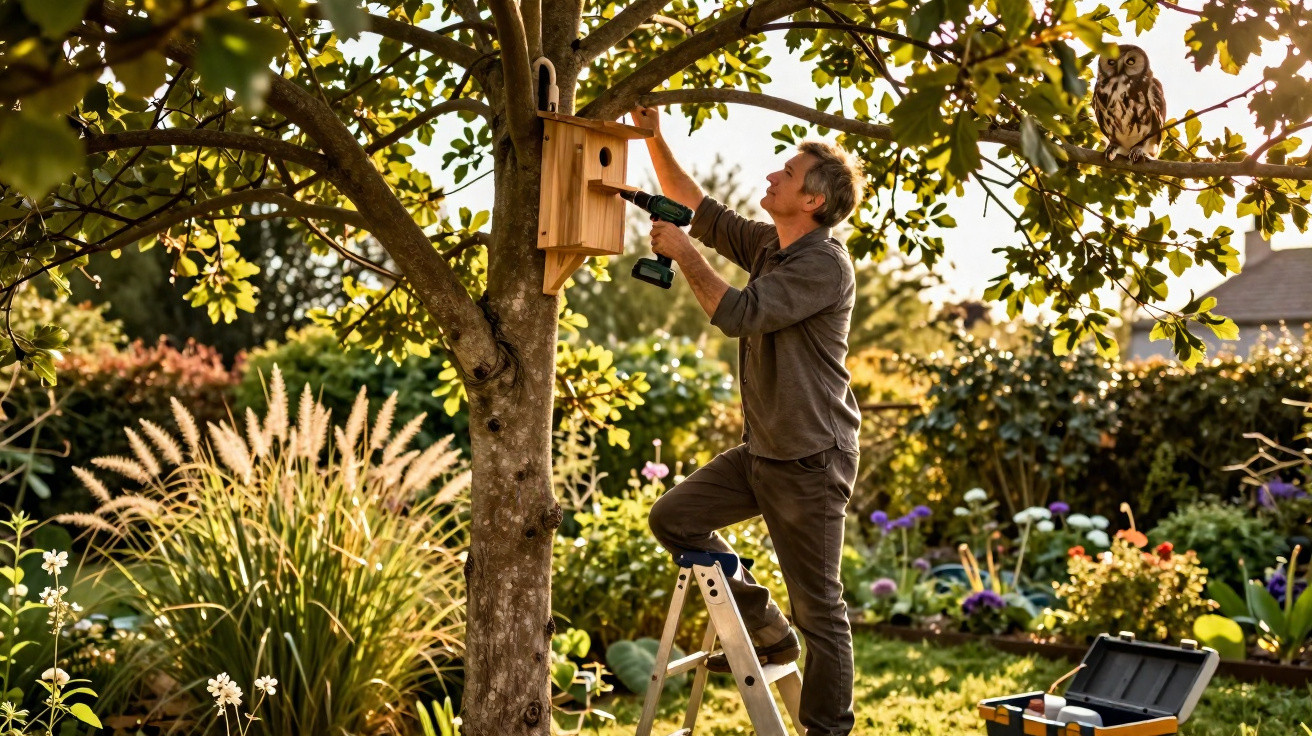
Owls were once considered an ordinary part of the landscape. Yet old barns are disappearing, tree hollows are becoming scarce and these nocturnal birds are increasingly under pressure. Anyone with a balcony, courtyard or garden can make a real difference – one that goes far beyond simply feeling good and can protect several generations of these animals with little effort.
Why owls need our help more urgently than many people realise
Owls appear hardy: around 20 centimetres tall, covered in dense down, with alert eyes and perfectly adapted to the dark. But their greatest vulnerability is, of all things, the place where everything starts: the nesting site.
In the past, owls had plenty of places to hide, including decaying trees, barns, stables and church towers. Those structures are now vanishing. Old trees are felled, buildings renovated and openings sealed up. To these birds, a ‘tidied’ landscape can look empty and inhospitable.
Owls are still among the common bird species in many parts of Europe – but safe nesting places are becoming ever harder to find.
The breeding season in late March and April is also an exceptionally sensitive period. At this time, the familiar “hoo-hoo” calls of males can often be heard after dark, accompanied by the higher-pitched calls of females. Pairs come together and, only a few days later, one question becomes crucial: where will we lay our eggs?
Owls in Europe: more common than expected, yet still at risk
Many people assume that owls are rare and exotic. That is not entirely true. Tens of thousands of breeding pairs live in central European countries, particularly in rural and more secluded areas. Anyone paying attention at night may often hear them, and might even occasionally spot one in a car’s headlights.
The term “owl” is really a collective name. It covers more than 250 species worldwide. European species include:
- Tawny Owl – probably the most widespread species in woodland and parks
- Eurasian Pygmy Owl and Boreal Owl – small species that favour tree hollows
- Eurasian Eagle-Owl – the huge, striking species with distinctive ear tufts
- Long-eared Owl and Short-eared Owl – slender species often found in open landscapes
Despite this diversity, many populations face the same challenges: too few nesting sites, collisions with cars and fewer small mammals in intensively cleared fields. This is precisely why one small feature in your own garden can suddenly become so important.
The garden game-changer: a simple owl nest box
What owls truly need now is not a bird feeder, special lighting or an expensive high-tech gadget. Above all, they need a secure box in which to breed.
A sturdy nest box can replace the lost tree hollows and openings in barns. Put up in late winter or early spring, it may be used by several generations over many years.
A single well-positioned nest box can support an entire owl pair and its young for many years.
A typical clutch contains three to four eggs, and incubation lasts just under a month. During this time, the mother is completely dependent on a sheltered, dry and peaceful place. Without one, the whole breeding attempt often fails.
What a suitable owl nest box looks like
The ideal box depends on the species concerned. For smaller owls in gardens and villages, however, it is possible to build a model suitable for several species. A few key features matter:
| Component | Recommendation |
|---|---|
| Material | Untreated, thick timber (at least 18–20 mm) |
| Entrance | Relatively small, round or oval, and only as large as necessary |
| Interior | Rough surfaces or battens to allow young birds to climb |
| Roof | A generous overhang to prevent rain getting inside |
| Bedding | A layer of straw or wood shavings for cushioning |
The entrance must never be too large. Otherwise, martens, cats or crows can get in and empty the nest. A smaller opening provides a good balance between access for the owl and protection from predators.
Positioning an owl nest box correctly in the garden
Even the best box is of little use if it is placed in the wrong location. A few basic rules help prevent mistakes:
- Position it at least three to four metres high, preferably higher
- Choose a quiet spot with as little artificial light as possible
- Provide a slight roof overhang or leafy canopy to protect it from rain and heat
- Secure it firmly so that the box cannot sway in the wind
- Avoid direct access for cats or martens via branches or fences
If you do not have a large tree, a box can also be fitted to a barn wall or house façade, provided there is little activity there at night.
Build or buy an owl nest box – both options work
People with practical skills can make their own owl boxes. With a straightforward plan, a few boards and a saw, the box can be finished in an afternoon. Many conservation organisations provide building instructions.
Those who are less confident can choose a ready-made model instead. These are available from specialist retailers, well-stocked DIY shops and online suppliers. It should look robust: thick timber, sturdy screws and no thin plywood that will swell after two winters.
More important than perfection is creating a safe breeding place at all – every additional nesting aid matters.
What else garden owners can do for owls
A nest box has the greatest impact, but it is not the only measure. Anyone wishing to support owls over the long term can make their property a little more ‘owl-friendly’.
More prey, less disturbance
Owls mainly hunt mice and other small mammals. Where everything is closely mown, paved or covered with gravel, there is little food available. The following measures can help:
- Leave tall grassy strips or unmown corners in the garden
- Create piles of wood and stones as shelter for small mammals
- Avoid poison bait for mice
- Reduce permanent outdoor lighting
Avoiding poison is particularly important. Owls eat poisoned mice and often die painfully, without anyone recognising the cause.
Common questions – and what you should avoid
People who notice an owl in their garden for the first time are often unsure what to do. A few rules of thumb can help avoid common mistakes.
- Do not feed them: Owls are highly effective hunters. Feeding stations only put them at risk and attract rats.
- Do not open nests: Looking inside the box disturbs breeding birds and may cause them to abandon the nest.
- Do not rush to ‘rescue’ young birds: Young owls often appear helpless on the ground, but their parents usually continue to care for them.
Only contact a wild bird rescue centre if a young bird is clearly injured or in immediate danger, such as on a road or with a cat close by.
Why now is the best time to act
Taking action in late winter or early spring means choosing exactly the right moment. During this period, the birds are actively looking for new breeding sites. Even if the box remains empty in its first year, patience is worthwhile. Many owls investigate potential cavities for months before moving in.
It is remarkable how quickly this small measure can affect everyday life: suddenly, calls are heard again at night; shadowy wings appear in the half-light; and an occasional pellet may be found beneath the box. At the same time, the birds keep mouse numbers under control – a natural ‘pest-control service’ without chemicals.
So, anyone with a tree, a quiet house wall or a barn to spare can become a host this season. A sturdy nest box, some straw and a few screws are almost all it takes to help an owl family safely through the breeding season.



Comments
No comments yet. Be the first to comment!
Leave a Comment