
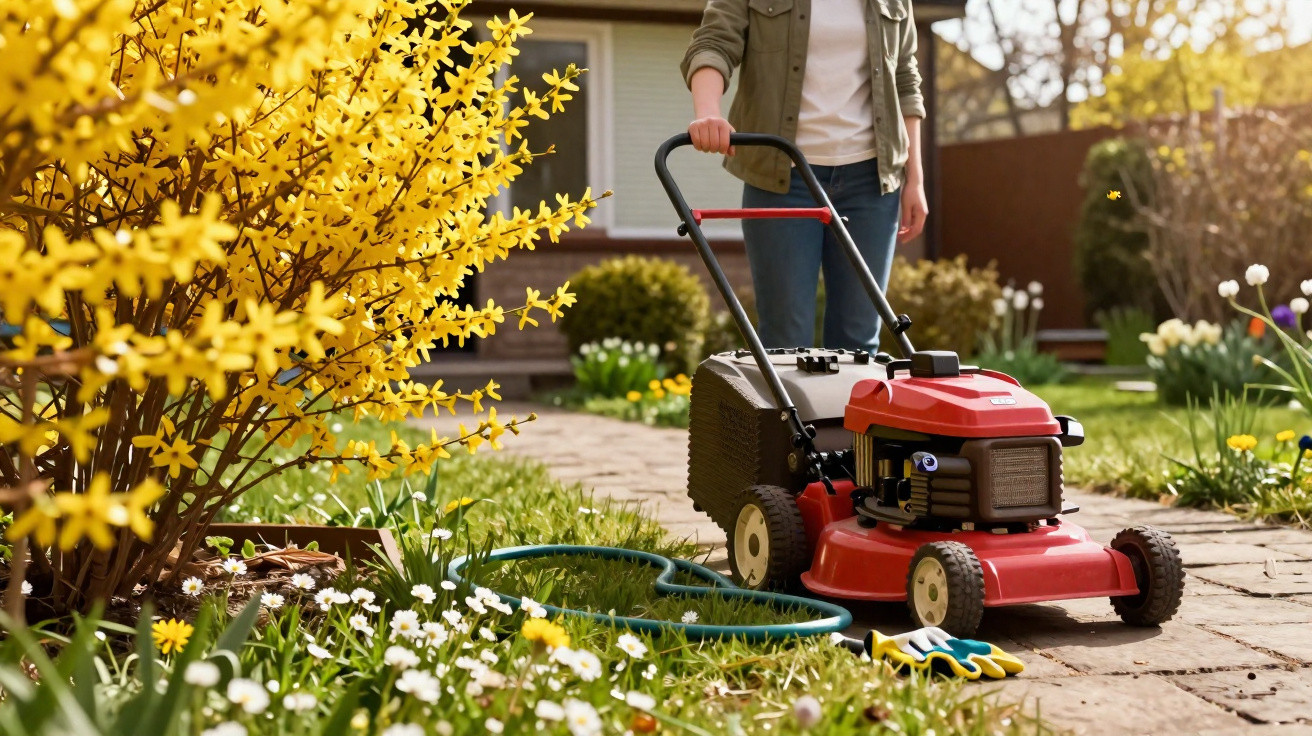
Spring is itching at your fingertips and the lawnmower is ready to go – but mowing the lawn too hastily now can weaken it for the entire season.
Many amateur gardeners begin the gardening year enthusiastically and reach for the lawnmower far too early. The familiar result is dull, patchy grass, moss rather than turf, and a garden that already looks tired by June. An inconspicuous yellow flower in the garden provides a surprisingly dependable indication of when the time is right.
Why the timing of the first lawn cut matters so much
After winter, the lawn’s most important work happens out of sight. The blades may still look grey and flattened, but beneath the surface the roots are rebuilding their reserves. These stores of energy later determine the lawn’s density, colour and resilience.
Mowing too early forces the lawn to direct its energy into producing new leaves above ground. Its roots consequently remain weak. The consequences appear in summer, when the lawn becomes more vulnerable to drought, disease and foot traffic.
The first spring cut often determines whether a lawn looks richly green in summer or patchy and dried out.
This is why lawn specialists use temperature rather than the calendar as their guide. Useful general indicators include:
- Several consecutive nights with temperatures above roughly 4°C
- Clearly noticeable blade growth once soil temperatures reach about 6°C
Below these temperatures, the lawn remains almost dormant. Mowing at that point uses time and electricity or petrol without delivering any real benefit – and can often cause damage. Waiting a few extra days pays off considerably.
The yellow flower as a natural starting signal: what the shrub tells you
Many experienced gardeners follow a straightforward sign from nature: a shrub with vivid yellow flowers that often blooms before its leaves emerge. Once its branches are glowing with colour, nature is signalling that plant growth is accelerating and spring has truly arrived.
This yellow bloom acts as a biological calendar. When it is in full flower, there is a strong chance that:
- nights are largely frost-free,
- the soil has dried out and is no longer soaking wet,
- the lawn is visibly greener and growing again.
In many areas, this period is the ideal time for the first cut, provided the weather cooperates.
Checklist: how to tell whether the first cut is really due
Rather than relying on a date in the calendar alone, use a few simple checks in the garden:
- The yellow-flowering shrub in your own or a neighbour’s garden is in full bloom.
- The forecast shows no overnight frosts for the coming days.
- The grass is dry, while the soil is neither muddy nor slippery.
- The blades feel soft, are turning a rich green and are visibly growing.
By waiting for these signs, you give the lawn time to strengthen its roots and can begin the mowing season much more confidently.
How to make the first spring lawn cut without shocking the grass
Once the right moment has arrived, it is not only the timing that matters but also the method. Many mistakes occur during this first cut of the year.
Preparation: clear the lawn and loosen moss
Before mowing, it is worth carrying out a brief inspection:
- Use a light rake to remove leaves, small branches and dead plant debris.
- Gently scratch at loose patches of moss so that air can reach the soil.
- Collect any forgotten toys, stones or pieces of wood, as these can blunt the blade.
This small amount of preparation ensures the blades cut cleanly instead of tearing the grass.
Set the height: never remove more than one third
For the year’s first cut, always set the lawnmower to a high cutting position. The rule of thumb is never to remove more than one third of the blade length.
Cutting too low the first time stresses the lawn, weakens its roots and encourages moss – the exact opposite of the dense green lawn you want.
Practical guidance for getting started:
- Set the cutting height to around 5–6 centimetres initially.
- Only gradually reduce it to 4 centimetres over the following cuts.
- On very sunny, dry areas, keep the grass slightly longer during summer.
The mower blades should be sharp. Blunt blades tear the grass and leave ragged tips that turn brownish.
Why you should not mow every corner closely
Many gardens resemble football pitches: short, neat and uniform. Relaxing that approach slightly benefits both you and nature.
An increasingly popular method is to mow only paths and seating areas regularly, while cutting other sections less frequently or allowing them to grow entirely. This creates small flower islands in the lawn where wild herbs and flowering plants can thrive.
More flowers, more life: what a lawn can do for insects
Early flowers are vital for bees, bumblebees and other pollinators, particularly in spring. Many common “weeds” provide much-needed nectar at this time:
- Dandelions
- Daisies
- Clover
- Small blue and violet wildflowers among the grass
Gardening associations and conservation organisations increasingly advise against digging up every dandelion immediately. Some can be left in place, especially around edges or in less-used areas. Studies show that insect species are declining significantly worldwide. A lively lawn that is not kept completely short acts like a small emergency buffet in residential areas.
Leaving narrow strips or corners of the garden to grow taller creates valuable habitat for pollinators with minimal effort.
Practical ideas for an everyday “wild” lawn
There is no need to turn the entire garden into a meadow. Even modest changes can have noticeable visual and ecological benefits.
- Create mown paths: Keep only well-trodden routes and areas around the patio, sandpit or vegetable garden short.
- Leave flowering islands: Mow corners around trees, behind the shed or along the fence less often.
- Make buffer zones: Allow a wider, taller strip to grow at the edge of hedges or flower beds.
- Have a mowing-free period: Leave selected areas completely unmown for one or two months each year and watch how they develop.
Many garden owners report seeing more butterflies, bumblebees and solitary bees with this approach. Maintenance can even become easier, as less of the overall area needs mowing regularly.
Common spring-start mistakes and how to avoid them
Finally, here are some typical pitfalls to watch out for:
- Mowing on wet ground: The mower can slip, the turf becomes compacted and wheel ruts remain.
- Cutting extremely short at the outset: This encourages moss, weakens the roots and makes the lawn more susceptible.
- Mowing several times a week during the first few weeks: Start moderately instead, allowing the lawn time to recover between cuts.
- Mowing over bulb plants: Avoid areas containing daffodils, crocuses or tulips until the foliage has died back.
If you pay attention to nature’s signals, use the yellow bloom as your cue to begin and allow the lawn a little freedom around its edges, you will usually have dense, resilient grass in summer – along with far more life in the garden. The first spring lawn cut then becomes more than a maintenance task: it is the real starting point for the entire gardening season.




Comments
No comments yet. Be the first to comment!
Leave a Comment