
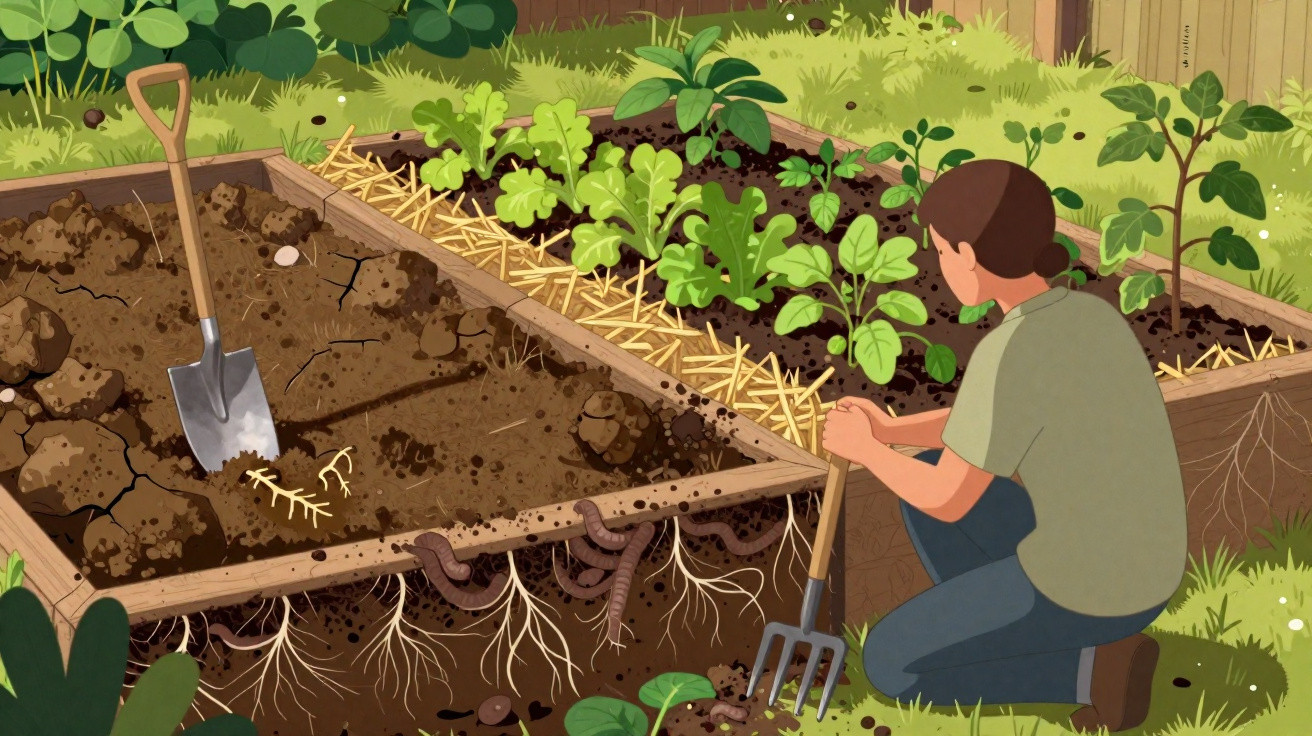
Many people picture a “proper” vegetable garden as a neatly dug plot of brown, completely bare soil. Anyone who does not turn over their beds through the sweat of their brow can almost be seen as lazy. Yet this very routine – deep digging, breaking up the soil and levelling it – is increasingly proving to be one of the most damaging habits in the home garden.
Why the idea of a “tidy” vegetable bed persists
For generations, people have absorbed the message that a productive vegetable garden requires hard physical labour. An aching back is almost treated as a badge of quality. As soon as the ground thaws slightly in spring, many gardeners reach for a spade, firmly convinced that soil needs human help to “breathe”.
At its heart, this belief comes from industrial farming. Machines plough vast areas of monoculture to prepare seedbeds and control weeds. Those techniques were then adopted unquestioningly in home gardens, despite the fundamentally different conditions: a few square metres rather than hectares, mixed planting rather than monocultures, and hand tools rather than tractors.
There is also the ideal of the “well-kept” garden. A bare, crumbly surface without a blade of grass appears orderly, controlled and almost sterile. In nature, however, entirely exposed soil is a warning sign, such as after landslides, flooding or forest fires. Living soil is nearly always covered by plants, leaves, dead plant matter or roots.
What looks “clean” to the eye is often an ecological emergency for the soil.
What happens below ground when you dig
When you dig, you may initially see only soil. Beneath your feet, though, lies a highly complex ecosystem of animals, fungi and bacteria that functions like a living organism. Every deep thrust of a spade acts like an earthquake within it.
Earthworms: the displaced construction workers
Earthworms create tunnels, loosen the soil, incorporate organic matter and provide excellent natural drainage. Some species bore vertical shafts downwards, allowing air and water to move efficiently into deeper layers.
Digging destroys these passages, brings the animals to the surface and exposes them to light and predators. Many die and the population declines. The result is less natural drainage, more waterlogging and greater compaction.
The invisible fungal network is cut apart
Another frequently overlooked casualty is the underground fungal network, known as mycelium. Its extremely fine threads link plant roots together and serve as a transport system for nutrients, water and chemical signals.
Each thrust of the spade severs this network. Plants must then labour to create new connections instead of directing their energy into flowers, fruit and roots. Over time, this weakens the entire system, even if the effects are not immediately visible at the surface.
Why digging can paradoxically make soil as hard as concrete
Many gardeners recognise this pattern: after digging, the soil initially seems as loose as coarse sand. Following a few heavy spring downpours, however, it develops a hard grey crust that a hoe can barely penetrate. Specialists call this “soil crusting”.
Healthy soil is made up of stable crumbs, known as aggregates. Clay, humus and bonding substances produced by soil organisms hold them together. These crumbs create air spaces and places where water can be stored.
When soil is aggressively broken down, these crumbs are smashed into dust. Rain washes the fine particles into the pores, everything sticks together and, as it dries, a hard layer forms. Rainwater then runs off rather than soaking in. Roots have to force their way through an almost cement-like barrier.
The more often you hoe the soil “loose”, the more vulnerable it later becomes to compaction and waterlogging.
Digging attracts weeds – quite literally
Weeds can feel like a curse, and many people spend their weekends pulling them from vegetable beds. The striking thing is that deep cultivation actively accelerates the growth of exactly these plants.
Below the surface lies a huge “seed bank”: millions of tiny seeds from thistles, bindweed, chickweed and others, which can remain dormant there for years. As long as they stay in darkness, very little happens.
Digging brings these seeds up to the surface. Light, oxygen and changing temperatures provide their starting signal. They germinate in large numbers while the vegetable crop itself is still only making a delicate start. Leaving the soil undisturbed and covering it instead prevents this germination trigger.
- Intensive digging = many fresh weed seeds at the surface
- Undisturbed, covered soil = seeds remain deep and inactive
- Result: the more you dig, the more weeding you will need to do
When soil becomes addicted to nutrients
One common argument for digging is: “It gets nutrients moving.” That is true – but only in the short term, and it comes at a later cost. The large increase in air causes the activity of certain bacteria to rise sharply. They break down organic material extremely quickly.
This does provide a rapid fertiliser boost: nitrogen, phosphorus and other nutrients are suddenly released. Plants grow vigorously and everything looks successful. At the same time, however, you are burning through your humus reserves. The soil’s storage material disappears like wood in an oven fired too fiercely.
Once humus has been heavily depleted, the soil becomes increasingly poor at retaining both water and nutrients. Watering achieves little, while fertiliser applications have to be repeated continually. The garden enters a kind of dependency: without regular feeding from outside, nothing works any more.
Rather than becoming fertile in the long term, soil that is dug too frequently slips into fertiliser addiction.
Gentle alternatives: loosening soil without turning it over
The good news is that planning your planting does not mean giving up; it means changing strategy. The aim is to aerate the soil without mixing up its layers or destroying the organisms that live in it.
Grelinette and similar tools: loosening without turning
Instead of a traditional spade, use a digging fork or a Grelinette, also known as a broadfork. Push it vertically into the ground, then tilt it back slightly. The soil opens up at depth but largely stays in its original place. There is no turning and no “churning”.
This introduces more air into the soil, allows roots to penetrate more easily and helps rainwater drain away faster – while earthworm tunnels and fungal networks remain largely intact.
Plants and mulch as natural soil workers
An even more elegant approach is to let nature do the work. Rather than leaving beds bare over winter, it is worthwhile maintaining permanent cover:
- leaves, straw or grass clippings as a mulch layer
- woodchip or coarse prunings
- unbleached cardboard as a weed-suppressing base, topped with organic material
Earthworms pull this material down, incorporate it and loosen the soil through their tunnels more effectively than any machine. At the same time, the surface is protected from heavy rainfall, and crusting almost disappears completely.
Green manure plants, such as phacelia, mustard or rye, offer another option. Their roots break through compacted layers, spread through the subsoil and leave behind a fine system of channels after they die back – along with an inbuilt nutrient supply.
How a “lazy” gardener harvests more over time
Anyone who leaves the spade in the shed may initially look unambitious to their neighbours. In reality, the work simply shifts: less digging, more observation and planning. Many people who move to “No-Dig” or soil-friendly growing report noticeable effects after one or two years:
- The soil can be loosened by hand, even after wet spells.
- Weed pressure falls because fewer seeds reach the surface.
- Plants appear sturdier, more resistant to disease and require watering less often.
- Your back benefits, as the truly strenuous digging sessions disappear.
A little patience is important. Depleted soil that has been dug repeatedly needs time to recover its structure and living community. Those who mulch consistently, use green manures and loosen only gently for one or two years will notice the soil gradually beginning to “breathe” again.
Useful terms explained briefly
Humus: Dark, stable organic material in soil. It holds water and nutrients like a sponge and is vital for soil structure and fertility.
Mycelium: The fine network of fungal threads in the soil. It connects roots, transports nutrients and allows a form of communication between plants.
Green manure: Special plants grown not for harvesting but solely to improve soil. When they die back, they remain in the bed as a source of nutrients and structure.
A practical example for starting a soil-friendly garden
Anyone wanting to change their habits can begin with a trial bed. A straightforward method is:
- Remove only large weeds from the existing surface; do not hoe deeply.
- Loosen selected areas with a digging fork, without turning the soil.
- Apply a layer of compost or well-rotted manure 5–10 centimetres thick.
- Add mulch material on top, such as leaves, straw or grass clippings.
- Plant into small planting holes, pushing the mulch to one side.
Even in the first summer, the benefits are usually clear: less watering, significantly fewer weeds and a noticeably looser soil structure. Anyone who maintains this approach for a few years may wonder why they ever spent hours battling with a spade.
Ultimately, much comes down to one simple question: do I want to work against my soil, or with it? Those who make the switch and choose gentle methods often harvest more, with less stress and a far healthier garden ecosystem.

Comments
No comments yet. Be the first to comment!
Leave a Comment