
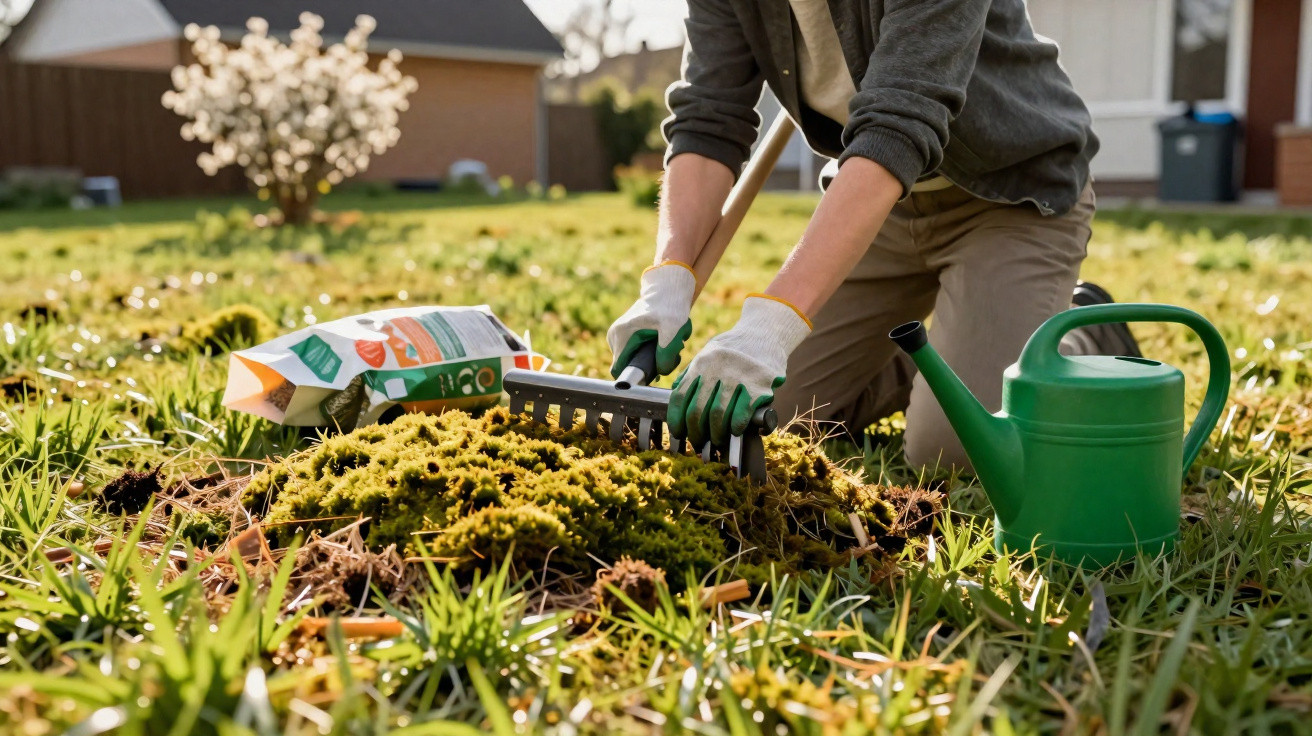
Many amateur gardeners instinctively reach for a popular yet disastrous quick fix.
After a wet, gloomy winter, your lawn can suddenly look unfamiliar: rather than lush green grass, dark cushions of moss spread across it, particularly beneath trees, along hedges and in shady corners. Social media is full of home remedies for this unwelcome growth – but one especially common suggestion causes more harm than good.
Why moss suddenly appears everywhere in the lawn in spring
The same scene plays out in countless gardens each year: as soon as the frost has gone, the winter’s legacy becomes clear. The grass is weakened and patchy, and moss ruthlessly exploits those bare areas.
Throughout winter, lawns receive little light and the soil stays damp for extended periods, often becoming compacted by standing water or frequent foot traffic. Grass largely stops growing, whereas moss thrives in exactly these conditions.
Moss is not evidence of “lazy maintenance”, but a warning sign: the location and soil do not match the ideal of a dense lawn.
Soil scientists and gardening experts have highlighted this for years: where the ground is as hard as concrete, waterlogging occurs or nutrients are scarce, lawn grasses struggle. Moss, on the other hand, favours such areas, especially in shade.
A small amount of moss in a lawn is not a major concern. However, when it forms entire carpets, there is almost always a combination of the following causes:
- insufficient light from dense trees, tall hedges or north-facing aspects
- permanently damp soil and waterlogging
- compacted ground caused by regular use or heavy machinery
- a lack of nutrients, particularly nitrogen
- infrequent or unsuitable maintenance, such as cutting too low or poor aeration
The major mistake: why washing-up liquid has no place on a lawn
Anyone searching for “lawn moss home remedy” will soon encounter advice to use diluted washing-up liquid. Add a few squirts to watering water, apply it to the mossy patch and the job is done. Supposedly, it will destroy the cushions of moss.
The idea is tempting: it is cheap, quick and already sitting in the kitchen cupboard. Yet it is simply unsuitable for use in the garden.
Washing-up liquid is intended for pots and pans – not living soil containing roots, earthworms and microorganisms.
The surfactants break down grease and alter surface tension – desirable in the kitchen, but problematic in soil. They can affect soil structure, while the sensitive roots of grasses may be irritated or damaged. In addition, soil life – including bacteria, fungi and tiny organisms – responds sensitively to foreign substances.
Landscape-management professionals have warned against this “trick” for years. Treating a lawn with washing-up liquid often only weakens the grass further. The moss may disappear briefly, but it returns all the sooner because the lawn is no longer competitive.
There is also an environmental issue. Anything applied to the lawn can be carried by rain into deeper soil layers or the drainage system. In larger quantities, surfactants from cleaning products are harmful to aquatic organisms.
The straightforward professional approach: mechanical rather than chemical
The good news is that most gardens do not need any “miracle products”, only a few traditional jobs. These are best done in early spring, once the ground has dried out and no further frost is expected.
First step: mow short and rake thoroughly
An ordinary lawn mower is sufficient to begin with. For the first cut of the year, the cutting height can be set slightly lower than during summer. This makes moss cushions and thatch easier to see.
The most important task follows immediately after mowing:
- rake the area in criss-cross directions using a sturdy leaf rake or scarifying rake
- thoroughly pull out moss cushions, old grass clippings and matted layers
- collect the removed material and dispose of it with garden waste or compost it separately
In many gardens, this step alone can remove more than half of the moss – without any specialist product.
Scarifying: when the lawn is heavily thatched
If the lawn is very mossy or heavily thatched, the next level is scarifying. A scarifier, whether hand-operated or powered, cuts a few millimetres into the turf. This loosens moss, thatch and old root debris, scratches open the soil and improves aeration.
Immediately after scarifying, the lawn often looks like a disaster – that is part of the process. After a few weeks, it is usually denser than before.
Using the right amount of force matters: one pass across and one pass lengthways is entirely enough. Scarifying too often or too deeply damages the lawn unnecessarily.
Without overseeding, you lose the full potential
Raking out or scarifying inevitably creates thin patches. It is at this point that either moss or grass gains the upper hand.
Professionals recommend scattering a specialist lawn seed mix over the treated surface. Choose a suitable mixture, sow it thinly, rake it in lightly and then keep it evenly moist. Using a spreader produces a more even result and prevents bare spots or dense clumps of seedlings.
Checking the label is worthwhile: there are dedicated mixes for shady locations that cope with lower light levels. Anyone expecting the same lawn beneath trees as on a sunny patio will usually be disappointed.
When moss persists: what treatments can actually do
In severely affected areas, many gardeners use moss treatments, most commonly those containing iron sulphate. The effect is obvious: within a few days, the moss turns black and can be raked out more easily.
However, this treatment does not solve the underlying issue either. Without improving and aerating the soil, as well as overseeding, the green cushions will return. Frequent use can also make the soil more acidic, which may actually encourage moss.
Other home-made remedies, including wood ash and bicarbonate of soda, are also widely suggested. Depending on the soil chemistry, they may have short-term effects, but they are difficult to dose and risk shifting the soil reaction too far. Anyone experimenting with them should proceed very carefully and first limit use to small test areas.
How to make a lawn less prone to moss over the long term
Rather than battling the same green patches every spring, it pays to consider the growing conditions. A few simple habits make life much harder for moss:
| Problem | Typical cause | Sensible measure |
|---|---|---|
| Lots of moss in shade | dense trees, high walls, north-facing position | Prune tree canopies, use a shade-tolerant seed mix and do not mow the lawn too short |
| Waterlogging | heavy soil, compaction, poor drainage | Improve the soil with sand or fine grit, or create beds rather than lawn in troublesome areas |
| Thin grass | nutrient deficiency, infrequent fertilising | Fertilise specifically in spring and early summer, ideally with a slow-release fertiliser |
| Hard ground | constant use, for example as a play area or parking space | Reduce use, aerate with an aerating fork or spiked shoes, and clearly define paths |
Anyone using their lawn as a “sports pitch”, delivery route, dog toilet and parking space all at once is unlikely to eliminate moss completely. In such cases, it may be more relaxing to deliberately redesign parts of the area, perhaps as a low-maintenance perennial bed or a herb meadow.
Practical tips from an amateur gardener’s everyday routine
Many experienced gardeners follow a simple annual routine: in spring, they scarify, overseed and, if necessary, fertilise moderately. In summer, they maintain the right cutting height; in autumn, they give the lawn a final cut that is not too low and may apply a potassium-rich fertiliser to improve winter hardiness.
One frequently underestimated factor is cutting height. Keeping a lawn extremely short during summer puts the grasses under stress. Longer blades shade the soil, keep it cooler and make it more difficult for moss and weeds to establish. For most ornamental lawns, a height of four to five centimetres is a good target.
How grass clippings are handled also matters. Mulching mowers can be useful where the lawn is maintained regularly and the clippings are very fine. Where cutting is infrequent or the grass is tall, it is better to collect them; otherwise, a thatch layer develops in which moss can thrive again.
Moss, lawns and climate: what hardly anyone discusses
One aspect is often overlooked: a perfect, unbroken carpet lawn is a demanding system. In many parts of Central Europe, long wet spells in winter and dry periods in summer are making it increasingly difficult to maintain this ideal without significant effort.
Moss responds sensitively to these changes and can simply indicate that a site would be better suited to another use. Those who permanently accept moss in particularly wet, shady corners while strengthening the rest of the lawn often have a more relaxed relationship with their garden.
What matters is not eliminating every cushion of moss, but understanding the causes – and adapting the garden to its conditions.
Taking this approach avoids risky home remedies such as washing-up liquid on the lawn. Instead, the emphasis shifts to sensible measures: loosen the soil, drain away water, choose suitable seed mixes, maintain the lawn regularly – and accept that a living garden is never entirely free of moss.




Comments
No comments yet. Be the first to comment!
Leave a Comment