
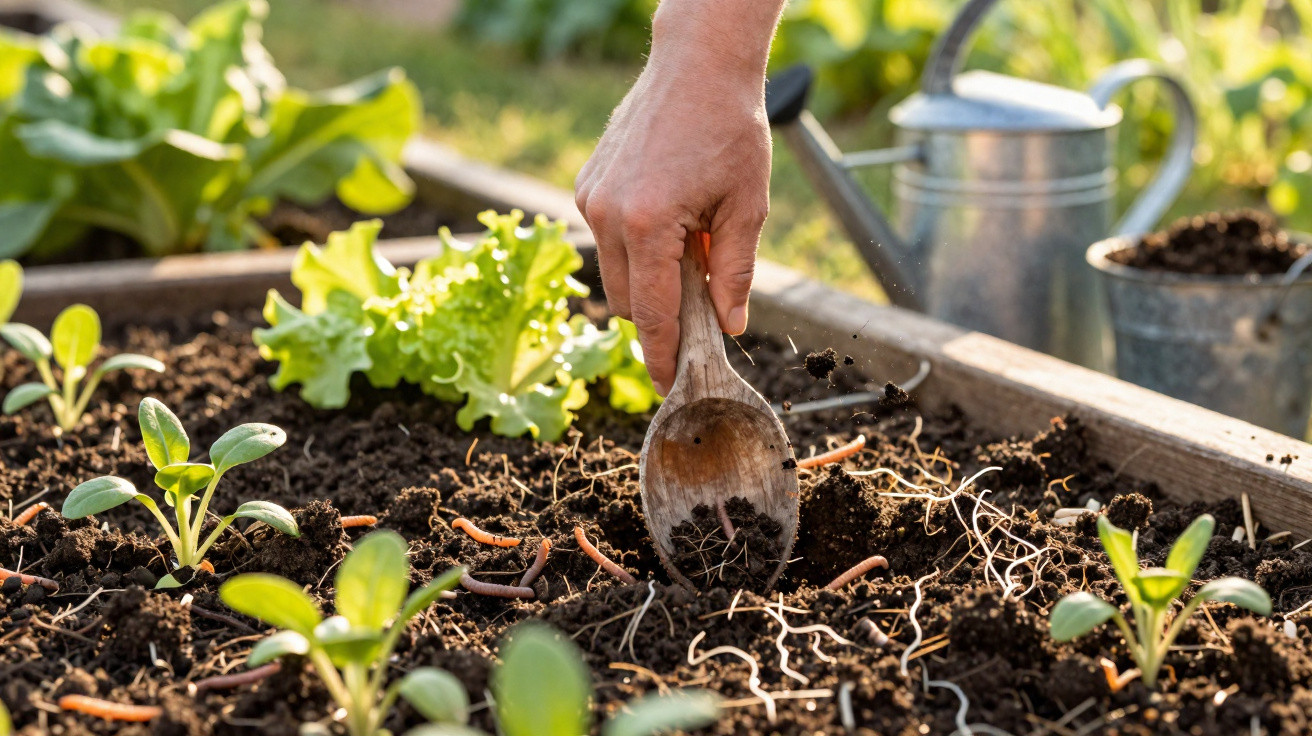
Among tomatoes, lettuce and courgettes, an inconspicuous tool is currently generating plenty of discussion on social media: the ordinary wooden spoon from the kitchen. Placed deliberately in the soil, it can provide surprisingly clear clues about how healthy the ground is – and whether plants are genuinely receiving the right amount of water.
Why a wooden spoon in the vegetable bed tells you more than expensive gadgets
The principle comes from soil biology. Wood is organic material that soil organisms are particularly keen to break down:
- Bacteria and fungi gradually decompose the wood.
- Earthworms and other creatures loosen the soil and move the remaining material onwards.
- This process produces nutrients that vegetable plants can absorb.
The wooden spoon test makes use of precisely this process. Bury an untreated spoon around 15 to 20 centimetres deep in a vegetable bed, then dig it up again after roughly a month. Its condition reveals how active life in the soil is.
“A nibbled, soft wooden spoon is a good sign: the soil is alive and working for the vegetables.”
If the spoon is visibly damaged, cracked, fibrous or even partly ‘eaten away’, this suggests vigorous soil activity. If, however, the wood looks almost new and remains hard and pale, there is often a lack of microorganisms – or the soil is too compacted, too dry or cultivated too frequently at depth.
Wooden spoon as a moisture indicator: too dry or too wet?
The method is not only a test of soil biology; it also works as a very simple moisture gauge. Push the wooden spoon only about 5 centimetres into the soil near the plants’ roots and leave it there for a week. It absorbs water much like a sponge.
When you pull it out, there are three common outcomes:
| Condition of the spoon | What is happening in the soil |
|---|---|
| Pale and dry | The soil is too dry or extremely free-draining, so water disappears quickly |
| Dark, damp and heavy | Soil moisture is very high; waterlogging is possible and roots may rot |
| Slightly damp, without mould | Moisture around the roots is even and broadly ideal |
Home gardeners watering with cans or hoses often underestimate how unevenly water is distributed through the soil. A wooden spoon that is bone-dry after only a few days makes one thing very clear: although the surface appears watered, drought still prevails in the root zone.
How to carry out the wooden spoon test step by step
For the method to give meaningful results, you need both the right spoon and a suitable position in the bed.
Choosing a suitable wooden spoon
- Use untreated wood only – no varnish, paint or protective treatment.
- Soft wood is best, as microorganisms can attack it more easily.
- Keep the spoon permanently for gardening and do not use it for food again.
Choose a spot that is representative of the area you want to assess. Putting the spoon beside a permanently wet puddle or at a dust-dry edge of the path will not provide a realistic picture of the actual vegetable bed.
Carrying out tests for soil life and moisture
In practice, the following routine has proved effective:
- For the soil test, dig a hole 15–20 centimetres deep.
- For moisture, insert the spoon only about 5 centimetres deep, close to the roots.
- Cover the spoon completely with soil.
- Mark the location so that you can find the spoon again.
- Wait 7 days for the moisture test and 30–60 days for the soil biology test.
- Carefully dig up the spoon and inspect its surface closely.
The result depends entirely on interpreting what you find. Fine cracks, swollen fibres and dark patches point to active decomposition. Smooth wood that appears almost untouched indicates weak soil life or unfavourable conditions.
What the wooden spoon’s condition reveals about your garden
Depending on the result, you can take specific action to improve the soil and make vegetables more resilient.
Spoon heavily decomposed: the soil is on the right track
When the spoon is clearly damaged, brittle and looks as though something has gnawed at it, there is usually plenty of activity underground. Many edible crops thrive in such a bed because organic material continually supplies them with nutrients.
Gardeners can maintain this positive development by:
- working mature compost lightly into the surface on a regular basis;
- covering the surface with leaves, grass clippings or straw;
- avoiding deep digging and using gentler loosening methods instead.
Living soil holds water more effectively and softens the effects of hot spells. Lettuce is less likely to wilt quickly, while tomatoes cope more easily with short dry periods.
Spoon almost untouched and dry: the soil is hungry and thirsty
If the wooden spoon is virtually unchanged at the end of the test period and feels dry, both moisture and soil life are often lacking. The soil may then feel hard, crumbly or even dusty, especially in the upper layers.
Useful corrective measures include:
- adjusting the watering routine, watering less often but more thoroughly;
- covering the soil with a mulch layer so moisture evaporates more slowly;
- adding organic matter, such as compost, well-rotted manure or green manure.
Over time, this also improves the structure: the soil becomes looser and more crumbly, and absorbs water better. Repeating the wooden spoon test the following year will then show whether the microorganisms have returned.
Spoon damp but barely decomposed: the soil is too wet and ‘suffocated’
There is another special case: the spoon feels wet and may be slightly mouldy, but has barely been attacked. This often points to compacted soil with poor aeration. Water remains in the pores for longer, leaving roots and microorganisms with too little oxygen.
Several measures can help here:
- Loosen the soil only shallowly, so that its structure is not smeared further.
- Incorporate organic material regularly to create pores and channels.
- If necessary, improve drainage, for example with gentle slopes or drainage channels.
Anyone gardening on heavy clay soil will know the issue well: after rain, water remains standing for a long time, while in summer the surface sets hard. The wooden spoon exposes this imbalance without mercy.
What the test can – and cannot – do
A wooden spoon does not replace a professional soil analysis, but it can offer a surprising amount of information without a laboratory, measuring device or app. A few factors can easily distort the observations:
- Very cold weather slows microorganisms down, so the spoon remains unchanged for longer.
- Periods of intense heat dry out the upper layers, even when water is still present deeper down.
- Sandy soils behave differently from heavy clay soils, particularly in terms of moisture.
Even so, combined with other observations – the colour of the earth, its crumb structure and the number of earthworms – it creates a fairly clear picture. Anyone who tests regularly can spot trends: is the soil becoming more alive year after year, or is it stagnating despite applications of compost?
Practical everyday tips for the vegetable bed
The appeal of this trick lies in its simplicity. Nearly every household has a wooden spoon, the method costs nothing and it makes many things easier to understand, particularly for beginners. A few practical examples show how the test can be used effectively:
- Check in spring before planting how well the soil has come through the winter.
- Test a new raised bed to see whether its contents are evenly moist.
- Look specifically for causes in an area with recurring problems, such as rotting tomatoes or stunted beans.
If you wish, mark several spoons and use them at the same time in sunny and shaded areas. Comparing their condition after a few weeks vividly demonstrates how strongly position, watering and soil type interact.
It also becomes interesting when different methods are compared: dig one bed over regularly, while only loosening and mulching the other at the surface. After a summer with identical planting, place the spoons from both areas side by side – and read the soil biology directly from them.
A wooden spoon in a vegetable bed may initially seem like an odd gardening fad. Yet anyone willing to try it receives practical, tangible clues about what is happening below the surface – and can tailor their care far more precisely as a result.

Comments
No comments yet. Be the first to comment!
Leave a Comment