
Whether it burns in summer or shines in all its glory is decided right now.
Every year, many gardeners notice the same pattern: their Japanese maple produces delicate new growth in spring, yet by high summer its leaves are scorched and dull. The reason is often neither its position nor its variety, but a straightforward job carried out at the base of the tree in March, using an entirely natural material.
Why Japanese maple needs protection right now
Japanese maples (Acer palmatum) are beautiful but sensitive trees. Their roots grow very close to the soil surface, where they are the first to encounter every extreme: late frosts in March, drying winds in April, and summer heat and sunshine.
When the soil around the trunk is left completely bare, the roots must cope directly with these sudden temperature changes. This puts the tree under strain, weakens it and uses up its energy. As a result, leaves may tear more easily, develop brown edges, or become dull and blotchy prematurely.
“A protected root zone allows the Japanese maple to direct its strength into vibrant foliage and balanced growth, rather than constant survival.”
March is when the plant begins sending sap upwards again. Buds start to swell and fresh shoots are preparing to emerge. At the same time, the ground may still be icy cold, with overnight ground frosts still possible. This combination of cold soil and renewed activity is delicate, which is where natural protection becomes important.
The simple natural solution: a protective layer around the trunk
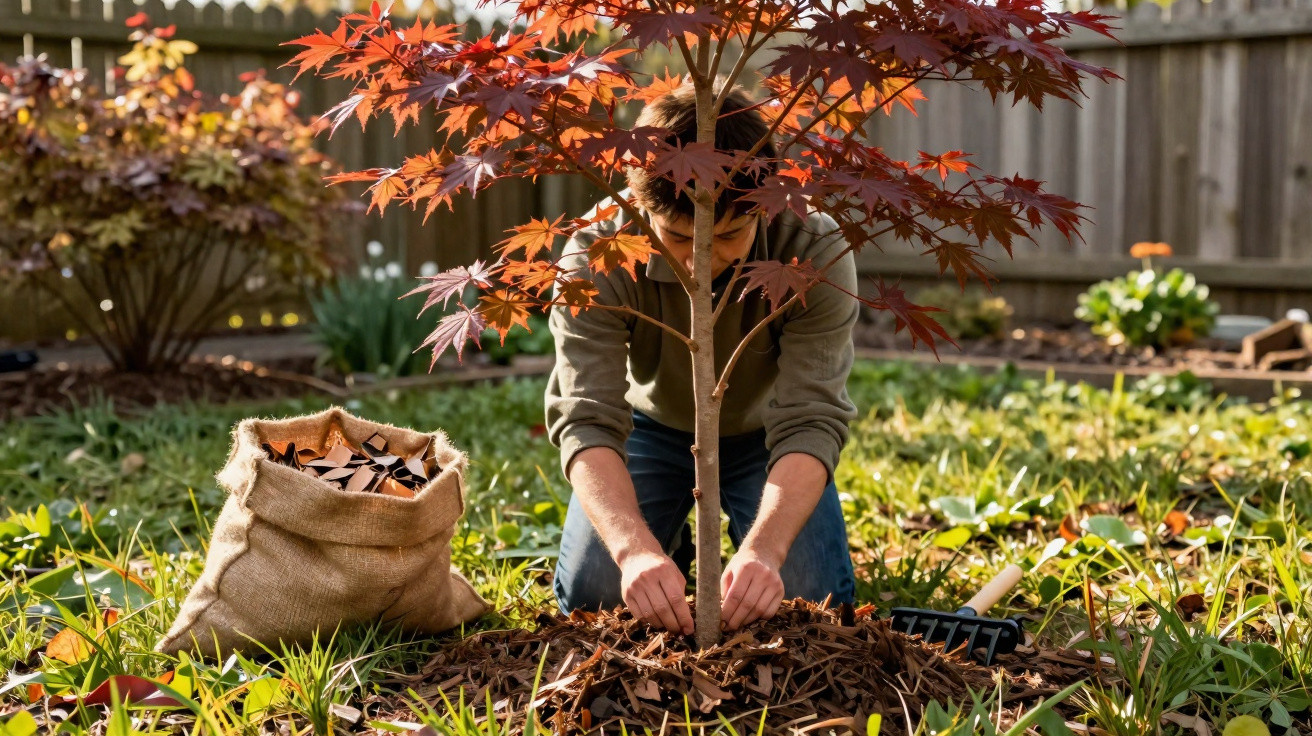
Gardeners who have cultivated healthy, richly coloured Japanese maples for years nearly all rely on the same technique: in spring, they spread an organic layer around the trunk. This natural-material “carpet” acts like a blanket over the soil.
It provides several benefits at once:
- It moderates temperature fluctuations.
- It retains moisture in the soil for longer.
- It protects fine roots from heat and drying out.
- Over time, it supplies additional nutrients.
- It suppresses unwanted weed growth.
Timing is crucial: apply it in March, when the ground is still cool but no longer frozen and the plant is beginning to wake up. The layer can then settle into place before the first hot days arrive.
How deep should the layer be?
A layer that is too thin has little effect, while one that is too deep is not ideal either. A depth of around five to eight centimetres has proved effective. This is enough to buffer heat and cold without sealing off the soil completely.
Importantly, leave the root flare visible: this is the point where the trunk meets the ground. Do not place the material directly against the wood; instead, keep a small circle around the trunk clear. This allows the area to “breathe” and remain dry, helping to prevent rot.
Natural materials Japanese maples love
Not every covering offers the same level of protection. Some materials become very hot, while others are too coarse or contain substances that sensitive plants dislike. Japanese maples benefit most from slightly acidic materials that form humus.
Good materials for Japanese maples
- Fine pine bark: Slightly acidic, attractive in appearance, slow to break down and gradually creates humus-rich soil.
- Well-rotted leaf mould: An excellent option if you collected plenty of leaves in autumn. It provides nutrients and improves soil structure.
- Wood chips from young branches (Bois raméal fragmenté): Finely chipped branches from deciduous trees and shrubs, which slowly turn into nutrient-rich humus.
These materials create loose, fresh soil similar to that found in open woodland. Japanese maples originate from precisely these kinds of habitats and respond with strong, intensely coloured leaves.
What can be recycled from your own garden
Many home gardeners already have suitable materials outside their door; they simply need to use them correctly. Useful options include:
- shredded leaves collected in autumn, applied in a layer that is not too deep
- dried hedge trimmings, roughly chopped
- thin layers of thoroughly dried grass clippings, as they become slimy if used wet
Using these garden leftovers saves money, reduces waste going into the garden-waste bin and provides the tree with long-term nourishment. The key point is that material should not be placed around the plant while it is fresh, wet or mouldy.
Materials best avoided
Stylish-looking coloured stones or dark rock may look appealing in photographs, but they do little for a Japanese maple. During summer, they store heat and can make the soil extremely warm. For a plant with shallow roots, this can effectively create an oven-like environment.
Less suitable materials include:
- dark gravel or chippings
- volcanic rock, such as coarse dark lava rock or pumice
- heavily coloured decorative bark mixes from garden centres that heat up strongly
It is also advisable to maintain a small clear ring around the trunk, roughly ten centimetres wide. This keeps the bark dry rather than permanently enclosed in damp material.
How to mulch your Japanese maple step by step
No specialist equipment is needed if you are doing this for the first time. All you need is some time, a rake and your chosen natural material.
- Clear the area: Remove all weeds around the trunk and scrape away old, matted material.
- Loosen the soil gently: Using your fingers or a small rake, lightly roughen the top one to two centimetres of soil. Take care not to damage the fine roots.
- Apply the layer: Spread the chosen material in a ring, extending slightly wider than the tree’s canopy. Leave it loose rather than pressing it down.
- Keep it away from the trunk: A small uncovered circle around the trunk prevents moisture from sitting directly against the bark.
- Water thoroughly: Give the area a generous watering afterwards, so the material settles and the roots benefit from the protected, moist conditions.
Over the following weeks, one or two deep waterings per week are sufficient in normal weather. During prolonged dry spells, this can be increased to three or four times weekly. The layer keeps water in the soil for longer, meaning considerably less watering is required.
Japanese maple in a pot: the same technique on a smaller scale
Many Japanese maples are grown in large containers on balconies or patios. Temperature swings are even more pronounced there, as pots warm up and cool down much faster.
A five to eight centimetre layer of fine pine bark or leaf mould is also worthwhile in a pot. The method is similar to that used in the ground: clean the surface, loosen it carefully, spread the material loosely and keep the watering rim of the pot clear. In summer, you will clearly notice that the compost does not dry out as quickly.
Positive effects that develop over the years
Gardeners who care for their Japanese maple in this way every March usually see a clear difference. The trees appear sturdier, suffer leaf scorch less often and retain their colour for longer. Gradually, the root area develops dark, crumbly soil, a sign of active microorganisms and good structure.
“Over time, the organic layer creates its own small habitat beneath it, supplying the maple almost as it would be in its natural environment.”
Rather than continually adding fertiliser, this annual natural covering is enough in many cases. It releases nutrients slowly, in line with the plant’s rate of growth. This reduces the risk of overfeeding, which can quickly cause stress in sensitive ornamental maples.
Common mistakes that are easy to avoid
The same problems arise repeatedly in practice, but a few simple rules can prevent them:
- Do not make the layer deeper than eight centimetres, otherwise moisture can become trapped underneath.
- Avoid fresh grass clippings in thick layers: they compact together, allow very little air through and begin to rot.
- Do not press bark pieces directly against the trunk, as this leaves the bark permanently damp.
- Do not use strongly lime-rich materials, as many Japanese maples prefer slightly acidic soil.
If you are unsure, begin with a thinner layer and observe the tree throughout the season. If it responds well, you can apply a little more gradually the following spring.
Why sensitive Japanese maple varieties benefit especially strongly
Red, deeply dissected or particularly small-leaved varieties react noticeably to heat stress. Their leaves scorch more quickly when the root zone is exposed to extreme temperatures. A natural covering is particularly helpful in allowing them to cope more calmly with the midday heat of summer.
For example, if you have a deep-red Japanese maple in a sunnier position, this measure can often prevent the leaf tips turning brown as early as July. In partially shaded gardens, protected soil also encourages richer autumn colour because the tree remains healthy for longer.
Practical additions for even more resilient trees
If you want to give your Japanese maple extra support, you can take care of a few small jobs at the same time. Lightly pruning dry tips, removing dead branches or checking the container-whether it is large enough and whether drainage is adequate-will complete the care routine.
Controlled watering is particularly worthwhile for container-grown trees: waterlogging is just as harmful as complete dryness. Combined with the organic layer, this creates a fairly stable environment in which the tree is less sensitive to mistakes. That leaves more time to enjoy its delicate leaf structure and changing seasonal colours, instead of wondering each year why its leaves have scorched.


Comments
No comments yet. Be the first to comment!
Leave a Comment