
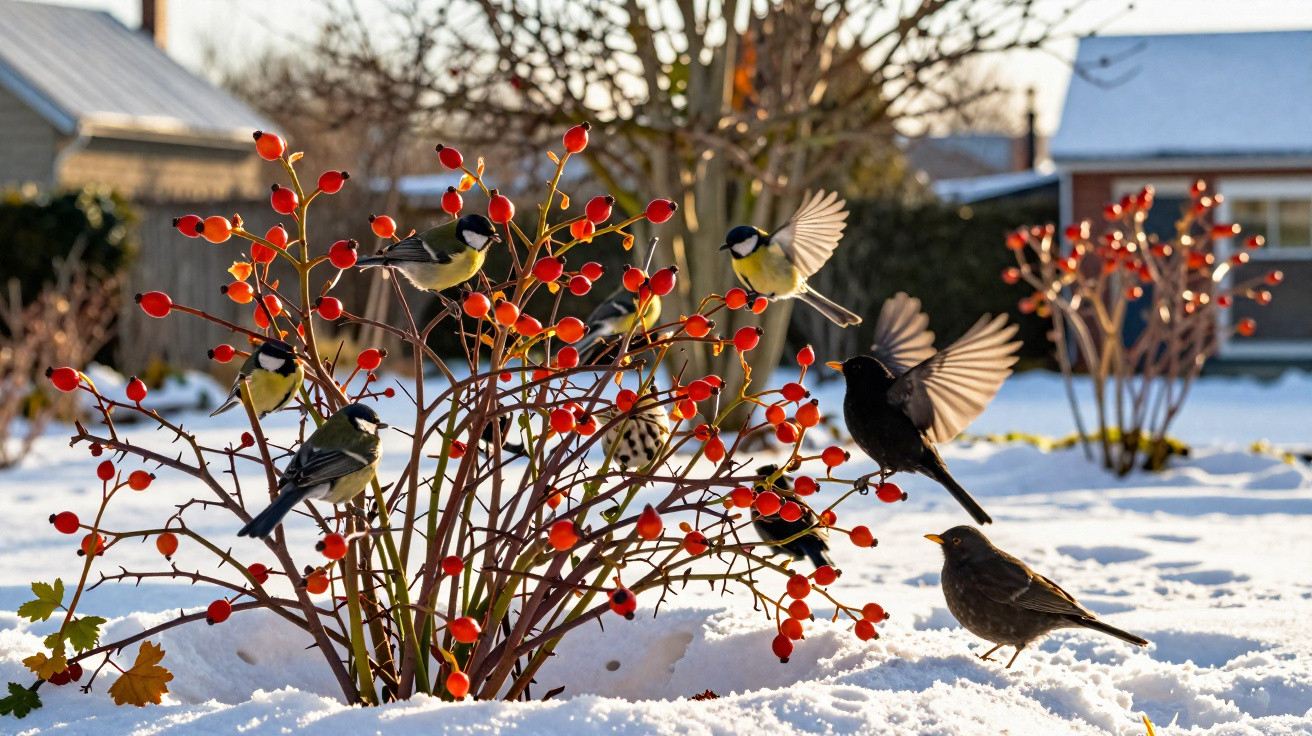
Many keen amateur gardeners hang up fat balls and still wonder why the branches remain empty. Yet winter birdlife is not decided at the feeder, but years earlier – when the right shrubs are chosen. Two particularly hardy wild roses can turn a lifeless garden into a bustling meeting place for blackbirds, thrushes and other birds.
Why so many gardens seem deserted in winter
During the colder months, feeding stations are often emptied at remarkable speed. Even so, birds rarely stay for long. They move from garden to garden in search of more dependable food sources. Supplementary food on a feeder offers short-term help, but it cannot replace a healthy ecosystem.
The most common mistake is choosing whatever looks most attractive in a catalogue. Double hybrid roses with countless petals may create stunning photographs, yet they provide hardly any food. Insects cannot reach the nectar, or the blooms are simply sterile. Without pollination, no rose hips develop – and without rose hips, birds lose an essential part of their winter diet.
A garden that relies solely on decorative roses offers pretty thorns in February – but not a single mouthful for hungry birds.
Anyone hoping to hear more birdsong should think less about Instagram appeal and more about wildlife when planting. Native species, or hardy plants with a natural character, supply food, shelter and nesting sites for decades, without needing constant care.
The stars for bird lovers: dog rose and Japanese rose
When it comes to protecting birds in the garden, two rose species stand out: the dog rose (Rosa canina) and the Japanese rose (Rosa rugosa). Neither looks especially dramatic at first glance, but both are genuine heavyweights for wildlife.
Dog rose: delicate flowers, enormous value
The dog rose has grown in field hedges, beside paths and along woodland edges for centuries. Its simple, pale-pink flowers open wide, allowing wild bees, bumblebees and other pollinators to reach the pollen easily. The shrub works quietly through summer, with the reward appearing in autumn: countless elongated red rose hips remain on its branches well into winter.
This creates a natural food store that is available for months without any human intervention. A few plants can form a dense, lively hedge where there is an unused corner along a garden boundary.
Japanese rose: a hardy defensive barrier for a bird-friendly garden
The Japanese rose originates from cooler regions and thrives in harsh conditions. It tolerates wind, salty air and poor soil, is rarely troubled by disease, and forgives gardeners who do not reach for the pruning shears all the time. Its flowers are large, strongly scented, and appear in white, pink or purple.
Its real highlight arrives later: plump, round, tomato-like rose hips in bright orange to red. They are highly nutritious and often stay on the branches far into winter. For many bird species, they are something of an emergency buffet when other fruit has long since disappeared.
Anyone combining dog rose and Japanese rose is effectively building a filling station for birds – open from autumn until late winter.
Why simple flowers are worth their weight in gold for birds
Both rose species share one important feature: simple flowers with five petals. That structure is the key. Their stamens are freely accessible, pollination works reliably, and the shrubs produce masses of fruit.
- Double roses: little or no access to nectar, often sterile, with hardly any rose hips
- Single roses: easy for insects to access, reliably pollinated, producing many rose hips
- The result: more insects in summer, more fruit in winter, and more birds throughout the year
Anyone wanting a “living garden” rather than a “flower stage without an audience” will do far better with simple blooms. They still provide plenty for the eye, while benefiting wildlife at the same time.
Rose hips as a winter powerhouse for tits, thrushes and other birds
For birds, rose hips are true energy packages. They provide vitamins, sugars and energy when insects are absent and seeds are scarce. This becomes especially important towards the end of winter, when the birds’ reserves are usually depleted.
Typical visitors to rose bushes include:
- Blackbirds: keen to peck at ripe, slightly softened rose hips
- Various thrush species: use dense rose hedges as places to feed and rest
- Robins: benefit from the hiding places and peck at fallen fruit beneath the shrubs
- Finches and sparrows: depending on the species, also take remaining seeds and small insects
Many birds wait until frost and moisture have softened the rose hips slightly. Then there can be a constant shuttle between the shrub and neighbouring gardens. Planting the hedge close to a window lets you watch this spectacle directly from the sofa.
A few metres of rose hedge can literally make the difference between life and death for small birds in late winter.
A thorny fortress: protection from cats and birds of prey
Food alone is not enough. Birds also need safe retreats where they can feed, sleep and breed. This is where the thorns of wild roses show their greatest strength. They can be irritating from a human perspective, but from a bird’s point of view they can save lives.
Dense, thorny hedges of Japanese rose and dog rose act as a natural barrier. Cats struggle to get through, while birds of prey can barely seize their quarry among the branches. Birds can slip easily into the middle of the hedge and remain protected there.
The shrubs provide:
- concealed nesting places within the hedge
- secure sleeping spots close to a food source
- cover during attacks by sparrowhawks or crows
Because these roses manage without chemicals, nests remain free from pesticide residues. The insect larvae fed to young birds by their parents are uncontaminated. This creates a healthy microclimate that also benefits hedgehogs, lizards and many beneficial insects.
How to incorporate bird-friendly roses cleverly into your garden
Anyone now tempted to improve their own garden does not need to dig everything up. Just a few shrubs can make a difference when they are positioned well.
Suitable positions and straightforward care
Sunny to partly shaded sites along a boundary or behind a vegetable patch are ideal. The soil can be fairly poor, but the shrubs do not tolerate waterlogging. Once established, they cope with very little watering.
- Choose a position: allow at least 1.5 to 2 metres from paths and patios because of the thorns
- Dig the planting hole: make it twice as wide as the root ball and loosen the soil with compost
- Plant and water in: water thoroughly so that no air pockets remain
- During the first few years: water in dry periods, but otherwise leave the shrubs largely undisturbed
Heavy pruning is needed only every few years, when the shrubs become too dense. Remove old, dead shoots close to ground level and thin them out slightly. Important: do not cut during the main breeding season, so carry out major work in late winter instead.
Combinations with other shrubs
The garden becomes even more interesting when wild roses are mixed with other bird-friendly species. Suitable companions include:
- Elder: provides berries and food for insects, and flowers abundantly
- Blackthorn: thorny and ideal as a breeding hedge, with fruit for birds and wildlife
- Hawthorn: offers berries and dense branching for protection
- Rowan: an important food source in late summer
Step by step, this creates a genuine small habitat that remains appealing throughout the year: a sea of flowers in spring, shade and insects in summer, fruit in autumn, and rose hips plus shelter in winter.
What many people do not know: rose hips also help people
The fruits of the dog rose and Japanese rose are not only valuable to birds. They contain plenty of vitamin C, fruit acids and secondary plant compounds. Dried skins can be used to make tea, while the fruit pulp can be turned into jelly or purée.
When gathering them, it is essential to leave some of the fruit for wildlife. Careful harvesting provides both a vitamin-rich addition to your own kitchen and a well-stocked table for feathered visitors.
More life in the garden: little effort, great impact
Moving away from highly bred show roses towards robust wild forms noticeably changes a garden’s character. Instead of a brief explosion of flowers, there is a yearly sequence to observe: the first buds in spring, buzzing in summer, reddening rose hips in autumn, and finally winter food around which whole flocks of birds gather.
Anyone who deliberately includes one or two dog roses or Japanese roses in their next planting project lays the foundation for greater biodiversity on their doorstep. The result will not appear overnight, but after one to two years the garden will become noticeably noisier – in the best possible sense.

Comments
No comments yet. Be the first to comment!
Leave a Comment