
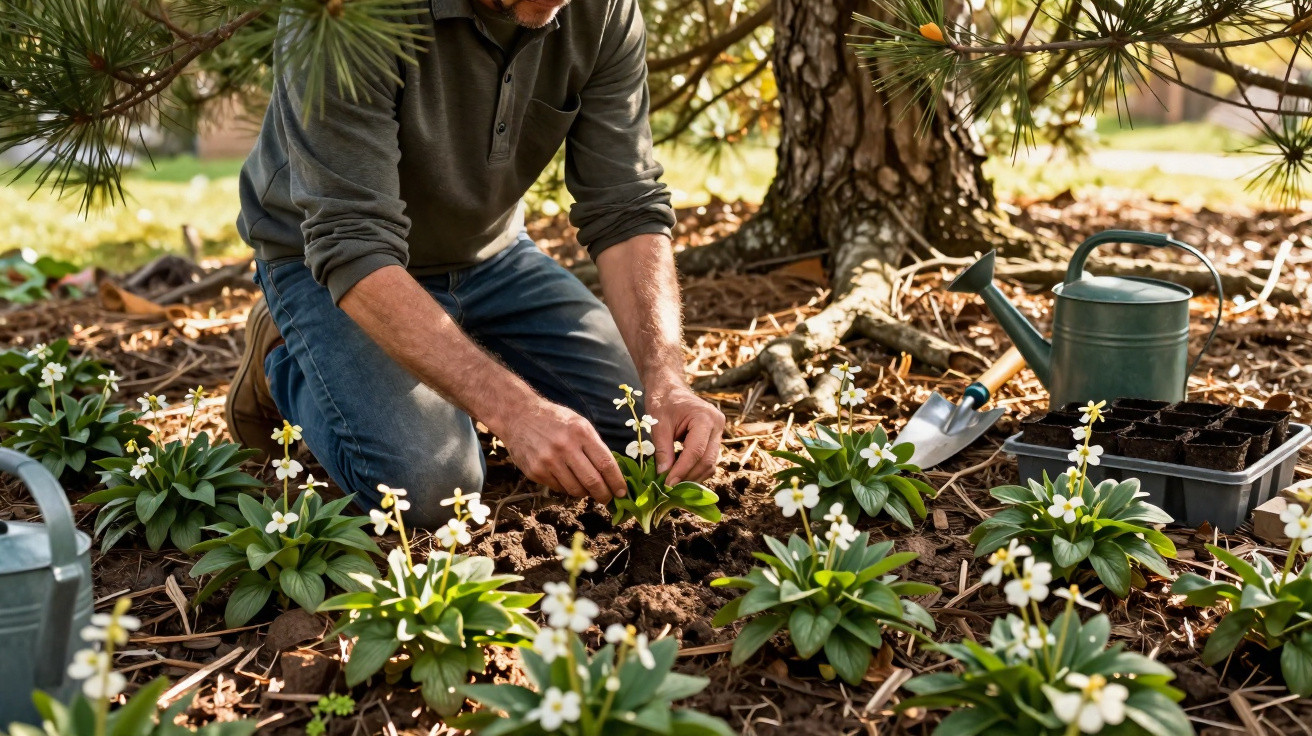
A modest ground cover can work a small miracle in precisely this sort of spot.
Many amateur gardeners eventually give up on these “cursed corners” of the garden. Nothing grows, everything dries out and every new attempt fails. Yet the issue is rarely a lack of gardening skill; it is more often the extreme conditions of the site. This is exactly where one particular, often overlooked perennial comes into its own: it turns dry shade into a thick green carpet, without the need for constant watering.
Why seemingly nothing grows beneath pines and oaks
Anyone who has tried to establish a lawn or conventional perennials directly beneath a pine, oak or dense hedge will recognise the scene: yellowing grass, sparse growth and soil as hard as concrete. Experts call this “dry shade” – one of the most difficult positions anywhere in the garden.
The explanation is quite straightforward: large trees work against every new planting.
- Roots draw away the water – young plants receive hardly any moisture.
- The canopy blocks the light – there are often fewer than two hours of direct sunshine each day.
- The soil becomes compacted – through root pressure and a lack of soil fauna.
- Leaves, needles and tannins can make it genuinely difficult for other plants to get established.
Research in areas such as tree biology and soil ecology points to an additional effect: some tree species release substances into the soil that suppress nearby competing plants. Combined with a shortage of light and water, this creates an area where even tough perennials quickly struggle.
“Anyone planting conventionally beneath old trees ‘on the off-chance’ is not battling their own lack of green fingers, but the tree’s perfectly organised competitive system.”
Why popular shade plants fail here despite their promises
They look wonderful in photographs: hostas with enormous leaves, delicate astilbe plumes and elegant fern fronds. All are considered shade-loving plants. The difficulty is that they need cool to moist shade, along with deep, humus-rich soil – not dry shade.
Beneath a broad, mature tree, almost none of these conditions applies:
- The soil is densely rooted at a shallow depth rather than deep.
- Organic matter breaks down more slowly, so humus is lacking.
- Summer brings months of dryness directly around the roots.
The result appears year after year: scorched leaves, stunted flowers and, eventually, completely bare ground. Many gardeners then abandon these areas or use them merely to store pots and garden tools.
Epimedium, the quiet solution for dry shade
One perennial excels in exactly this niche, despite often looking unremarkable among the plants at the garden centre: Epimedium, commonly known as barrenwort. It is a long-lived, clump-forming perennial that gradually produces a dense carpet.
Its particular strengths include:
- It tolerates the root competition of large trees remarkably well.
- Once established, it copes with dry shade.
- It forms a thick, low carpet that almost suppresses weeds.
- It is often evergreen or sends up new growth very early.
- It flowers in spring with fine, delicate blooms in white, yellow, pink or coppery orange.
The flowers seem almost to hover above the foliage, lending elegance to even the bleakest tree bases. Over the course of the year, many varieties take on subtle reddish or bronze tones, bringing extra movement to the planting.
“Epimedium is not a loud, colourful show plant – it is the understated professional that works where the usual stars have long since given up.”
Turning a difficult site into a green oasis
The right timing determines success
Anyone intending to establish Epimedium in dry shade should not simply plant it on a whim in June. The best time is when the soil is warm but not parched, and some rainfall can help from above. Particularly favourable are:
- The first rainy weeks of autumn, once summer stress has passed.
- Alternatively, mild periods in spring, while there is still residual moisture in the soil.
The advantage is that plants can root steadily without needing daily watering. This initial stage is particularly important in the dense root mat of old trees.
Prepare the soil – but with a light touch
Beneath mature trees, there is no need to dig deeply with a spade and pickaxe. Damaging substantial roots harms the tree and weakens the whole system. Gentler methods work far better:
- Loosen the upper 5 to 10 centimetres with a hand rake or cultivator.
- Deliberately avoid thick roots and work only in the spaces between them.
- Apply a thin layer of leaf compost or fine leaf mould – this mimics natural woodland soil.
Before planting, one easily overlooked step is worthwhile: place the small pots of Epimedium in a bucket of water for around 15 minutes, until no more air bubbles rise. This thoroughly wets the root ball so it does not immediately dry out in the tough, tree-rooted ground.
Spacing, care and the route to a closed carpet
To make the most of this ground cover’s strengths, the plants need a clear layout and adequate space. The following approach has proved effective:
- Plant spacing: around 30 centimetres, staggered rather than in straight lines, so no gaps remain.
- Water thoroughly after planting, deeply rather than merely sprinkling the surface once.
- During the first year, bridge every prolonged dry spell with a proper watering session.
A light mulch of leaves between young plants serves two purposes: it retains moisture and gradually supplies nutrients. Thick layers of bark mulch are less suitable, as they can cool and impoverish the soil considerably.
Once the carpet is established, Epimedium requires remarkably little attention. Many gardeners simply cut the oldest, untidy leaves down close to the ground at the end of winter, allowing the fresh shoots and flowers to stand out more clearly.
The best companion plants for more light and colour in shade
An area planted solely with Epimedium feels calm and unified, but can be slightly monotonous. Suitable companions can add light-catching effects and colourful accents without overwhelming the site again.
Alchemilla mollis: soft yellow-green clouds
The lady’s mantle species Alchemilla mollis forms rounded cushions of soft, lightly hairy leaves. Rain and dew bead decoratively across them, an especially attractive effect in partial shade.
In early summer, countless yellow-green flower sprays emerge to brighten dark corners visually. Their colouring acts like a natural spotlight against dark tree bark or an evergreen backdrop.
Vinca minor: a resilient filler for the edge
For the transition towards the sunnier part of the garden, Vinca minor, or lesser periwinkle, is a good choice. It grows flatter than many ground covers, creeps across the soil with trailing stems and quickly forms closed areas.
- It copes surprisingly well with root pressure.
- It manages in poor soils.
- It flowers in violet or white from spring into autumn.
Combined with Epimedium, it creates a multi-layered carpet: dense, low-maintenance and much livelier than a bare, cracked surface.
“Where there were once only needles, dust and roots, the right plant selection creates a kind of miniature woodland floor – stable, green and pleasant to look at.”
A practical example: from dead ground beneath a tree to an elegant shade area
A typical scenario: beneath an old pine, the lawn has been struggling for years, the ground looks baked hard and thick roots are partly exposed. Instead of scattering grass seed yet again, take a systematic approach:
- Gently loosen the topsoil, avoiding substantial roots.
- Spread a thin layer of leaf mould or mature compost.
- Plant Epimedium in staggered rows at intervals of around 30 centimetres.
- Place lady’s mantle in small groups at the edge, with periwinkle forming a border towards the open side of the garden.
- Water generously, then water again during dry weather in the first growing year.
After only one season, the difference is clear: the first connected islands of carpet appear, there is more green and less dust. By the second year, the areas look cohesive; barrenwort’s spring flowers add delicate colour, and the whole zone resembles a naturally developed woodland edge rather than a problem area.
Useful guidance for lasting success in dry shade
Anyone redesigning areas like these should allow for patience. Ground covers such as Epimedium work more at marathon pace than sprint pace. In return, they provide a lasting effect.
| Aspect | Recommendation |
|---|---|
| Feeding | A little leaf compost once a year is usually sufficient; heavy mineral fertilisers are unnecessary. |
| Watering | Water thoroughly in the planting year; afterwards, water only during extreme dry periods. |
| Fallen leaves | Some can be left in place; remove overly thick layers in late winter if needed. |
| Spread | Epimedium spreads moderately and can easily be rejuvenated and propagated by division. |
There is also a practical side benefit: greening tree bases with robust perennials and ground covers protects roots from drying out and soil from erosion. The microclimate improves, the ground remains looser and the tree itself benefits over the long term.
For many gardens, choosing barrenwort represents a small strategic shift: away from short-lived flowering wonders in pots and towards plants that suit the site and perform reliably for years. That is precisely what can turn apparently hopeless shady corners into the most interesting parts of the entire plot.
Comments
No comments yet. Be the first to comment!
Leave a Comment