
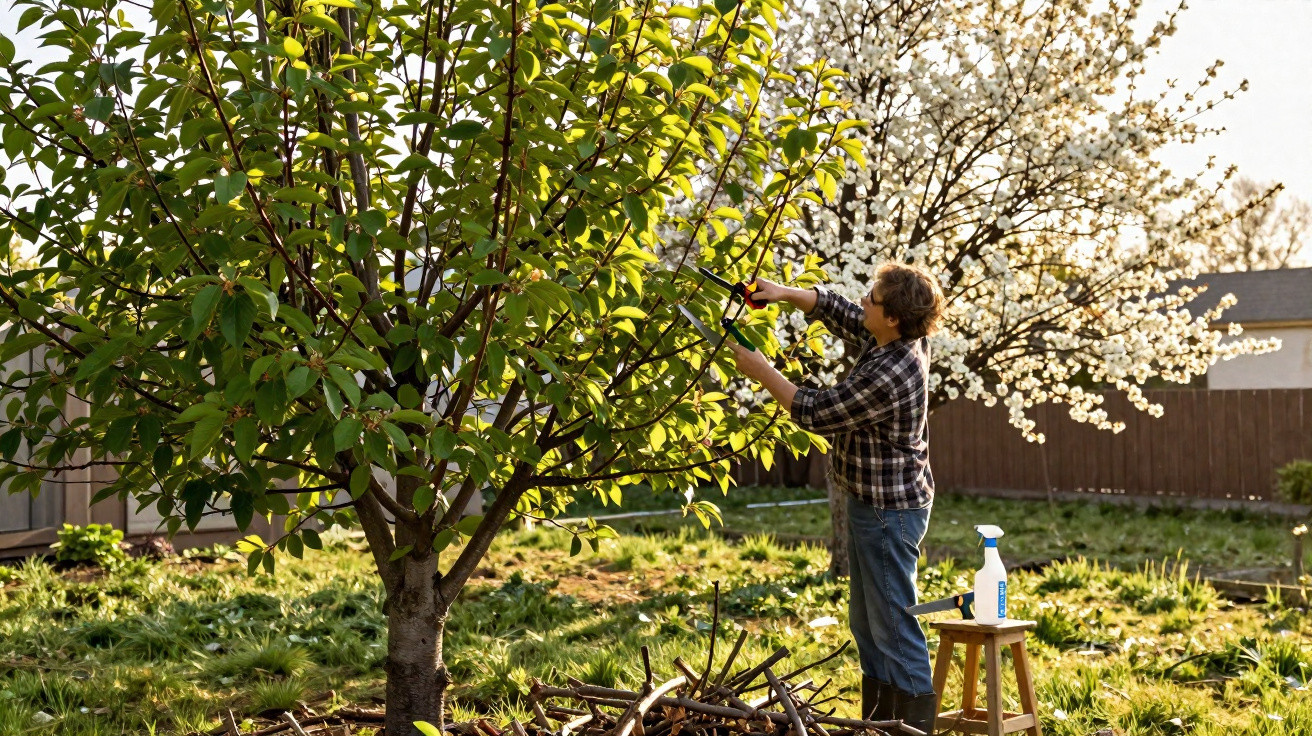
A vigorous, deep-green cherry tree stood in the garden. It flowered reasonably well, provided shade and looked healthy – yet the bowls stayed empty in summer. There were no worms, no disease and no frost damage. The answer did not come from the garden centre, but from the neighbour over the fence: targeted pruning in the right places had the tree producing a plentiful crop within a single season.
Why a vigorous cherry tree can still produce hardly any fruit
Too much wood, too few flower buds
Many amateur gardeners take dense, strong branches as proof that a tree is in perfect condition. With a cherry tree, however, this can be precisely the problem. If it puts too much energy into growing wood, it directs everything into shoots and leaves rather than flowers.
This mass of shoots then acts as an energy drain. Nutrients are channelled into young wood, while flower buds are effectively “starved”. The tree may look full of vigour, yet deliver little or no harvest.
“A cherry tree that grows only wood is doing bodybuilding – but forgetting to produce fruit.”
Leaving a tree unpruned for years, or pruning only timidly, encourages exactly this result: a luxuriant crown but a poor yield.
Too little light in the centre of the crown
The second major obstacle is a lack of light within the crown. When a tree is too dense, sunlight can barely reach the fruiting areas. Many buds then remain blind or develop only weakly.
Light is what prompts buds to become flower buds. Without sunshine in the middle of the crown, the tree switches to “maintenance” rather than “reproduction”. The outcome is impressive green growth on the outside and silence on the fruiting front.
The neighbour’s tip: remove energy-draining shoots decisively
The first shoots to remove: upright “gourmets”
The neighbour’s crucial advice concerned a particular type of shoot that many people overlook. These are smooth branches that shoot vertically upwards, often growing from the middle of stronger limbs. In fruit growing, they are known as “water shoots”.
Typical signs of these energy-draining shoots include:
- they grow very quickly, usually straight upwards
- they often have smooth, slightly lighter bark
- they produce few or no flower buds
- they thicken the crown and shade productive areas
They look powerful but offer very little benefit. These were the first shoots the neighbour targeted.
How to make the key cut
To redirect the tree towards fruiting, water shoots must be removed very low down. Do not round them off or cut them in half; cut them directly at their point of origin.
What matters is:
- use sharp, clean secateurs or small pruning shears
- remove the shoot as close as possible to where it begins, without leaving a stub
- make a few clean cuts rather than frantically “picking away” at the tree
“Every water shoot removed gives the fruiting branches more light and more energy.”
Even after this first step, the tree looks less as though it has “exploded” and allows more light through.
More air, more light: making the crown productive
Crossing branches are dangerous in two ways
In the second step, the neighbour looked for branches that touched or crossed one another. Particularly inside the tree, some sections grow in a way that causes them to rub together in the wind. This causes harm in two respects:
- The bark becomes damaged, giving fungal diseases an easy opening.
- The crown becomes even denser, keeping light on the outside.
Wherever two branches obstruct each other, the rule is simple: one can stay, and one must go. Usually, the weaker branch or the one growing inwards into the crown is removed.
Create a “light shaft” through the middle of the tree
The aim when pruning a cherry tree is not a perfectly round ball, but an airy crown with an open centre. Ideally, when viewed from above, sunlight should be able to reach right into the heart of the tree.
This “light shaft” has several benefits at once:
- Flower buds in the centre of the crown are activated.
- Wood dries more quickly after rain, making conditions less favourable for fungi.
- Pollinators such as bees and bumblebees can reach the flowers more easily.
“A well-thinned cherry tree is like an open house: sun, air and insects have free access.”
The right timing and clean tools
When pruning helps a cherry tree – and when it does not
Cherry trees are more sensitive to pruning than many other fruit varieties. Heavy pruning in the depths of winter can cause the tree to “bleed” – a sticky, amber-coloured gum seeps out. This can weaken it for years.
Fruit-growing practice is to:
- carry out larger corrections immediately after harvest
- perform light maintenance pruning and remove individual shoots in spring or late summer
- avoid frosty periods, to prevent cracking and poor wound healing
The neighbour followed exactly this approach with the tree’s owner: larger water shoots and troublesome branches were removed after the season, while minor follow-up work was done in spring.
Why disinfecting tools is not a luxury for fruit trees
Every cut is a wound. Using a dirty blade can easily transfer fungal spores or bacteria from one tree to another. This is especially risky if fruit-tree diseases are already present somewhere in the garden.
For healthy wounds:
- clean the blade with alcohol or methylated spirits before starting work
- clean it again after cutting an obviously diseased branch
- on thicker branches, make a smooth, slightly angled cut so water can run off
Many gardeners also cover larger wounds with a natural clay-based wound sealant or a specialist tree balm. It is not essential, but it reduces the risk of infection after major pruning.
When the cherry tree suddenly “explodes” – the change in spring
From problem crown to a cloud of blossom
Immediately after pruning, the cherry tree looked almost bare. Some neighbours shook their heads: “It’s ruined.” The following spring, the picture had changed completely. The crown was still full, but much more structured and brighter.
More importantly, the number of flowers was noticeably greater. Buds opened not only at the outer tips but deep within the tree as well. Bees had an easy task, moving through the newly opened channels in the crown.
“The same tree, the same soil – only with different pruning: suddenly the branches are laden with cherries.”
The most important pruning rules for lasting results
Anyone who has seen this result will want to maintain it. In most home gardens, three measures are enough to secure better harvests over the long term:
- Remove water shoots and steeply upright growth early every year.
- Thin out inward-growing, crossing or rubbing branches selectively.
- Cut out diseased and dead wood cleanly.
With restrained use of the secateurs and a little patience, the cherry tree becomes a relatively low-maintenance fruit tree. Expensive specialist fertilisers or radical cut-backs are unnecessary in most cases.
Practical guidance for other fruit trees and common mistakes
What also applies to plum, apricot and peach trees
These principles do not apply only to cherries. All stone fruits – including plums, damsons, apricots and peaches – react similarly badly to dense crowns, insufficient light and heavy winter pruning.
Anyone who also regularly:
- removes water shoots,
- keeps the crown airy, and
- makes corrections after harvest rather than in the depths of winter,
can in most cases expect more stable, healthier trees and better yields.
The most common mistakes when pruning fruit trees
Many problems begin with good intentions but no plan. Typical pitfalls include:
- radically “topping” the crown, which creates masses of water shoots in response
- being afraid of every cut until the tree becomes completely overgrown and woody in the middle
- pruning during frost or rain, which makes wound healing more difficult
- making untidy, ragged cuts with blunt tools
If you are unsure, mark just a few shoots with a ribbon in the first year, remove them and watch the effect on light, blossom and fruit. This gradually develops your feel for your own tree.
Whether it is a cherry tree, plum tree or a small trained pear against a house wall, considered pruning directs the tree’s energy to where it is most useful – into flowers and fruit rather than endless woody growth. Sometimes, all it really takes is the eye of a neighbour pointing out the crucial place to put the secateurs.

Comments
No comments yet. Be the first to comment!
Leave a Comment