
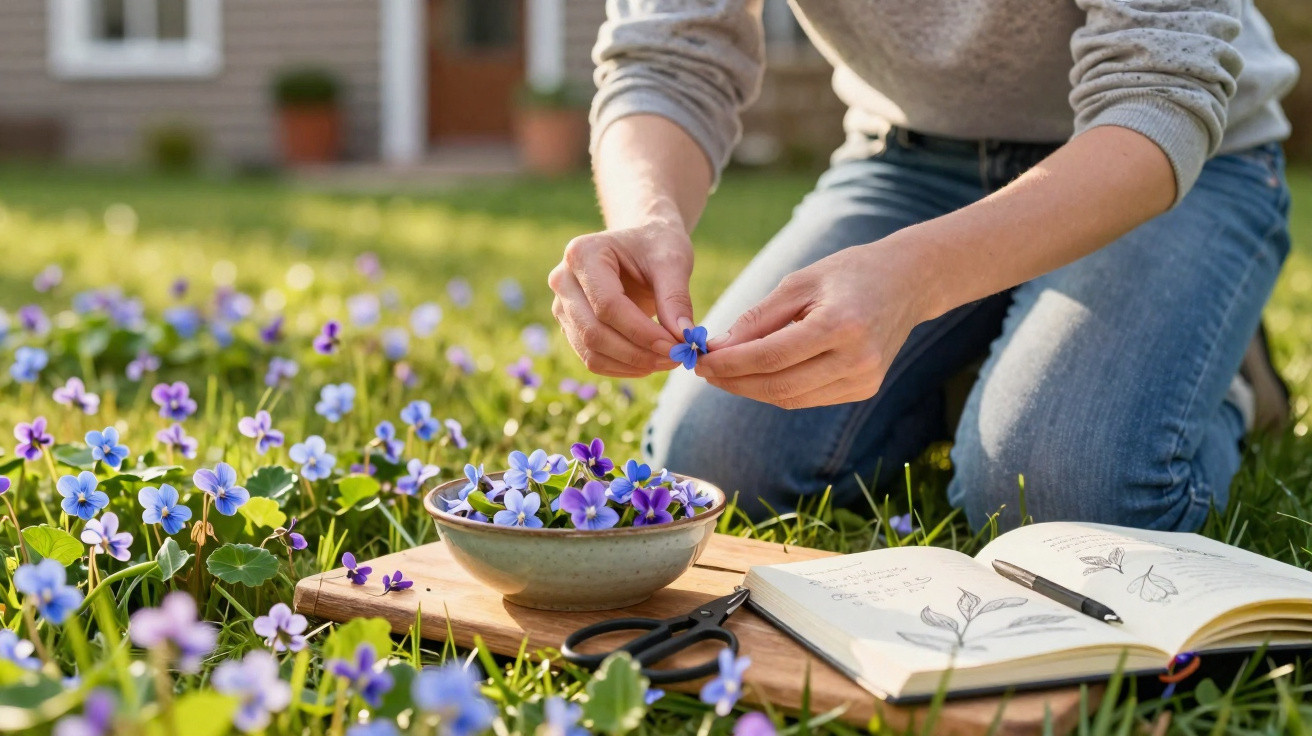
In March, the garden comes back to life, bringing small blue and purple flowers with it: across the lawn, between paving stones and around bed edges. What many people dismiss as troublesome weeds is actually a free store cupboard, an insect buffet and a sign of healthy soil. Knowing these plants can save money, reduce environmental impact and put valuable wild herbs right on your doorstep.
Why blue and purple “weeds” are a positive warning sign for your lawn
A lawn where sweet violets, ground ivy or Persian speedwell emerge in spring is not a neglected garden; it is a working mini ecosystem. These plants favour areas that have not been overloaded with fertiliser or treated with pesticides.
Where delicate blue flowers appear in March, the soil is at work – for you, not against you.
Rather than immediately digging everything out, take a moment to look closely: what shape are the leaves? What does the herb smell like? Many supposed nuisances are among the most useful native wild herbs, suitable for salads, spreads or traditional herbal preparations.
Sweet violet: an early flower with intense fragrance and major value for insects
Sweet violets are usually among the first to appear. They often hide in partially shaded spots, beneath shrubs or along hedge borders. Their flowers are deep violet, sometimes almost blue, while their leaves are soft and heart-shaped.
Their distinctive sweet scent is unmistakable. It has attracted people and insects alike for centuries. Violets held an important place in traditional household remedies. The plant contains essential oils, mucilage and flavonoids – compounds traditionally used in teas, syrups and rubs.
Today, however, many herb experts advise leaving sweet violets largely undisturbed. They rarely grow in vast quantities and provide an important early food source for bees, bumblebees and other insects weakened by winter. Eating a few flowers causes no harm, but harvesting whole carpets removes a vital source of energy for wildlife.
Sweet violets are spring’s filling station for insects – leaving them in place supports biodiversity right outside your door.
How to identify sweet violets safely
- Heart-shaped, gently toothed leaves growing close to the ground
- Deep violet to blue flowers with a sweet, strong fragrance
- Growth in small clumps, usually in partial shade
- Often flowering as early as March, sometimes into April
If sweet violets grow in your garden, you can count yourself fortunate: they suggest that the soil is neither completely compacted nor wholly depleted.
Ground ivy: from “garden pest” to kitchen favourite
Ground ivy is a different matter. This creeping subshrub quickly forms extensive mats in lawns, pushes through gaps in paving and trails over bed borders. Its small blue-violet flowers grow in whorls along the stems, while the leaves are rounded to kidney-shaped and lightly scalloped.
Many gardeners see ground ivy as an irritating invader and attack it with scarifiers and knives. In doing so, they overlook an intensely aromatic culinary herb. The plant contains bitter compounds, tannins, essential oils and saponins. Together, these create a bold, resinous and savoury flavour reminiscent of a blend of parsley, mint and thyme.
Ways to use ground ivy in the kitchen
Because its flavour is powerful, use ground ivy sparingly. It works particularly well alongside milder herbs.
- Finely chopped into herb butter or cream cheese
- As a punchy addition to a wild herb salad
- In herby quark with baked potatoes
- As a seasoning herb in soups or stews, added only at the end
Ground ivy often grows in abundance – using it moves the “war on weeds” into the kitchen and saves work in the garden.
Its great advantage is its hardiness and vigorous spread. Unlike sweet violet, you can harvest ground ivy generously without impoverishing nature. If you want to keep it somewhat under control, simply pick it regularly for cooking.
Persian speedwell: flowers like a miniature bouquet
Persian speedwell particularly likes lawns and patches of open ground. It remains low-growing, with stems that often lie along the soil. Its tiny sky-blue flowers, marked with delicate lines, stand out like little eyes in the grass.
For a long time, speedwell was regarded as a classic lawn weed. Yet this delicate plant also contains a range of compounds: bitter substances, tannins and secondary plant compounds once made it a valued household remedy.
Persian speedwell has a mild, fresh and slightly grassy taste. It is best used in the kitchen as an accompaniment rather than a main ingredient.
Ideas for using Persian speedwell in the kitchen
- As colourful edible decoration on soups, desserts or bread
- A handful of leaves in a wild herb salad
- In herb oils alongside other spring herbs
As speedwell occurs in large quantities in many places, it can be gathered without difficulty. Always avoid harvesting directly beside busy roads or in areas regularly used by dogs.
Eat or protect? Making the right choice in the garden
Not every blue- or violet-flowering plant belongs in a salad, and not all should be harvested in large amounts. A sensible approach follows one simple rule:
| Plant | Role in the garden | Recommendation |
|---|---|---|
| Sweet violet | Important food source for insects; tends to occur in isolated patches | Mostly leave it alone; enjoy only a few flowers |
| Ground ivy | Spreads across wide areas; robust | Use generously in the kitchen and manage growth |
| Persian speedwell | Frequently found in lawns | Gather without concern, using mainly the flowers |
Being able to tell the difference pays off: protect what is rare, use what is plentiful – that is modern conservation in your own garden.
What blue spring plants reveal about your soil
Wild herbs are not merely attractive or tasty; they also act as soil indicators. Plenty of ground ivy often points to nutrient-rich, slightly moist soil. Sweet violets prefer loose, humus-rich earth in partially shaded locations. Speedwell thrives in relatively open areas that can be dry at times.
By noticing which wild plants appear in different places, you can respond accordingly:
- Allow more floral variety in the lawn instead of aiming for sterile green turf
- Adapt planting areas: place shade lovers near the violets and sun lovers in speedwell areas
- Gradually turn turf lawns into species-rich meadows
In this way, you can gradually create a garden that demands less maintenance while supporting far more life. Children also learn to distinguish plants rather than seeing every green thing simply as “grass”.
Gathering wild herbs: simple rules for greater safety
Anyone using wild herbs has a responsibility. A few basic guidelines help ensure that neither people nor nature come to harm:
- Harvest only plants you can identify with 100 per cent certainty.
- Never collect beside busy roads, dog-walking areas or industrial sites.
- Take only individual leaves or flowers from rare plants, or preferably nothing at all.
- With plentiful species such as ground ivy and speedwell, pick from many different spots rather than clearing one area completely.
- Wash thoroughly before eating.
If you are unsure, use a reliable identification guide, join a herb walk or compare your finds with several trustworthy sources. The learning effect is considerable: after one spring of paying close attention, you will never again walk through your garden “blind”.
More self-sufficiency: from “weeds” to microgreens on the windowsill
Blue wild plants in the lawn are only one element of becoming less dependent on the supermarket. At the same time, many people begin growing simple miniature vegetables on the windowsill, such as microgreens. All you need is a shallow tray, some water, a natural-fibre mat and seeds. Within a few days, dense mats of young plants will grow, including rocket or radish.
Combining wild herbs such as ground ivy or speedwell with home-grown microgreens makes it easy to create nutritious open sandwiches, salads or bowls. This gradually encourages a different view of food: less packaging, fewer transport miles and more personal initiative.
What many people underestimate: the mental effect of these small flowers
Alongside all their practical benefits, blue and purple spring flowers have another effect: they change how you see everyday life. Someone who thinks, instead of “the lawn has to go, it is full of weeds”, “the ground ivy is flowering there, and speedwell is coming through here” experiences the garden as a living space rather than a problem area.
This outlook reduces stress, strengthens a connection with nature and gives both children and adults a piece of knowledge that has often been lost. Ironically, the plants most often pulled out first make an ideal starting point: they are striking, easy to find and grow virtually everywhere.
Blue and purple spring herbs are not a flaw in the lawn, but an invitation – to more flavour, more knowledge and more nature in everyday life.


Comments
No comments yet. Be the first to comment!
Leave a Comment