
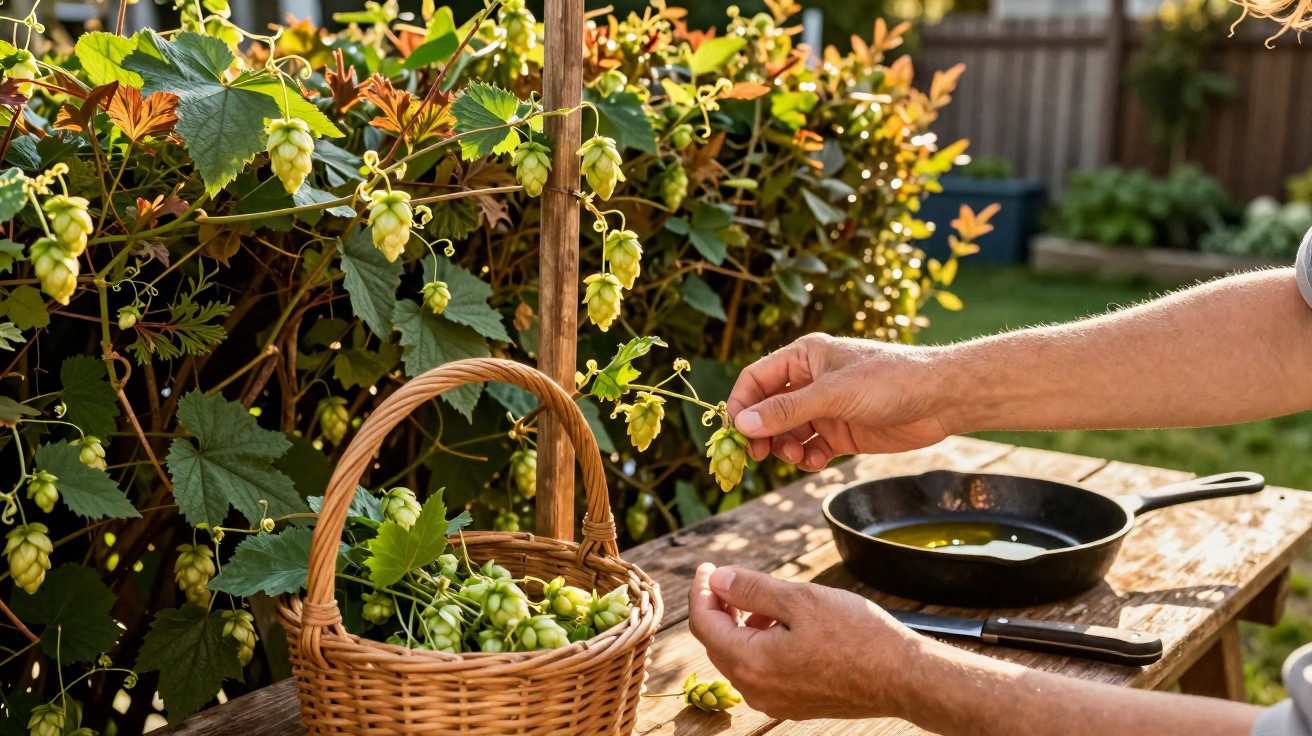
Among faded perennials, old hedgerows and neglected corners of the garden, there may be a plant most people try to eradicate as an annoying nuisance. Yet top chefs pay sums for its delicate spring shoots that would make even truffle enthusiasts pause. Spot it in time and, instead of ‘weed’, you have a small delicacy right on your doorstep.
An inconspicuous climber and costly delicacy: wild hops
The plant in question is wild hops. In summer, this tough, rough-stemmed climber can smother entire hedges, but in early spring it produces a sought-after seasonal vegetable. These are the young shoots emerging from the rootstock, well before the plant develops its familiar leaves and flower clusters.
“In specialist gourmet retail, selected freshly harvested hop shoots can fetch prices of up to €1,000 per kilo.”
The price reflects the labour involved. Each shoot weighs only about one gram, while usually just the tender top two to three centimetres can be eaten. Producing a kilogram therefore requires hundreds, and more likely thousands, of individual shoots to be carefully picked by hand – within a very brief harvesting window of only a few weeks.
What is more, the best places to forage are rarely beside the patio. They are more often found in hedgerows, woodland edges and overgrown areas. Professional harvesting takes a sharp eye, considerable experience and plenty of time. This makes the shoots a classic niche product, appearing chiefly in fine-dining kitchens and on the tables of a small number of connoisseurs.
How to identify wild hops in the garden
To stop your garden from supplying free material for the compost heap, inspect its climbing plants carefully in spring. Wild hops is a perennial vine with rough, slightly scratchy stems. The way it twists around a support is one of its defining features.
- The shoots always wind upwards clockwise.
- Its leaves grow in opposite pairs on the stem; they are palmately divided and toothed.
- The plant favours damp, nutrient-rich locations, including hedges, riverbanks and partly shaded garden corners.
In early spring, the edible parts look very different from the mature summer plant. Slender, flexible shoots emerge from the soil, often a delicate light green and sometimes tinged with purple. Their tips are slightly curled, still soft and easy to snap off with your fingers.
Rub a fresh shoot between your fingertips and it releases a resinous, spicy scent with a subtle, lightly lemony note. These young tips are the prized delicacy.
Beware of lookalikes: not every climber is edible
Many gardens contain other climbing plants that can initially resemble hops. The main examples are bindweed and poisonous white bryony. If you are not completely certain of the identification, do not use any of them in the kitchen.
“If there is even the slightest uncertainty about identification, do not eat it; leave it where it is.”
One typical distinction is that bindweed has smooth rather than rough stems, along with heart-shaped leaves that are not palmately divided. Poisonous white bryony later develops conspicuous berries, whereas hops forms the characteristic cones known from beer production.
Harvesting wild hops: timing, technique and the limits of self-sufficiency
The hop-shoot season is short. Depending on the region, it starts in March and generally ends in April. Once the shoots become too long and fibrous, they lose their tender bite and are of limited use in cooking.
Harvest them by hand, snapping or cutting the still-flexible tips a few centimetres above the ground or just above a branch point. Pulling too roughly can unnecessarily damage the rootstock, so a small knife is useful.
- Pick only soft, pliable shoot tips.
- Always leave enough shoots for the plant to recover.
- Use the shoots on the same day wherever possible, as they wilt quickly.
Anyone dreaming of instant wealth will probably be disappointed. The quoted top price of up to €1,000 per kilo applies to strictly selected produce harvested professionally and usually delivered directly to high-end restaurants. A small bunch from your own garden is unlikely to reach that market, as it lacks the volume, consistency and certification required.
For home gardeners, the real appeal is culinary: free fine food instead of troublesome ‘weed’.
How hop shoots reach the frying pan
In the kitchen, treat the shoots much like asparagus tips. Their flavour sits somewhere between a refined bitterness, nuttiness and a hint of green vegetables – distinctive in its own right, yet surprisingly approachable.
- Rinse the shoots briefly in cold water, then drain them thoroughly.
- Remove any woody sections and use only the tender tips.
- Cook for no more than a few minutes so they remain firm to the bite.
Popular ways to prepare them include:
- briefly blanching them in salted water and tossing them in butter
- gently steaming them with a little lemon juice and coarse salt
- frying them with shallots, garlic and olive oil
- using them as a topping for risotto, pasta or scrambled eggs
“In some restaurants, hop shoots are regarded as the ‘asparagus of the North’ – rare, available for only a short time and consequently highly sought-after.”
Their gently bitter character works well with eggs, creamy sauces and mild fish. If you are trying them for the first time, prepare a small portion and season it simply so their flavour is not masked.
Beyond the kitchen: what the rest of the plant can do
Wild hops has value beyond its culinary use. The well-known hop cones – the female flower clusters – have been a fundamental ingredient in brewing beer for centuries. They provide bitterness, preservation and the distinctive hop flavour.
Herbal medicine also uses the calming effect of the cones. Once dried, they can be added to tea blends or put into small pillows, creating a relaxing fragrance in the bedroom. If you collect your own cones, dry them somewhere airy and dark, then store them in tightly sealed containers.
Benefits and risks in the home garden
Allowing wild hops to remain in the garden gives you a versatile plant, but you must be able to manage its vigorous growth. Without control, it can quickly overwhelm other perennials, climb into trees and completely envelop privacy hedges.
A clear approach is sensible: either allow it to grow on a particular trellis or pole and keep it cut back elsewhere, or remove as many root runners as possible. A useful middle ground is to leave the plant precisely where harvesting it is most convenient.
Anyone with small children or pets in the garden should generally take great care when gathering wild plants. Confusion with poisonous species is uncommon, but it is possible if an inexperienced person starts foraging without plant-identification knowledge.
Why it is worth taking a closer look at the hedge now
The appeal of this green ‘luxury weed’ lies not only in its theoretical price per kilo, but also in seeing supposedly worthless plants differently. What was an irritation yesterday may become an exciting ingredient for the frying pan tomorrow, as well as a talking point when visitors next come to the garden.
By approaching the subject with identification guides, plant apps or an experienced forager, you can discover an additional dimension to your own garden: seasonal vegetables straight from the fence, without a raised bed or seeds. Perhaps, when you next cut back the hedge, you will look twice before the vine ends up with the garden waste.
Comments
No comments yet. Be the first to comment!
Leave a Comment