
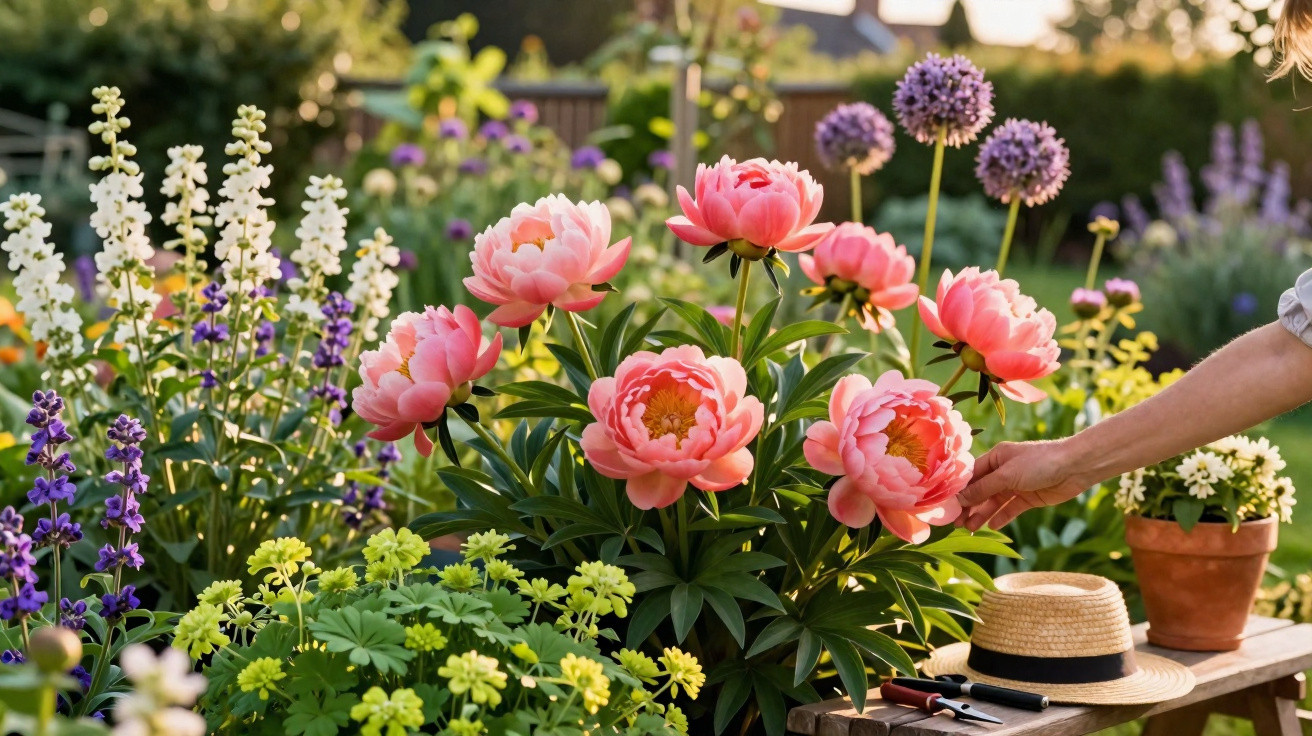
Many gardening enthusiasts simply put peonies anywhere in a border, then wonder why the flowering falls short of expectations. Yet the crucial factor is often not fertiliser or variety, but their immediate companions. Choosing suitable partners helps these perennials perform far better, both visually and in terms of plant health.
What peonies need before companion plants are added
Although peonies are regarded as easy-going, they have definite preferences. Ignoring them can lead to fungal disease and sparse flowering. These perennials favour full sun or light partial shade, along with deep, nutrient-rich yet freely draining soil. Winter waterlogging is especially damaging to their roots.
It is equally important that they do not appreciate pushy plants growing close by. Overcrowded planting keeps foliage damp for too long, encouraging fungi such as grey mould. The roots of vigorous neighbours also compete for water and nutrients.
“Give peonies air, light and space, and you will have sturdier plants and more dependable flowers – year after year.”
Three straightforward principles apply when planning a border around peonies:
- Choose only plants with similar light and soil requirements.
- Avoid positioning substantially taller species immediately in front of the perennials.
- Leave a visible, airy area of open space around every peony.
Alchemilla and other ground-cover plants that make peonies shine
Once the site has been established, the enjoyable part begins: designing the planting. Companions that complement the large, lavish peony blooms without crowding them create a particularly harmonious result.
Alchemilla: a delicate veil rather than competition
Lady’s mantle (Alchemilla) is an especially popular choice. This hardy perennial forms a loose-looking carpet of rounded, gently crinkled leaves. In early summer, a mist of tiny yellow-green flower sprays floats above it. The effect makes pink, white and pastel peonies appear even more striking, both in the border and in a vase.
Lady’s mantle remains fairly low, has shallow roots and takes very little nutrition from peonies. Its foliage also covers the soil, preventing the bare ground between perennials from looking empty.
Bellflower perennials for a lighter border
Perennials with bell-shaped flowers bring movement and an airy quality to a peony border. Many varieties of bellflower, along with comparable perennials, work well because they grow compactly and do not interfere deeply with the peony root system.
One issue does need consideration, however: bellflowers and other delicate species may attract more pests. Anyone wishing to plant them should arrange the surrounding border to include as many “protective plants” as possible, whose fragrance and essential oils have a deterrent effect.
Hydrangeas, iris and daylilies for flowers over several months
Peonies flower spectacularly, but only for a few weeks. With thoughtful planning, they can nevertheless form part of a continuous display running from spring until late summer.
Hydrangeas as a calm backdrop
Hydrangeas make ideal background plants. Their dense shrubs and large flower heads echo the rounded forms of peonies. Positioned some distance behind them, they provide light shade on hot summer days without completely covering the perennials.
The soil may be humus-rich and fertile, provided excess water can drain away well. Hydrangeas cope with sun when there is sufficient moisture, and can be planted from autumn through to spring, depending on the region and weather conditions.
Iris and daylilies: passing on the flowering baton
A staggered flowering sequence is particularly appealing:
- Bearded iris open their flowers shortly before the peonies. Their colours create a link between spring and early summer.
- Peonies then take centre stage with their large, scented blooms.
- Daylilies continue flowering through summer, when peonies are once again showing more foliage than flowers.
This creates borders with no glaring visual gaps. Selecting varieties in related shades gives a calm, refined effect. Those who prefer contrast can deliberately choose complementary hues, such as purple iris beside soft-pink peonies.
Lavender as fragrant protection: beautiful and useful
Lavender is surprisingly well suited to peonies, provided the soil is not too heavy or wet. Both enjoy sunshine and free-draining ground. This subshrub forms dense rows, making it ideal for border edges.
“Lavender offers more than colour and fragrance – it acts like a living protective barrier against many garden pests.”
Its strong scent disrupts numerous insects and even larger visitors. Mosquitoes, flies, some sap-sucking pests and often deer avoid the smell. Planting lavender along a border edge creates a naturally perfumed barrier, allowing peonies to develop more comfortably.
Allium species perform a similar dual function. Their spherical flower heads are decorative, while their sulphurous scent deters a range of insects. Planted among peonies, they add vertical interest while offering some protection at the same time.
Plants that have no place in a peony border
Mixed borders may be beautiful, but not every fashionable plant makes a good companion. A common mistake is using very vigorous ornamental grasses that spread through dense root masses. They draw heavily on the soil’s water and nutrients, depriving peonies of breathing space.
Species that prefer permanently wet, heavy soils are also a poor match. They encourage precisely the persistently damp conditions in which fungal diseases can readily affect peonies. The perennials may then develop limp stems, rotting buds and brown marks on their foliage.
| Suitable companions | Unsuitable companions |
|---|---|
| Lady’s mantle (Alchemilla) | Large, vigorously spreading ornamental grasses |
| Bellflowers and other bellflower perennials | Plants for permanently wet, boggy soils |
| Hydrangeas in the background | Shallow-rooted, nutrient-hungry shrubs planted directly beside the clump |
| Iris, daylilies, alliums | Dense ground-cover plants that grow right up to the stems |
| Lavender as edging | Any species that encourage high humidity within the border |
Practical examples: what a successful peony border looks like
Anyone new to growing peonies can use simple planting combinations as a guide. In one example, place two or three peony clumps in the middle, slightly offset from one another. Add a loose band of lady’s mantle in front, punctuated with individual allium spheres. Set a low hydrangea shrub behind them, with a strip of lavender at the edge.
Another approach focuses more strongly on staggered flowering: plant a row of bearded iris, with peonies behind it and alliums between them, then hydrangeas at the rear of the border. Place daylilies in the front area, where they will flower later. The result is a border that remains active with colour from May into August.
What home gardeners should also consider
Anyone planting new peonies needs patience. These perennials often take two to three years to reveal their full potential. During that period, especially open planting is worthwhile so they can establish roots without stress. The surrounding planting can become denser later, but air circulation must always remain a priority.
When planting, it helps to allow for the space a peony will require in five to ten years. Mature clumps can become impressively large. Planning too tightly can leave you with an overcrowded border only a few years later, where fungal diseases gain a foothold more quickly.
Another often underestimated factor is soil preparation. Deeply loosened ground improved with compost, but not wet soil, is invaluable for peonies. Drainage, for example by adding gravel to heavy soils, substantially reduces the risk of root rot. Those who make this effort at the outset will be rewarded for many years with healthy, abundantly flowering perennials.
Comments
No comments yet. Be the first to comment!
Leave a Comment