
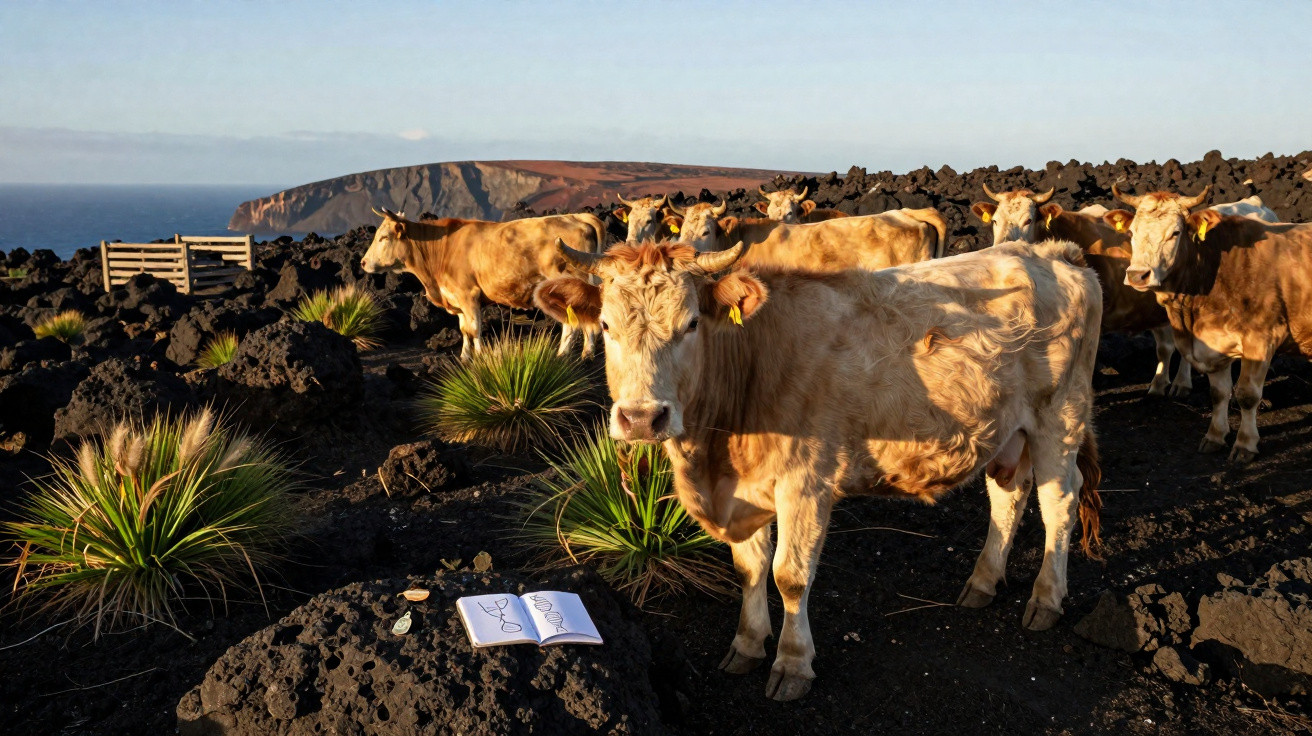
Five cattle taken to a sub-Antarctic island in 1871 founded a population that, several decades later, grew to roughly 2,000 animals. Cut off on Amsterdam Island for almost 140 years, the herd appeared to be doomed by its limited genetic diversity. Yet a DNA analysis published in 2024 uncovered a far more unexpected evolutionary story.
How did just five animals produce such a large herd?
Historical records examined by the researchers show that a French farmer from Réunion Island introduced five cattle to Amsterdam Island in the southern Indian Ocean. Left there in 1871, the animals lived and bred without human management, eventually forming an entirely feral population.
The research, published in Molecular Biology and Evolution, found that the herd reached peaks of close to 2,000 animals in 1952 and again in 1988. This case attracted attention because populations founded by so few individuals usually face substantial risks from inbreeding and the loss of genetic diversity.
What did DNA reveal about these cattle?
Scientists examined samples from 18 animals collected in 1992 and 2006. Their genetic reconstruction showed that the founders did not come from a single lineage. Instead, they carried a mixture of European taurine and Indian Ocean zebu ancestry, increasing the genetic variation available from the outset.
The team led by Mathieu Gautier also identified signs of a severe but comparatively brief population bottleneck. Although inbreeding levels were high, the decline in genetic diversity was judged to be moderate. The researchers also found no substantial removal of highly harmful variants, challenging one possible explanation for the herd's success.
What clues explain survival across so many generations?
One key may lie in the founders' own origins. The study concluded that an important share of the traits needed for survival was probably already present before the animals reached the island. Put another way, they did not need to rapidly acquire every adaptation after becoming isolated.
- The population began with only five cattle introduced in 1871.
- The herd grew to approximately 2,000 animals at points during the 20th century.
- DNA showed ancestry combining European taurine cattle and Indian Ocean zebus.
- Genes linked to the nervous system were among the regions showing signals of selection during feral life.
The authors also found genomic regions mainly associated with nervous-system function and development. They interpret these signals cautiously, but suggest that behavioural changes may have contributed to feralisation - the process in which domesticated animals establish self-sustaining populations in the wild.
Watch the video shared by the YouTube channel DISCOVERING ANIMALS, showing what happened to the cows while they were isolated on the island.
Did these cattle really become smaller because they lived on an island?
A 2017 study published in Scientific Reports had interpreted the cattle's reduced size as a possible case of rapid island dwarfism. That hypothesis combined body measurements with the idea that large mammals isolated on islands can undergo marked changes in size over successive generations.
However, the 2024 genomic analysis offered a different account. The cattle were genetically close to naturally smaller populations, including lineages related to Jersey cattle and Indian Ocean zebus. The authors found no strong evidence of selection favouring short stature, indicating that their ancestors were probably already small.
Why did this extraordinary herd disappear?
The cattle's success had consequences for Amsterdam Island's vegetation and native species. Control measures began towards the end of the 20th century and, as part of environmental restoration efforts, the population was ultimately eradicated in 2010. Local conservation work also included initiatives to restore native plants affected by the introduced animals.
The herd vanished, but its DNA remained preserved in samples collected years earlier. It is this material that continues to tell its story. Examining how five animals gave rise to such a long-lasting population now helps scientists better understand inbreeding, adaptation and feralisation, revealing how unexpected evolutionary experiments can remain hidden even on a remote island.



Comments
No comments yet. Be the first to comment!
Leave a Comment