
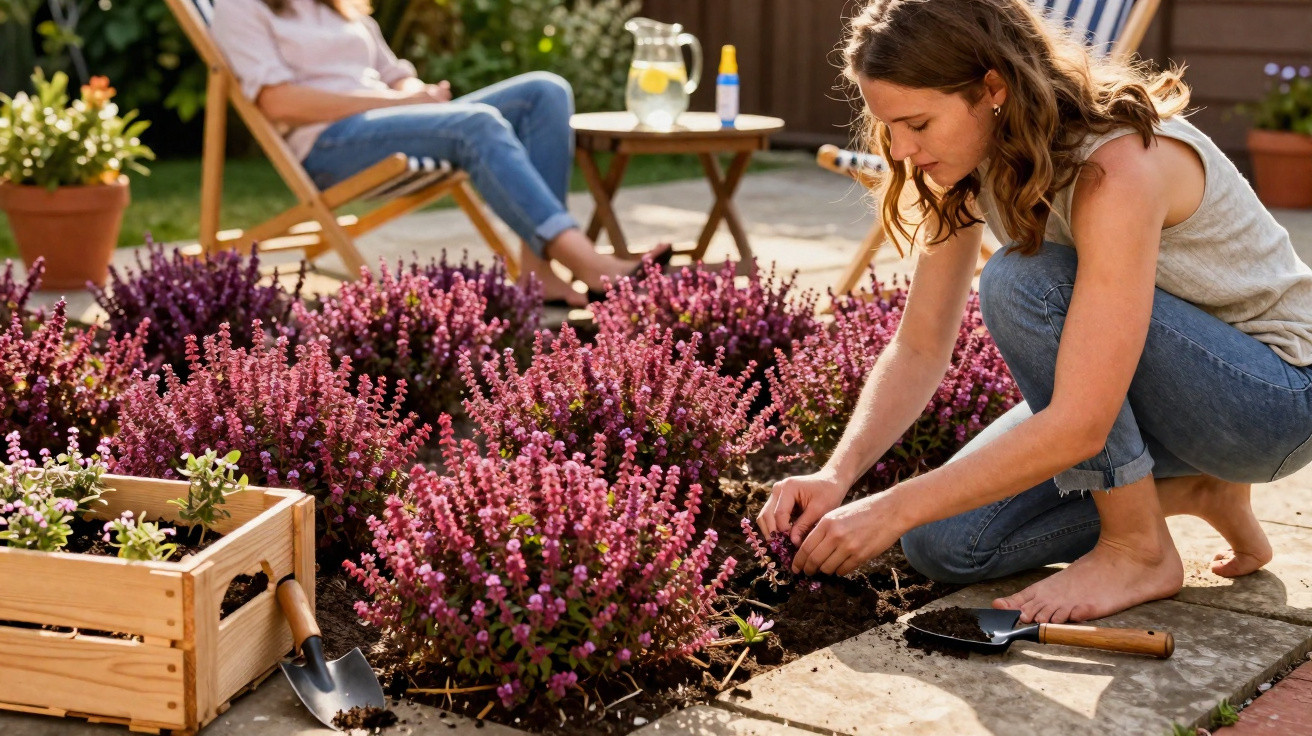
If you are thinking of mosquito sprays, buzzing by your ear and itchy bites, you are on the right track. At the same time, many garden owners struggle with thirsty lawns that turn yellow in summer and need constant mowing. One unobtrusive, low-growing plant can change both: it flowers for months, has a pleasant fragrance and makes life difficult for mosquitoes – while also serving as a lawn alternative.
The understated star: red field thyme as a fragrant carpet
The plant in question is red field thyme, a low, foot-tolerant variety of thyme. It grows to only around 10 cm tall, yet spreads across the ground and gradually forms a dense carpet. It is particularly effective between patio slabs, on dry slopes and in places where a lawn struggles anyway.
From May until September, it produces countless tiny flowers in shades ranging from pink to purple. This makes the garden feel more vibrant without demanding much work. Its leaves remain on the plant all year, adding structure to otherwise bare beds even in winter.
“Red field thyme combines three effects in one plant: a long flowering period, an intense scent and a natural barrier against mosquitoes.”
Unlike many lawn mixes, this thyme tolerates prolonged dry spells. Even during heatwaves, the carpet generally stays green without watering. In areas subject to hosepipe bans or sharply rising water costs, that is a strong argument against a conventional, thirsty lawn.
Why the scent bothers mosquitoes – and delights people
The leaves of red field thyme contain essential oils. We perceive these aromatic compounds as pleasantly spicy and fresh, much like culinary thyme. For mosquitoes, however, this cloud of fragrance is confusing and off-putting.
When you sit on the patio in the evening after taking a few steps over the thyme carpet, its aroma becomes stronger. Crushing the small leaves releases the essential oils into the air. This is when a scented layer forms close to the ground, exactly where mosquitoes dislike it most.
- People: find the fragrance Mediterranean and relaxing
- Mosquitoes: lose their bearings and avoid the area
- Bees and bumblebees: value the flowers as a food source
The plant does not replace mosquito repellent applied to the skin, but it can create a noticeably more pleasant atmosphere around seating areas. Many amateur gardeners report perceptibly fewer bites near thyme carpets.
Plant now: why the timing matters
Spring, before the soil dries out completely, is the best time to plant. By then, the ground has warmed up somewhat, nights are no longer freezing, and young plants can establish their roots quickly.
“Anyone who plants red field thyme before summer can enjoy fragrance, flowers and fewer mosquitoes in the first year.”
The plant prefers poor, free-draining sites. If your garden has heavy clay soil, mix in plenty of sand and some fine gravel. Heavy ground otherwise holds too much water, which can cause the roots to rot.
How to plant red field thyme step by step
- Choose the location: it should be as sunny as possible and not permanently shaded.
- Loosen the soil: dig or fork it over to a depth of around 15–20 cm.
- Improve drainage: work sand and grit into heavy soils.
- Do not fertilise: add neither compost nor general-purpose fertiliser.
- Set out the plants: use 9–12 plants per square metre, spaced 30–40 cm apart.
- Water in: water thoroughly after planting so the soil settles around the roots.
During the first few weeks, it is worth checking the forecast. If there is no rain, watering once or twice a week is sufficient. Once established, thyme will generally manage entirely without watering.
Red field thyme as a smart lawn replacement
Large parts of many gardens are covered with lawn, which needs frequent mowing and substantial watering. Yet only a small proportion of that space is often actively used. This is where alternatives such as red field thyme offer the greatest potential.
Replacing lawn with thyme on slopes, narrow strips alongside paths or areas between paving slabs brings several benefits at once:
- considerably less mowing
- hardly any watering required
- more flowers, more insects and more colour
- a pleasant fragrance with every step
| Lawn | Red field thyme |
|---|---|
| frequent mowing required | no regular mowing required |
| high water use | copes well with drought |
| barely flowers | flowers from early to late summer |
| little fragrance | intense herbal scent |
| does little to deter mosquitoes | its scent disrupts mosquitoes nearby |
It is not completely maintenance-free: once a year, preferably in late winter or very early spring, trim the carpet back lightly. This keeps it dense, encourages fresh growth and prevents it from becoming too woody.
Where the thyme carpet performs best
Red field thyme is not a lawn for football matches, although it can handle normal foot traffic. It is ideal for areas that are walked across regularly but not driven over by heavy equipment or used for constant rough play.
Typical places to use it in the garden include:
- between stepping stones and patio slabs
- on dry banks or slopes
- as edging around seating areas
- in rock gardens and on the tops of walls
- as a gap-filler in sunny borders
If you have a patio seating area, plant a strip of thyme directly along its edge. Walking to the table naturally brushes against the cushions, releasing the fragrance and making the mosquito-deterring effect around the chairs more noticeable.
Practical advice on buying, choosing varieties and combining plants
In shops, red field thyme may appear under several names, including field thyme, sand thyme or carpet thyme. The key point is to check its mature height and suitability as a ground cover. Plants should grow compactly and close to the ground, rather than tall and shrubby like traditional culinary thyme.
Anyone wanting to make their garden less welcoming to mosquitoes with little effort can combine field thyme with other fragrant plants:
- Lavender for additional height and flowers
- Lemon balm in pots near the patio
- Mint in containers to prevent uncontrolled spreading
- Lemon verbena for an intense, fresh fragrance
These mixed plantings create a scented belt around seating areas. At the same time, bees and other pollinators benefit from a broader food supply, making the garden livelier overall.
What to consider: limitations and risks
Although red field thyme seems hardy, a few considerations are important. It needs plenty of sun. In the deep shade of trees or tall hedges, it becomes patchy, grows more slowly and may be overrun by moss. It also copes poorly with waterlogging, such as in spots where rainwater remains standing.
In exceptionally harsh winters, individual plants may die back, particularly where the area is completely exposed to wind. Usually, though, the carpet regrows from the remaining sections in spring. To be on the safe side, plant a larger number of small plants rather than just a few, allowing the area to fill in more quickly.
There is also a point worth noting for families: thyme is non-toxic but highly aromatic. Children and pets can walk over it safely while playing. If you dislike strongly scented areas directly beneath bedroom windows, avoid planting it there and position the thyme carpet nearer the patio and paths instead.
With the right location and a little patience, a bare or laboriously maintained lawn area can become a dense, fragrant carpet. It saves water, reduces work and means the next patio season brings less shouting about mosquito bites.




Comments
No comments yet. Be the first to comment!
Leave a Comment