
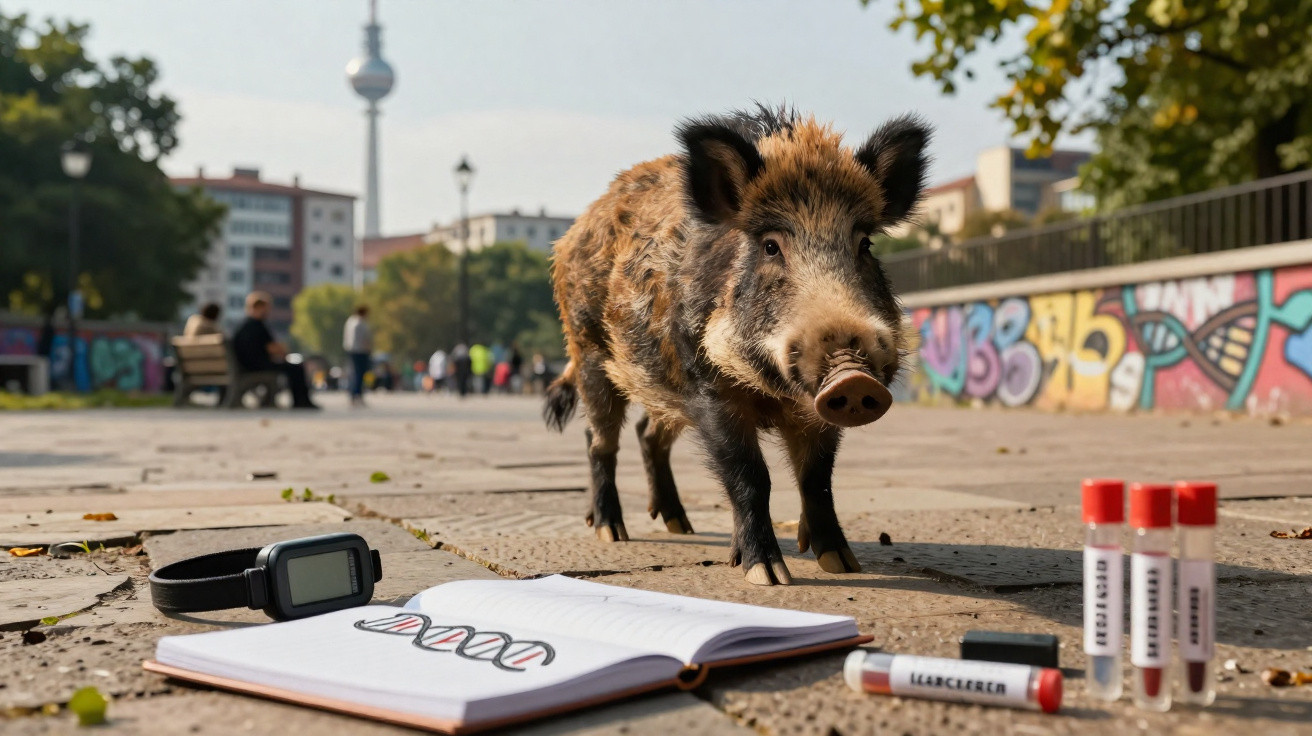
Urban wild boar living in major European cities are not merely a continuous extension of populations in neighbouring countryside. Researchers examining hundreds of animals in Berlin and Barcelona have identified urban genetic groups that are clearly distinct from rural wild boar, showing that city colonisation can reshape gene flow within a single species.
What did researchers find when analysing wild boar?
The project, led by researchers at the Leibniz Institute for Zoo and Wildlife Research, compares populations in Berlin and Barcelona with animals from the surrounding rural areas. The study involves genotyping around 400 wild boar in each of the two cities, using genetic markers that can reveal relatedness, migration and population structure.
Findings so far indicate the same pattern in both regions: animals linked to urban environments make up a distinct genotypic group, separate from that found among rural counterparts. This does not mean they have become a different species; rather, breeding and movement do not fully mix the two groups.
How can researchers tell whether a wild boar came from the city or countryside?
Researchers examine differences in the frequency of genetic variants and use clustering algorithms to establish which individuals are most similar to one another. This form of population genetics can reconstruct part of the history of urban colonisation and identify animals with mixed ancestry. The information being investigated includes:
- which individuals belong mainly to the urban group;
- which have a genetic profile closer to rural populations;
- how much gene flow occurs between the two environments;
- the direction in which animals are moving;
- where specimens with ancestry from both groups are found.
Why did Barcelona show a type of genetic “island”?
A specific study in Barcelona used 19 microsatellite markers to assess whether urban wild boar were isolated or continually mixing with animals from nearby natural areas. The results revealed genetic differentiation despite gene flow, mainly from rural areas towards urban ones. The authors described the urban population as a type of population island within the metropolitan landscape.
Woodland fragments and green spaces may help sustain these groups within, or close to, cities. Where certain animals remain and breed repeatedly in these locations while others move mainly through rural zones, behavioural and spatial separation can leave a detectable signature in DNA over successive generations.
Is the urban environment creating a new wild boar species?
No. The difference identified by the researchers represents genetic structure within the species *Sus scrofa*, rather than the emergence of a separate urban species. Migration between countryside and city still occurs, including among genetically mixed individuals. What is notable is that this exchange has not been enough to erase the observed differentiation.
- Urban and rural wild boar remain part of the same species;
- animals move between the two environments;
- gene flow does not occur evenly;
- urban populations can remain genetically recognisable;
- the degree of connection differs between cities and landscapes.
Why does this genetic difference change how wild boar are managed?
Knowing where animals originate matters because removing wild boar from one urban area alone may not solve the issue if new individuals continue to arrive from neighbouring regions. The data suggest an ongoing dynamic between urban groups and outside populations, which is stronger in Berlin and somewhat weaker in Barcelona. Researchers therefore argue that councils and nearby regions should coordinate their management strategies.
The finding shows that streets, parks, woodland fragments and nearby rural areas create a connected landscape, but not one that is genetically uniform. Mapping the groups, mixed individuals and migration routes makes it possible to understand where new animals come from and why some populations remain established in cities. This is essential for reducing conflict between people and wildlife without treating all wild boar in the region as one undifferentiated population.


Comments
No comments yet. Be the first to comment!
Leave a Comment