
Yellowing leaves, limp flowers and little growth: hydrangeas often look like this when their position is unsuitable or the soil is gradually becoming “tired”. Many amateur gardeners then reach for costly specialist fertiliser. Yet the answer surprisingly often ends up in the food-waste bin – and costs nothing extra.
When hydrangeas struggle: the real issue is in the soil
Hydrangeas are classic ericaceous plants. Like rhododendrons and azaleas, they prefer slightly acidic soil. However, soil in many gardens is more alkaline and chalky. That is where the problem begins.
When the pH level rises too far, the roots find it harder to absorb essential nutrients. The effects soon become visible:
- Leaves turn yellowish but often retain green veins (chlorosis).
- Flower heads remain smaller and have a looser structure.
- The shrub looks weak and generally stunted.
This is often interpreted as “too little fertiliser” or “the wrong weather”. In reality, the soil frequently needs to be moved back towards a slightly acidic condition – and organic matter achieves this far more gently than pouring on fertiliser.
“Anyone who gently lowers the pH of their hydrangea soil restores the plants’ full colour and growing strength.”
Why dried orange peel benefits hydrangeas
Among kitchen scraps, citrus peel – especially orange peel – is a small star for hydrangeas. It would usually be thrown away or added to the compost heap, but it can do considerably more in a flower bed.
For one thing, the material has a mildly acidifying effect on the topsoil. The peel also contains a blend of nutrients that is useful for flowering shrubs, especially:
- Potassium – supports flower formation and cell stability.
- Magnesium – essential for producing leaf chlorophyll.
- Calcium – helps to maintain strong cell walls and healthy root growth.
Together, these minerals encourage vigorous shoots, rich green foliage and sturdier flower heads. This is not an overnight miracle fertiliser, but it supports the plant’s vitality over time – particularly when used regularly as part of a balanced care routine.
Preparing orange peel correctly for hydrangeas
Simply throwing freshly peeled kitchen scraps onto the bed is not a good idea. Whole, damp pieces of peel attract small flies, can easily go mouldy and break down very slowly. They need an intermediate step before they become a useful soil aid.
Step 1: dry thoroughly
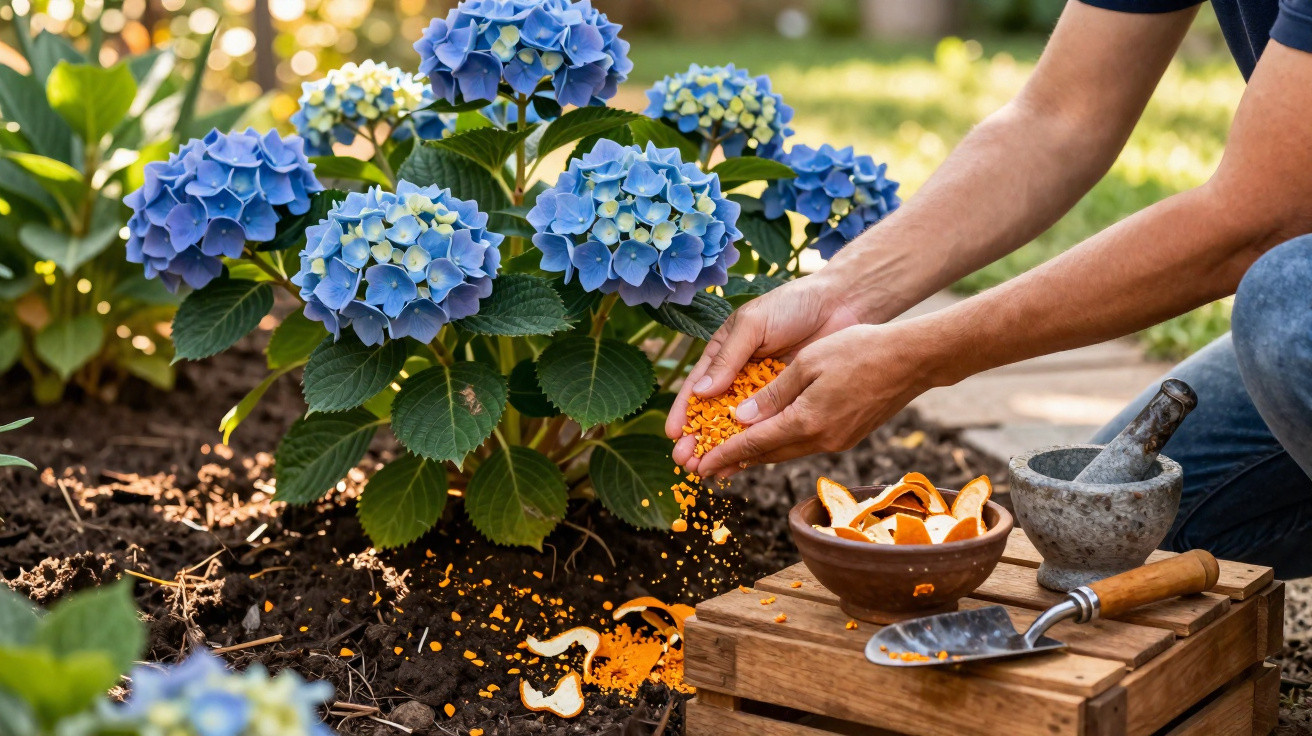
First, dry the peel completely until it is hard and brittle. There are two suitable methods:
- Spread it on a plate or baking tray and leave it for several days in a warm, airy place.
- Dry it in the oven at a low temperature, keeping the door slightly open so that moisture can escape.
Once the pieces snap when bent, they are dry enough. They should not brown or burn, as this causes valuable constituents to be lost.
Step 2: chop or grind
Next, put the crisp peel into a blender or pestle and mortar, or chop it with a sharp knife. A fine, crumbly texture is ideal. The smaller the particles, the faster soil organisms can decompose them and release their nutrients.
If you do not want to use a blender, crush the pieces with a rolling pin inside a fabric bag. The important thing is that you are left with a reasonably fine granulate rather than coarse “peel waste”.
Applying it around the shrub: how much and how often
The prepared orange-peel mix can be used around the root area like a very mild organic specialist fertiliser. The quantity and method are what matter.
For established, vigorous hydrangeas, the usual amount is:
- around one small handful of powder or granulate per shrub;
- spread over the area beneath the canopy;
- roughly once a month throughout the growing season, from spring to late summer.
Do not leave the material in a thick pile in one spot. Instead, apply it as a thin layer, forming a fine ring around the plant. Then lightly cover it with soil or compost. A thorough watering afterwards helps to begin the decomposition process.
“A thin carpet of orange-peel granulate first nourishes the soil organisms – and they then take care of the hydrangea.”
What orange peel can do – and what it cannot
In areas with very chalky tap water or highly calcareous ground, kitchen scraps alone will eventually reach their limits. Orange peel is a helpful addition, but it does not replace a complete soil-care approach.
For long-term strong hydrangeas, it is best to combine several measures:
- regular applications of leaf mould or composted bark;
- mulch layers of bark chips or pine needles;
- rainwater rather than chalky tap water where possible;
- targeted use of organic fertilisers specifically labelled for ericaceous plants.
Orange peel fits into this approach as a small but clever component. It helps to acidify the soil surface slightly, provides extra nutrients and stimulates soil life – while also reducing the amount of kitchen waste.
Risks, limits and useful additions
Although the trick sounds simple, gardeners should keep several points in mind. Using heavily sprayed imported fruit can also introduce pesticide residues from the peel into the garden. Untreated fruit from a reliable source is the better choice.
Dosage is another limitation: excessive quantities of citrus material can temporarily compact the surface of sensitive soils and drive away earthworms. The rule is therefore to use small amounts regularly and combine them with other organic matter.
The method is also interesting for other acid-loving garden plants. Rhododendrons, blueberries, camellias and skimmias can benefit from similarly prepared citrus peel when it is used sparingly. In this way, one kitchen scrap can gently support an entire corner of the garden.
If you are unsure how acidic your soil already is, you can check it with simple test strips from a garden centre. A reading of around 5 to 6.5 is ideal for most hydrangeas. If it is substantially higher, orange peel alone will usually not be enough: larger quantities of leaf mould, specialist composts or even partial soil replacement may be needed.
Hydrangeas have another interesting feature: pH affects not only their health but, in some varieties, the flower colour as well. Blue-flowering types need acidic soil so that aluminium remains soluble in the ground. For anyone wanting to keep blue varieties vigorous, mildly acidifying kitchen aids such as orange peel are therefore a good choice in two ways – for greater vitality and the desired colour effect in the bed.



Comments
No comments yet. Be the first to comment!
Leave a Comment