
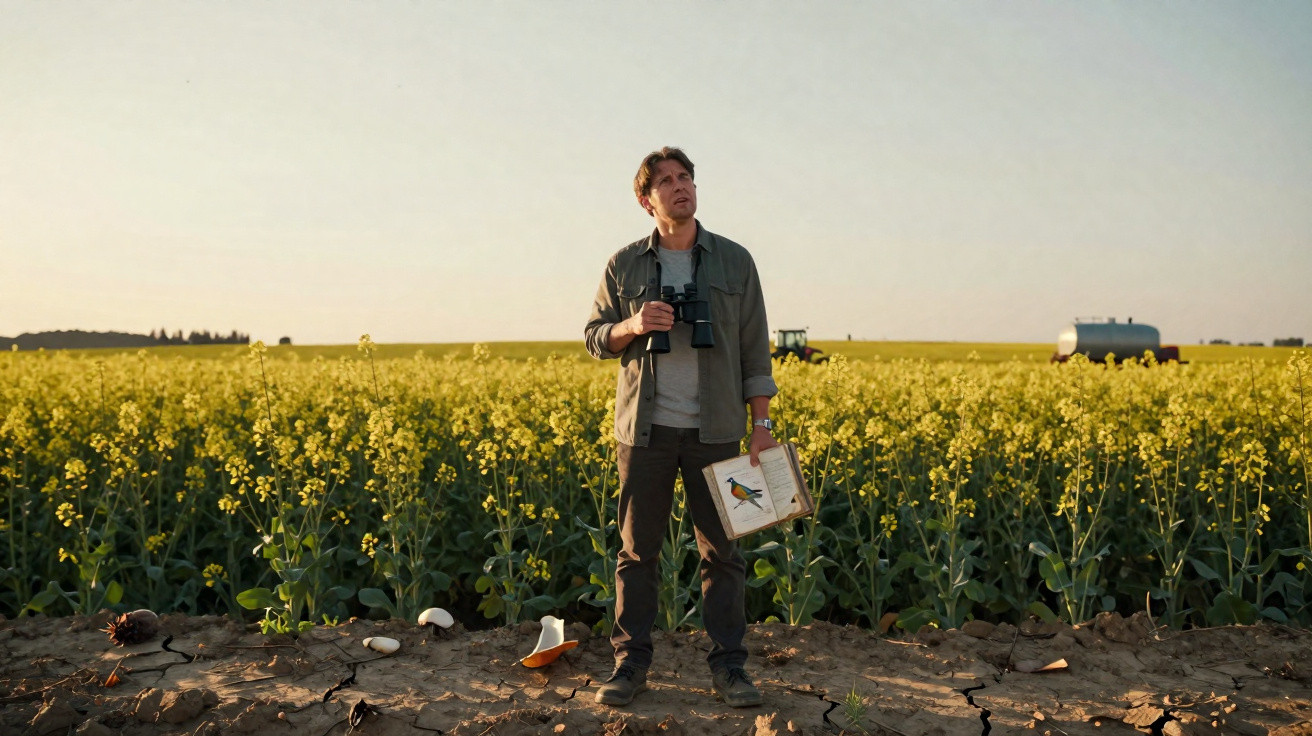
Birds are disappearing from North American landscapes at a rapid rate. A widely noted new study in the journal “Science” now suggests that declines are especially severe where farming is highly industrialised. Pesticides, artificial fertilisers and vast areas of arable land appear to combine to accelerate this negative trend.
Bird decline in fast forward
The research team analysed data for 261 North American bird species collected from 1987 to 2021. This provided an unusually clear view of changes in bird populations over more than three decades.
- Average decline across all populations examined: about 15 per cent
- 47 per cent of species showed a clearly measurable downward trend
- For 24 per cent of species, the decline even accelerated year after year
The researchers looked not only at the number of birds lost, but also at changes in the speed of those losses. This is what makes the findings particularly alarming: in many areas, population decline is not progressing in a straight line but gathering pace like an engine revving up.
“Near large-scale agricultural land with heavy pesticide and fertiliser use, populations are falling considerably faster than elsewhere.”
These hotspots of accelerating decline occur chiefly in regions dominated by intensive agriculture. The result is consistent with an analysis by the International Union for Conservation of Nature (IUCN), which had already found that populations are declining in 61 per cent of bird species worldwide, with intensified farming among the principal drivers.
How industrial farming puts birds under pressure
Industrial agriculture can transform entire landscapes remarkably quickly. Places once occupied by hedgerows, woodland, wetlands or species-rich meadows are often replaced by monocultures of maize, soya or wheat.
Habitat loss caused by land conversion
For birds, this means nesting sites disappear, refuges are lost and food becomes scarce. Typical measures involved in converting land to arable production include:
- Removing lines of trees, hedgerows and small woods
- Levelling fallow land and wetlands
- Constructing access roads, storage buildings and livestock facilities
As a result, people fragment habitats that were previously connected. Species dependent on varied landscape features, including ground-nesting and woodland birds, lose several resources at the same time.
“When hedgerows, old trees and fallow land disappear, a complex ecosystem turns into a green yet largely lifeless production area.”
Poison for insects, hunger for birds
The extensive use of fertilisers and crop-protection products is at least as consequential. Although these substances primarily target pests and “weeds”, their effects run through the whole food web.
Many songbirds feed insects to their young, especially during the breeding season. This is where industrial farming has a direct impact:
- Insecticides reduce beetles, caterpillars, midges and other arthropods, all of which are valuable energy sources for birds.
- Herbicides eliminate wild plants where insects live or gather nectar.
- Artificial fertiliser alters the composition of plant communities, often benefiting only a small number of grass species.
The study concludes that the damage is caused less by birds being poisoned directly. At the heart of the issue is the loss of food. When insects disappear, many species lose their nutritional base, creating a critical bottleneck above all during breeding and chick-rearing.
Double pressure: agricultural industry meets the climate crisis
The team also identified a clear link between rising temperatures and falling bird numbers. Heatwaves, shifting rainfall patterns and extreme weather events place additional strain on birds.
“Intensive agriculture and climate change do not act separately; they reinforce one another, with noticeable consequences for birdlife.”
In areas that have warmed especially strongly, bird populations in industrially farmed zones performed even worse. There are several reasons for this:
- Cleared land provides little shade, causing soil temperatures to rise.
- Felled trees are no longer available to store CO₂ and bind greenhouse gases.
- Monocultures retain less water, so soils dry out more quickly.
Birds consequently face several pressures at once: they must cope with heat, find less food and make do with fewer secure nesting sites. Populations already weakened beforehand are particularly vulnerable to these conditions.
Which species suffer most?
The study covers a wide range of species, from woodland birds and larks to waterbirds. The groups most severely affected are those closely associated with agricultural landscapes or reliant on insects as their main food source.
These typically include:
- traditional farmland birds such as larks and buntings
- swallows and swifts that hunt insects over fields
- certain birds of prey whose prey disappears from intensively cultivated land
Species with broader diets and greater flexibility appear able to cope somewhat better for now. However, they too are coming under growing pressure as landscapes become increasingly uniform.
Routes out of the dead end: making agriculture more bird-friendly
The researchers explicitly point out that land can be managed differently. Worldwide, trials described as “regenerative agriculture” or “ecological intensification” aim to maintain yields while also protecting biodiversity.
Core principles for more bird-friendly farming
From an ornithological perspective, several measures could have a particularly strong effect:
- Less pesticide and herbicide use
Every spraying operation avoided improves the likelihood that insects survive and remain available as food. - Allowing structural features
Hedgerows, field margins, small ponds and mature trees provide nesting places and shelter. - Breaking up monocultures
Mixed cropping, crop rotation and smaller fields create a mosaic that benefits many species. - Fallow land and flower strips
Land that is “unproductive” in the short term can provide pollinators, beneficial insects and bird territories over the longer term.
“The more varied the structure of an agricultural landscape, the more likely it is to support a diverse bird community.”
What these findings mean for Germany and the DACH region
Although the study concerns North America, the similarities with central European farming regions are clear. Large-scale monocultures, heavy fertiliser and pesticide use, and steep declines among traditional farmland birds also dominate here.
In many parts of Germany, the grey partridge, northern lapwing and skylark are already regarded as conservation concerns. The new data offer another argument for aligning agricultural policy, subsidies and land-use planning more closely with environmental criteria.
Terms worth knowing
Several key terms recur in connection with the study and help place these relationships in context:
- Industrial agriculture: highly mechanised production geared towards high yields, with large fields and intensive chemical use.
- Monoculture: the cultivation of a single plant species over extensive areas for years at a time – efficient, but generally ecologically impoverished.
- Regenerative agriculture: an approach that prioritises soil building, humus formation, diversity and circular thinking.
- Decline hotspot: an area where populations are not merely falling, but where the rate of decline itself is becoming faster.
For farmers, shifting towards more nature in the fields can also bring long-term benefits: healthier soils, more stable harvests, reduced reliance on costly inputs and a landscape once again filled with more chirping, fluttering and song.


Comments
No comments yet. Be the first to comment!
Leave a Comment