
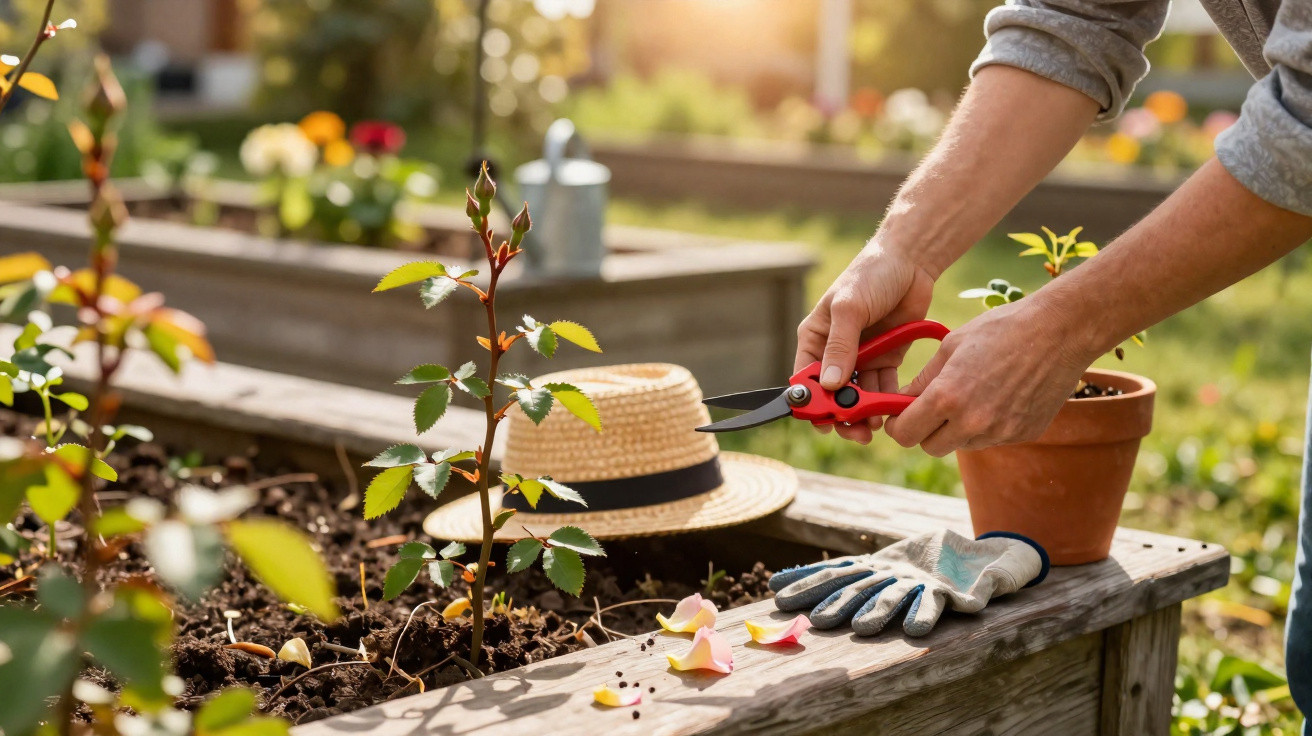
The air still carries a faint scent of winter: damp soil and cold metal, just as the first pair of secateurs clicks shut. In the neighbouring garden, an older woman bends over her roses, her face intent and her movements remarkably decisive. A few houses away, a young man in a hoodie carries a battered bucket already holding a small mound of cut branches. The same scene is playing out everywhere: people in wellington boots, red hands and slightly runny noses – and, all at once, every shrub looks a little ragged. For a moment, you might wonder why they are doing this to their plants precisely now, when everything is about to grow again.
The apparently harsh cut – and why it makes plants stronger
Walking through a residential area in early spring, you could be forgiven for thinking that everyone has collectively lost the plot. Shrubs are being cut back severely, perennials trimmed almost to ground level, and fruit trees shaped as neatly as beard lines before a job interview. It can look severe, even unkind. Yet there is a distinctive calm to the task. This is the quiet, almost meditative kind of gardening in which you suddenly notice the sound of a woodpecker tapping in the woods. Beneath it all is one thought: If I prune properly now, summer will be all the more abundant.
It is a familiar scene: the first mild Saturday in March, a jumper still worn beneath an old gardening jacket, and suddenly everyone is outside with loppers and saws. One neighbour explains that she cuts back her hydrangeas the same way every year, “my mother did it that way too”. Someone else proudly shows off his apple tree, which bore twice as heavily after a bold prune the previous year. Some local councils even publish short pruning calendars showing when particular woody plants should be tackled. The results can be striking: gardeners repeatedly report noticeably larger blooms, more fruit and healthier plants after a well-timed spring prune.
There is a fairly straightforward piece of plant biology behind it. During winter dormancy, woody plants store energy in their roots and wood. As temperatures rise, that stored strength is channelled into the buds. If old, diseased or poorly positioned shoots are removed in late winter or early spring, the plant can direct its energy towards fewer, better-placed buds. The outcome is sturdier growth, stronger shoots and considerably more flowers. More light and air can also reach the centre of the plant, giving fungal diseases fewer opportunities to take hold. Spring pruning is not sadism; it is rather like a health check and a haircut for the garden rolled into one.
How experienced gardeners prune in spring without the drama
Anyone attempting their first spring prune should begin with one simple rule: look first, cut second. Start by identifying dead shoots – they are brittle, with brown rather than juicy green tissue inside. These can be removed without hesitation. Next comes the plant’s shape: branches growing inwards, rubbing points and unruly crossing shoots. Many gardeners work from the outside in, stepping back regularly to assess the overall outline. Almost all of them follow one principle: it is better to make one clean cut immediately above a bud than ten tentative snips.
Most garden mishaps happen when people become too perfectionist. Roses are cut as though they are undergoing open-heart surgery, while lavender is pruned so timidly that it ends up woody at the bottom and sadly matted at the top. Let us be honest: nobody checks every single branch against a textbook. Nor do they need to. What matters far more is a sense of rhythm and timing: do not start too early if severe frost is still expected, but do not leave it until fresh growth is already well underway. Once you have seen a seemingly “cut to the ground” perennial burst into life in May, the fear of decisive pruning soon disappears.
A seasoned fruit grower from the Palatinate once told me, on a frosty morning among his trees:
“Pruning does not hurt. Neglect is what hurts. An unpruned tree is like an overfilled diary – everything is in there, but nothing has room to truly flourish.”
- When in doubt, leave fewer leaves and create more light: plants need sunshine within the canopy, not only around its outer edges.
- Remove diseased wood first, then crossing branches: create order before moving on to the finer work.
- Keep tools sharp and clean: smooth cuts heal more quickly and are less likely to spread disease.
- Do not try to learn everything in one day: one section of the garden each weekend is perfectly enough.
- One mistake each season is normal – gardens are more forgiving than you might think.
More than technique: what spring pruning has to do with us
Anyone who has deliberately watched the faces of people cutting back their plants in spring will recognise an interesting expression. It is a blend of concentration, caution and quiet anticipation. There is a strange satisfaction in seeing an overgrown shrub suddenly regain its shape. Just as when clearing out an overcrowded cupboard, space appears: for air, for light and for something new. Perhaps that is exactly why this ritual moves so many people – it feels like a visible fresh start after the dark months. You are not merely cutting wood; you are cutting away a small part of winter too.
| Key point | Detail | Benefit for the reader |
|---|---|---|
| Spring as the ideal pruning time | The plant has stored energy reserves and new growth is imminent | Understands when pruning has its greatest effect |
| Targeted pruning rather than “snipping about” | Removal of diseased, old and crossing wood | Learns how plants can become healthier and longer-lived |
| An emotional reset through gardening | Pruning as a ritual of clarity and renewal | Experiences gardening as restorative balance rather than simply a chore |
FAQ: Spring pruning
- How can I tell whether a shoot is truly dead? Lightly scratch it with your fingernail: if the tissue beneath is green and moist, the shoot is alive. If it is brown and dry, it can be removed without concern.
- When is the best time in spring to prune? Many gardeners use forsythia flowering as their guide: once it is in bloom, the harshest frosts have usually passed and most shrubs are ready to be pruned.
- Can I cut back my plants in autumn as well? Some can be, but many respond better to pruning in late winter or very early spring. Autumn pruning may make young shoots more vulnerable to frost.
- What if I accidentally cut off too much? Stay calm: many perennials and shrubs produce surprisingly vigorous new growth. In the worst case, one season may be a little sparse, but the garden usually recovers faster than expected.
- Which plants are better left unpruned in spring? Early-flowering plants such as forsythia and flowering currant are best pruned immediately after flowering; otherwise, you will remove this year’s flower buds at the same time.



Comments
No comments yet. Be the first to comment!
Leave a Comment