
Bare patches, yellow marks, waterlogged ground.
Many people instinctively reach for chemical moss treatments at this point. Garden professionals, however, recommend a different approach: complete three simple jobs in March and you can make your lawn considerably denser, greatly reduce moss and improve the soil for the long term – without specialist products.
Why lawns suffer so much after winter
After months of rain, snow and limited sunshine, the soil is under considerable strain. Water collects in low spots, the turf becomes thatchy and the ground is compacted. These are precisely the conditions in which moss spreads – not as an “enemy”, but as a warning sign.
Moss in a lawn nearly always means that the soil is compacted, poorly aerated and usually too wet or too shady.
Rather than treating the green growth with moss killers, it is worth addressing the cause. Compacted soil retains water like a sponge. Grass roots receive too little oxygen, so they remain shallow and weak. Moss, by contrast, copes well with these conditions – and takes advantage of the gap.
This is where March lawn care comes in: the soil is loosened, water can drain away and air reaches the roots. As a result, grass is once again better placed to outcompete moss.
First task: aerate the lawn with a garden fork or aerator
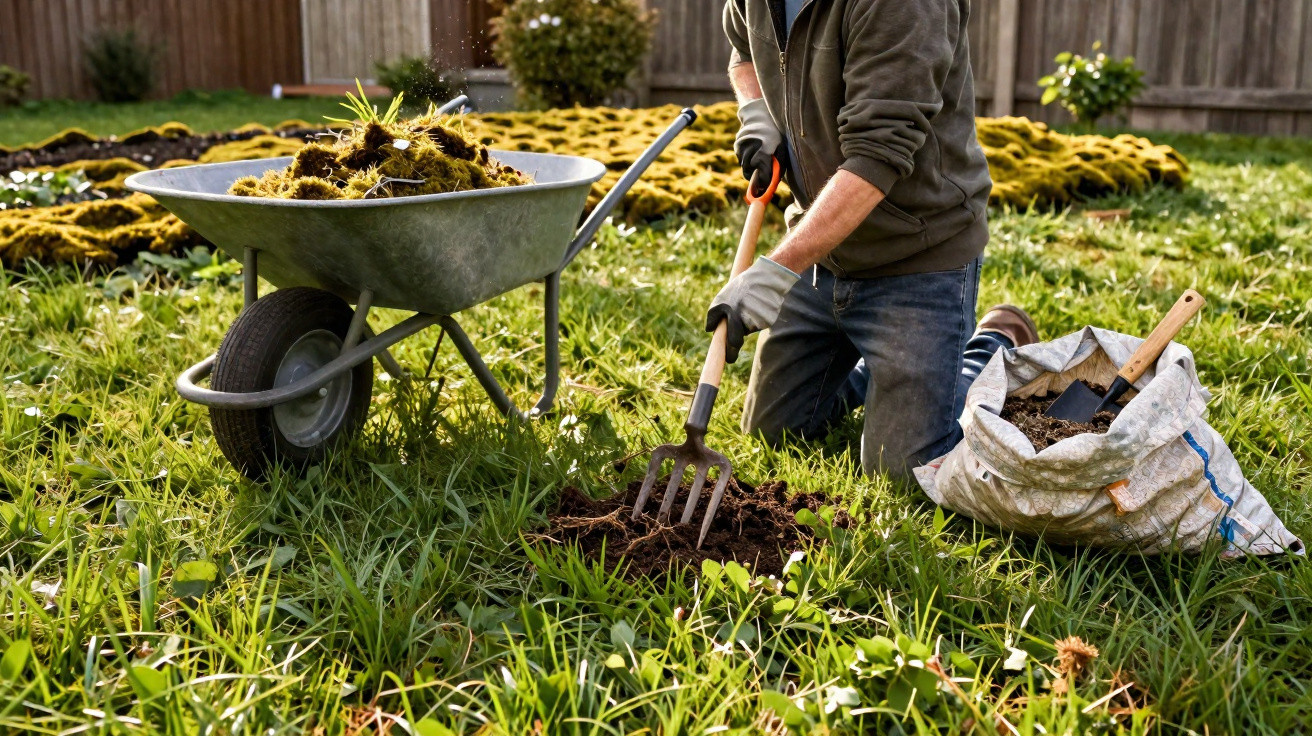
The most important job is aerating the soil. A standard garden fork is enough for small areas, while larger lawns benefit from a dedicated aerator or a hired machine from a DIY shop.
How home gardeners should use a garden fork
- Wait until the ground is no longer frozen and is not completely saturated.
- Push the fork tines around 8–10 cm into the soil.
- Tilt the handle slightly backwards or sideways to open up the ground.
- Repeat at roughly 15 cm intervals, working methodically across the lawn.
- Work particularly thoroughly where puddles form or where the soil sounds “hard”.
This creates numerous small air channels. Water is less likely to collect, oxygen reaches further into the ground and the roots can spread.
One dry afternoon is often enough to aerate an entire medium-sized lawn.
If waterlogging is a recurring problem, plan to aerate once a year. Depending on the region, the best window is from late February to late March, once the soil has warmed slightly.
Second task: “feed” the lawn with a thin layer of soil
Aerating is followed by a step that many home gardeners still barely know: topdressing, meaning a thin application of soil or a soil-and-sand mix over the lawn.
A suitable mix for the home garden
A straightforward blend of three components has proved effective:
- finely sieved garden soil or potting compost;
- coarse sand, not play sand;
- mature, sieved compost or leaf mould.
Every component should be dry and crumbly. If you do not have everything available, use coarse sand at the very least – that is certainly better than nothing.
How to spread the mix correctly
Scatter the mixture thinly over the lawn after making the holes. One spadeful per square metre is usually sufficient. The layer should not cover the grass; it should sit over it like a light veil.
Then brush it into the holes using a sturdy broom or yard broom. That is exactly where the material should go: into the air channels and fine cracks created by the fork.
Topdressing improves soil structure, encourages drainage and supplies grass roots with nutrients – a natural boost for a dense lawn.
Over time, the sand, soil and compost combine with the existing ground. The soil becomes looser, more even and less prone to waterlogging. Grass roots grow deeper, while the lawn becomes denser and more hard-wearing.
Third task: rake out moss vigorously – then mow higher
Next comes the part that can look alarming at first – but that is also why it is so effective.
Remove moss and thatch thoroughly from the lawn
Before the first spring mow, it is worthwhile giving the area a firm rake. A traditional lawn rake with metal tines or a scarifying rake is ideal.
- Work on the lawn when it is as dry as possible.
- Rake firmly in both lengthways and crossways directions.
- Pull out thatch, dead grass and moss generously.
- Collect the material and add it to the compost heap.
On heavily thatchy or moss-covered lawns, it is unsurprising if several wheelbarrows of plant material are removed. It may seem harsh, but it gives the grass light, air and room to grow.
First spring mow: higher is better than shorter
Mow for the first time straight after raking, but do not cut the grass too low. A cutting height of around 4–5 cm is suitable at the start of the season. Cutting lower weakens the grass unnecessarily.
The lawn often looks alarmingly bare after raking and the first mow – but after one to two weeks, it grows back noticeably denser.
At this stage, the earlier soil work pays off. Roots have access to more air and nutrients, allowing the grass to put on strong new growth quickly – and deprive moss of its habitat.
When these lawn jobs are best done
In mild areas, you can begin as early as late February, once the soil is no longer frozen. In cooler regions, mid to late March is generally the ideal period. The key point is that the ground must not be waterlogged. Working on overly wet soil would cause more harm than good, as the turf would be crushed.
| Region | Starting period | Note |
|---|---|---|
| Mild lowland areas | Late February to early March | Begin when the ground is frost-free and has dried out slightly. |
| Moderate areas | Mid-March | Check that the soil has warmed up; it is better to wait a few days. |
| Cooler upland areas | Late March | Do not work on frozen or heavily saturated soil. |
Useful additions for a consistently strong lawn
Anyone who takes the trouble to loosen the soil, work in a soil mix and remove moss is creating an excellent foundation. A few additional measures can strengthen the effect even further.
Fertilise properly rather than overfeeding
An organic or organic-mineral lawn fertiliser applied in April supports growth without “scorching” the soil. Importantly, do not over-fertilise immediately after aerating; give the plants time to form new roots first. Too much nitrogen promotes rapid but soft growth, which makes it easier for moss to benefit again.
Seed for bare patches
Where larger gaps remain after raking, overseeding with a specialist lawn-repair seed mix is worthwhile. The freshly loosened areas are ideal for this. Rake the seed in lightly, firm it down gently and keep it evenly moist over the following weeks.
Why these three tasks achieve more than any moss killer
Chemical moss products generally tackle only the symptom – the unwanted green growth disappears for a while, but the underlying soil problem remains. The March routine of aerating, topdressing and vigorous raking instead tackles the triggers: compaction, waterlogging and lack of light around the root zone.
The lawn responds with denser growth and deeper roots. This effect becomes stronger with every season when the measures are repeated regularly. Gradually, this creates a robust, hard-wearing carpet that stands up better to everyday life – whether children are playing football, you are having a barbecue or simply walking barefoot in summer.




Comments
No comments yet. Be the first to comment!
Leave a Comment