
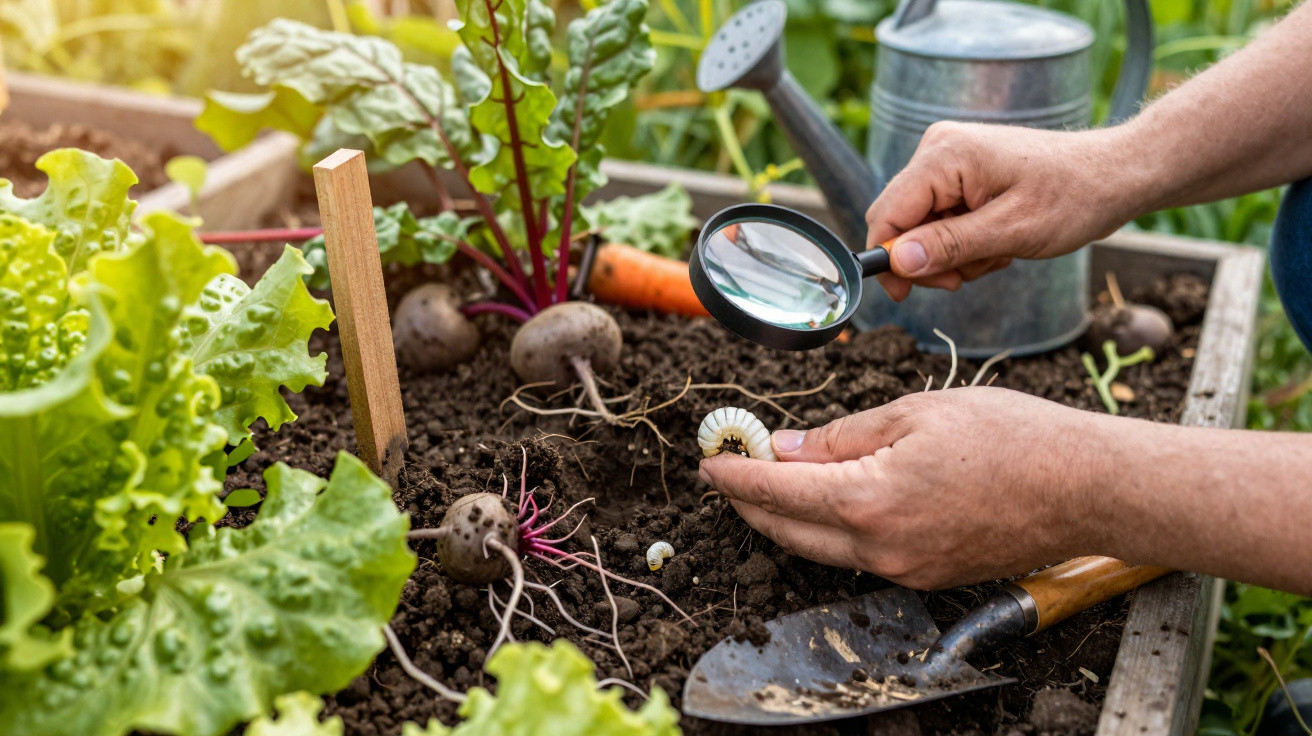
Thick, white grubs suddenly appear in the vegetable bed – is it time to panic in the garden?
Not necessarily. Their presence can reveal far more than you might expect.
Many amateur gardeners are alarmed when they uncover plump, curved larvae while digging. Their immediate reaction is often to get rid of them. A closer look, however, may show that these creatures are a valuable sign of soil quality – and, in some cases, important allies for healthy beds.
Hidden life below ground: not every larva is a pest
Beneath the soil surface, life is thriving: earthworms, woodlice and beetle larvae all help to break down plant matter and loosen the ground. Among them are large white larvae which, at first glance, can look much the same.
This is where the misunderstanding starts. Many people lump them all together and regard them as enemies. In reality, there are two very different groups:
- harmful root feeders that can severely damage vegetables and ornamental plants
- beneficial “soil workers” that create compost and humus
“Anyone who instinctively kills every white larva often destroys the very helpers that make the soil fertile.”
Common pests: cockchafer grubs and others at the roots
The best-known troublesome examples are the larvae of cockchafers. These grubs feed heavily on the roots of vegetables, strawberries, perennials and young trees. Plants may become stunted, suddenly wilt or pull from the ground with almost no resistance because their roots have been chewed away or partly destroyed.
The larvae of weevils, such as vine weevils, are just as deceptive. They have no visible legs, remain well hidden in the soil and systematically feed around the root zone. From above, the plant can initially appear healthy before suddenly collapsing.
- Cockchafer larvae: thick and curved, with strong thoracic legs; they eat roots
- Weevil larvae: legless, white and concealed around roots
- Crane fly larvae (for example, European crane fly larvae): favour damp lawns and young plants
If their numbers increase greatly, these species can thin out entire beds.
Beneficial creatures out of sight: when “grubs” make humus
In contrast, larvae of certain rose chafer species are commonly found in gardens. Although they may initially resemble cockchafer larvae, they perform valuable work underground: they shred dead plant material and turn it into nutrient-rich humus.
These larvae are often found in compost, old leaf piles, rotting wood or bed areas that are particularly rich in humus. They do not eat living roots, feeding only on dead plant remains.
“Where these beneficial larvae live, the soil quality is usually good too: there is plenty of organic matter, a loose structure and active soil life.”
What white larvae reveal about the health of your vegetable bed
The number and type of larvae offer a direct indication of conditions in the vegetable bed. If you only occasionally come across one while using a spade, there is little cause for concern. A larger concentration, by contrast, suggests that something in the system has become unbalanced.
Signs of compacted or excessively wet soil
Many damaging larvae favour compacted ground that is poorly aerated and continually damp. If rainwater sits on the surface for a long time, or the soil below the surface remains sticky and heavy, these species thrive.
Such conditions often result from:
- watering too frequently or for too long
- heavy soil without added sand or compost
- repeatedly walking over the same area, causing compaction
- bare soil, which can lead to surface capping
Soil heavily populated by root-feeding larvae generally needs structural improvement: loosening, more organic matter and adjusted watering.
A lack of natural predators in the garden
White larvae are an energy-rich food source for birds, hedgehogs and some bats. When pests can multiply without disturbance, this often points to a shortage of natural predators.
Typical warning signs include:
- very few birds visiting the garden
- no shelter for hedgehogs, such as hedges, leaf piles or quiet corners
- sterile areas without dead wood, leaves or shrubs
“A garden without hiding places for hedgehogs and shrubs for birds gives pests a stage with no opposition.”
Responding correctly: what to do when thick larvae appear in the bed
Before reaching for chemical treatments or angrily crushing every larva, it is worth taking a careful look and following a calm approach.
Identify first, then take action
If you find a larva while gardening, briefly place it on your hand or on a firm surface and check the following:
- Does it have clear thoracic legs, or is it legless?
- Is it in compost or old plant remains, or directly beside living roots?
- How robust is its body, and how pronounced is its head?
Larvae found mainly in compost heaps or decomposing plant matter usually belong to beneficial soil-dwelling species. In these cases, simply move them gently back to a suitable spot – ideally the compost heap or beneath a layer of leaves and mulch.
Relocate friendly larvae rather than destroying them
Once you have identified a beneficial larva, you can give it a more suitable home:
- place it in the compost heap
- put it beneath a layer of grass clippings, leaves or chipped branches
- move it to a quiet garden corner with plenty of organic material
There, it can continue breaking down plant material and provide the garden with valuable humus over time. This improves soil fertility and, in turn, the harvest.
Target harmful species specifically
If you notice obvious root damage and find many typical pests nearby, act before entire beds fail. The first step is to collect and remove any visible larvae while digging. You can offer them to birds or hedgehogs on a shallow dish, which also encourages these beneficial animals to return to the garden.
For severe infestations, using nematodes can be worthwhile. These microscopic roundworms specifically attack certain larvae and are considered a standard biological measure in horticulture. They are mixed with water and applied to the soil, where they seek out pests in the root zone.
“Nematodes work unseen in the background, but attack only the target organisms and are harmless to plants, people and pets.”
How to prevent future population explosions
To stop thick white larvae from becoming a nuisance in the first place, focus on preventative measures. Many problems arise from one-sided cultivation and overly sterile garden areas.
Living structures instead of a “tidy” garden
Allowing hedges, shrubs, small wild corners, leaf piles and dead wood provides refuges for birds, hedgehogs and other beneficial wildlife. They will then patrol the garden regularly and reduce pest numbers without human intervention.
Also helpful are:
- mulching beds instead of leaving soil bare
- growing mixed crops rather than large monoculture areas in the vegetable garden
- avoiding broad chemical treatments that also destroy beneficial organisms
Improve soil structure and adjust watering habits
Healthy soil is loose, well aerated and rich in organic matter. If you have heavy clay soil, you can improve it gradually with sand, compost and green manure. This makes the area less appealing to harmful larval species.
Watering habits also deserve a critical review: water less often but thoroughly, rather than applying small amounts every day. This encourages roots to grow deeper and lets the upper soil layer dry out slightly between waterings. Damp, waterlogged areas can be significantly reduced in this way.
Why looking closely in the vegetable bed pays off twice
Anyone who sees thick white larvae only as “disgusting grubs” overlooks their value as a diagnostic tool for their own garden. They show how balanced conditions are below ground: are there enough beneficial organisms? Is the soil alive or compacted? Is watering appropriate?
With a little practice, it takes only seconds to tell dangerous root feeders apart from useful compost workers. What begins as a moment of alarm while digging can therefore become a clear advantage: you understand your own soil better and can make targeted adjustments instead of fighting blindly.


Comments
No comments yet. Be the first to comment!
Leave a Comment