
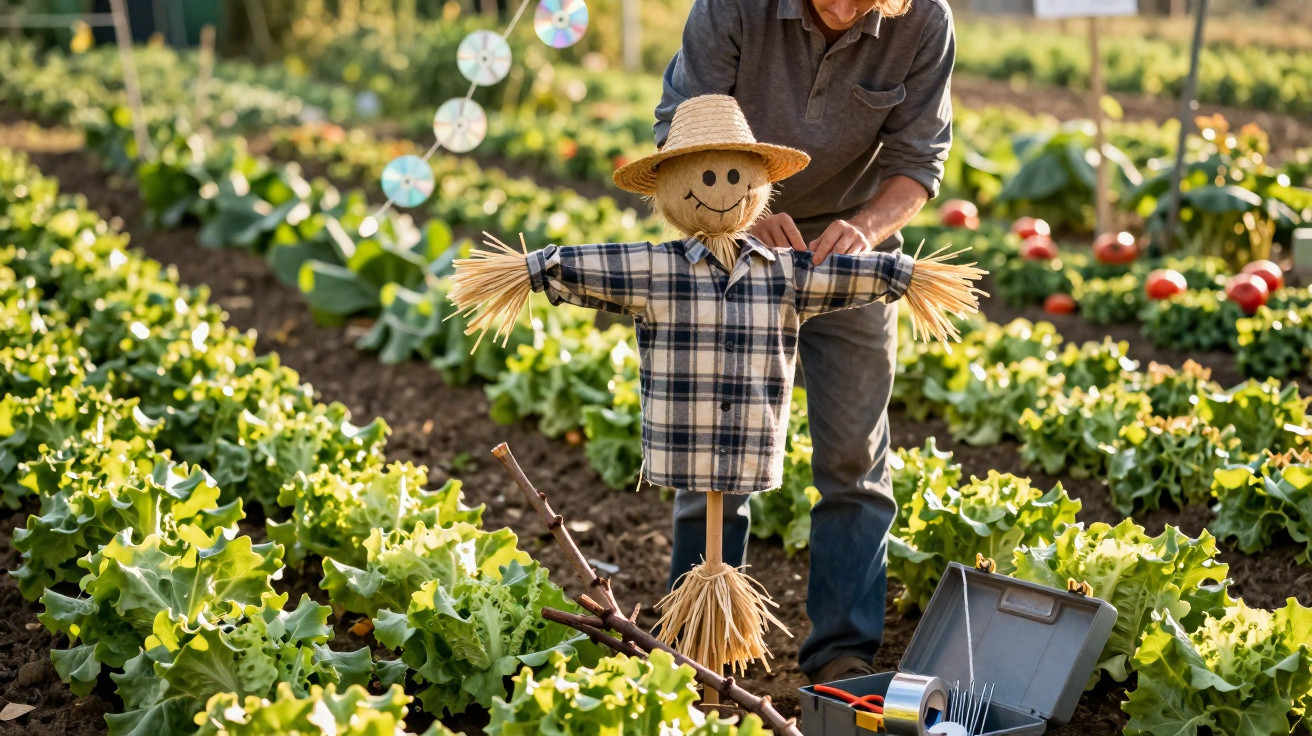
Many garden owners know the same frustration: after weeks of careful tending, the finest fruit is suddenly pecked at, half-eaten or gone altogether just before harvest. Blackbirds, starlings or sparrows are often responsible. Rather than turning to nets or drastic measures, more and more people are rediscovering an age-old solution: the scarecrow. Built and positioned properly, it keeps birds away without harming them – and can look rather good too.
Why scarecrows are popular again today
Whether in an allotment, traditional orchard or on the apple tree at the front of the house, birds are naturally drawn in as soon as buds open and fruit begins to form. They do not only peck ripe fruit; they can also damage young shoots and buds.
“A scarecrow protects the harvest, works entirely without chemicals and can be made yourself with very little effort.”
Compared with close-mesh netting, the figure has a clear advantage: birds cannot become trapped in it, hedgehogs and other small animals are left undisturbed, and the garden does not look as though it has been wrapped up. A scarecrow deters birds primarily through its outline and movement, imitating a human presence in the garden.
Materials: what you actually need
A practical scarecrow requires only a basic frame, some stuffing and old clothes. Almost everything can be found in a cellar, garage or among unwanted household items.
A wooden or branch frame
The foundation is a cross made from two sturdy poles:
- 1 long pole or thick branch, at least 1.50 metres tall – ideally 1.80–2.00 metres
- 1 shorter piece of wood for the “arms”
- screws, nails or strong cord for fastening
Attach the shorter pole horizontally at roughly one third of the total height. This creates a T-shape that will later suggest an upper body with arms.
Clothes and stuffing
To turn the wooden frame into a figure, you need a “body” and “head”:
- old trousers and a long-sleeved shirt or jacket
- straw, wood shavings or old fabric scraps for stuffing
- string or wire to secure the trouser legs, sleeves and waist
- for the head: an inflated or damaged balloon, hessian sack, old fabric bag or an upside-down flowerpot
The important thing is to choose materials that can withstand rain and wind. Delicate stuffing such as newspaper quickly becomes soaked, goes mouldy and attracts pests.
Build your own scarecrow step by step
1. Assemble the cross
First, position the long pole upright. Fix the shorter pole horizontally at around chest height, or approximately one third of the way up. Use screws, nails or strong wire wrapped around several times. The cross must not wobble.
2. Dress and stuff the figure
Put the trousers and top onto the cross. By this point, the garden’s future “resident” will already start to take shape. Then fill the trouser legs, torso and sleeves with straw, shavings or fabric scraps. The fuller it is, the more human the figure will appear.
Use string to tie the trouser legs together at the bottom and secure the waist and sleeve ends. A few stems of straw can be left visible at the “hands”. This gives it a livelier look and reinforces its silhouette.
3. Create a striking head
Place a form at the top of the long pole for the head. A balloon wrapped in fabric, a filled sack or a flowerpot is entirely sufficient. Painted-on eyes, a nose and a mouth may look silly to people, but birds need only the shape of a head as a warning signal.
A hat, cap or old cycle helmet increases the effect while also giving the material extra protection from rain.
The right position in the garden
Where you place it largely determines whether birds take the figure seriously. A site where the wind can make it move gently is ideal.
- In the middle of the garden: Place it near the most vulnerable areas, such as berry bushes or fruit trees.
- In an open spot: Keep it away from walls or hedges so that its outline remains distinct.
- Clearly visible: Birds should be able to spot the silhouette from a distance.
“Movement is more of a deterrent than a perfectly made but rigid ‘garden ghost’.”
Drive the pole into the ground so the figure stands securely while still being able to sway slightly. If the soil is loose, an extra piece of wood used as a support can help.
Greater impact with light reflections and sound
Modern scarecrows do not rely on the figure alone. Small additions can make the surprise effect stronger:
- old CDs hung on strings beneath the arms
- empty drinks cans or thin strips of sheet metal
- colourful ribbons or fluttering pieces of fabric
When the wind picks up, the CDs spin, reflect sunlight and cast bright flashes across beds and shrubs. The cans create quiet rattling sounds that unsettle many birds. Gardeners will barely notice them, but blackbirds and similar birds may regard these unfamiliar signals as a risk.
Move it regularly – otherwise birds will work out the trick
Birds are capable of learning. If the scarecrow remains in precisely the same place for weeks and barely moves, they become accustomed to it. They will then exploit gaps in its protection with increasing confidence.
For that reason, change its location regularly. Moving it by just a few metres is enough to restore the element of surprise. Anyone with time can combine the move with a new accessory: a different hat, a fresh scarf or extra ribbons.
Care: a scarecrow weathers wind and rain
As the figure stays outdoors all the time, it is exposed to sun, rain, frost and storms. Without any maintenance, it will rarely last beyond one season.
- Check its stability once a month: is the post wobbling, is the wood rotten or are the screws loose?
- Inspect the clothing: repair large tears or replace old garments.
- Examine the stuffing: remove damp or mouldy sections and add dry material.
- Look for animal lodgers: identify and remove nests, signs of mice or insect infestations.
If you do not need the scarecrow in winter, it is best stored somewhere dry, such as a shed or garage. It can then be put back into service the following spring with little effort.
Other gentle ways to prevent birds eating fruit
In large gardens, one scarecrow can quickly reach its limits. Many amateur gardeners therefore use a combination of several deterrents:
- netting over particularly vulnerable shrubs, leaving enough space between it and the branches
- metal wind chimes that clink and flash
- brightly coloured balloons with painted eyes, hung up for short periods
- irregular human activity in the garden – simply walking through the fruit-growing area frequently has an effect
The combination of visual stimuli, sounds and human presence stops birds from seeing the garden as a permanently safe feeding place.
Why the effort is worthwhile for gardeners
A homemade scarecrow costs very little, often uses materials already at hand and can be installed in one to two hours. This quickly pays off, especially for expensive berry bushes or old fruit varieties that produce only a limited amount of fruit.
There is another benefit that many people underestimate: a striking figure in the flower bed makes gardening feel more personal. Children give the scarecrow names, decorate it with a scarf or sunglasses, and neighbours start conversations. What begins as a protective measure becomes a small ritual for the start of the season.
By deliberately making the figure slightly imperfect rather than flawless, you achieve two things at once: more movement in the wind and a garden with character. For blackbirds, it remains threatening; for people, it often simply looks charming.


Comments
No comments yet. Be the first to comment!
Leave a Comment