
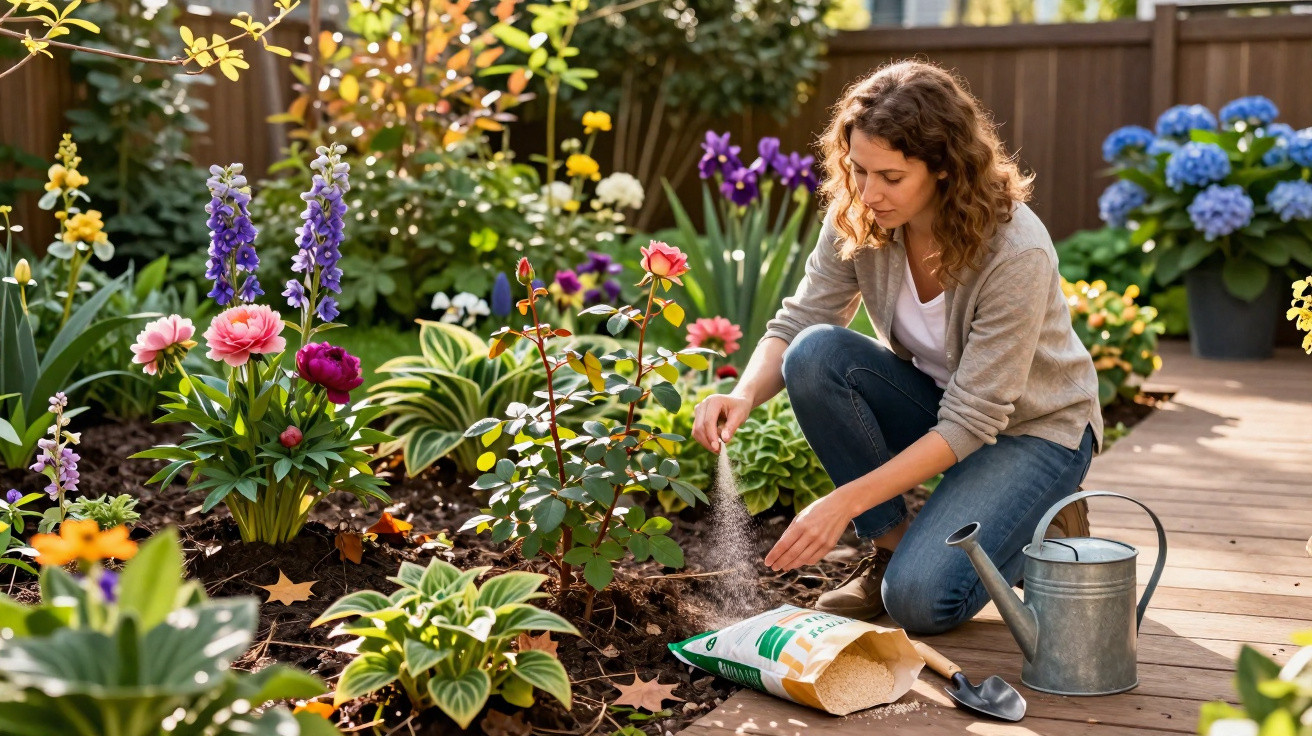
The crucial mistake is often made as early as March.
Anyone who only weeds and tidies up beds now is wasting their plants’ greatest potential. March, in particular, determines whether the garden later looks merely “quite nice” – or virtually erupts with flowers. A targeted fertiliser start for certain perennials makes all the difference.
Why March determines the quantity of flowers
Once frost has left the ground, the soil becomes more open and permeable. Roots begin to wake up, grow actively and absorb nutrients far more effectively than they do in high summer. At precisely this point, fertiliser acts as the starting signal for the season.
“Those who feed their perennials in March lay the foundation for vigorous growth, sturdy stems and a much longer flowering period.”
Organic fertilisers or products that release nutrients slowly are ideal. Their ingredients are delivered gradually, usually over three to six months. This gives plants a steady supply of nutrients rather than brief, stressful overdoses.
Depending on the region, the right time is from late February to early April. The requirement is that the soil is no longer frozen and is slightly moist, but neither soaking wet nor bone dry.
The 11 perennials that must be fed in March
Several classic border and cottage-garden plants respond especially well to spring fertilising. Keeping an eye on these species will help you get considerably more from your garden.
1. Roses – queens with a healthy appetite
Botanically, roses are not typical perennials, but they are treated in a similar way in the garden. They reward an early nutrient boost with more buds, richer colour and sturdier shoots.
- Fertiliser: a specialist rose fertiliser or a balanced general-purpose fertiliser (for example, 10-10-10 or 12-12-12)
- Timing: as soon as the ground is open and no longer frozen
- Application: work fertiliser granules lightly into the soil, then water
A further feed in June supports the second flush of flowers, particularly for repeat-flowering varieties.
2. Peonies – deep-rooted powerhouses
Peonies can remain in the same position for decades. Their deep roots obtain a great deal themselves, but a boost in March makes their flowers noticeably more abundant.
An organic general-purpose fertiliser with a moderate nitrogen content, plus a little mature compost around the root area, is usually sufficient. Important: do not scatter it directly over the peony’s “eyes”; apply it around the outer root zone instead.
3. Dahlias – a flower display needs potassium
Dahlia tubers are often planted only in April or May. Anyone starting them indoors or planting overwintered tubers early can cautiously plan a feed as early as March.
Choose a fertiliser low in nitrogen but higher in phosphorus and potassium, such as 5-10-10. This encourages plenty of flower buds instead of simply producing lush, greedy foliage.
4. Delphiniums – sensitive but rewarding
Delphiniums react strongly to nutrients. A balanced flowering-plant fertiliser helps them produce vigorous growth and tall, sturdy blooms.
The important thing is not to overdo it. Excess nitrogen makes the stems soft and likely to snap. A moderate dose in March is better, followed by a small top-up after the first flowering flush if needed.
5. Garden phlox (Phlox paniculata)
Phlox thrives in nutrient-rich soil that does not become too dry. A balanced fertiliser with the classic ratios of 10-10-10 or 12-12-12 provides what it needs for dense, intensely coloured flower panicles.
On sandy soils in particular, phlox quickly loses vigour without a spring feed, flowers for a shorter period and becomes more prone to powdery mildew.
6. Tickseed (Coreopsis)
Coreopsis appears tough and uncomplicated, yet it flowers noticeably longer when its nutrient balance is right. A light general-purpose feed in March is normally enough to produce bright cushions of flowers for weeks.
7. Bearded iris (Iris barbata)
The rhizomes of bearded iris prefer leaner conditions than many gardeners realise. A fertiliser rich in phosphorus and potassium but low in nitrogen (for example, 5-10-10) promotes flowering without making the plants excessively lush.
“Too much nitrogen for iris produces lots of leaf growth and few flowers – a typical mistake in home gardens.”
8. Hostas
Hostas favour partial shade and use their foliage to frame many borders. They are not exceptionally hungry plants, but they benefit from a gentle start:
- scatter a little slow-release fertiliser around the plants
- mulch with compost
- work it in lightly and water
This keeps the leaves deep green and more resilient against slug damage and drought stress.
9. Daylilies (Hemerocallis)
Daylilies are tough, but a March feed pays off in the number of flowers. They prefer formulations containing slightly more phosphorus and potassium. A second, small nutrient boost in summer supports a further flush of blooms.
10. Hydrangeas – with a special case for blue varieties
The popular blue hydrangeas are particularly sensitive to fertiliser and soil reaction. In acidic soil, and with a fertiliser low in phosphorus (around 12-4-8), flowers are more likely to remain in the blue range.
Simply choosing any “flowering plant fertiliser” risks shifting the colour towards pink. With mophead hydrangeas, it is therefore worth checking the nutrient information on the packet.
11. Astilbes – hungry stars of the shade
Astilbes enjoy partially shaded, moist borders and are among the hungriest of all perennials. They benefit particularly from a generous spring application of a balanced product and a second feed in autumn.
Giving them an additional mulch layer of compost or leaf mould produces dense, tall flower panicles and rich foliage.
How to apply fertiliser correctly
How fertiliser is applied matters at least as much as the amount used. Many cases of garden damage result from incorrect handling rather than from the product itself.
| Correct | Incorrect |
|---|---|
| Spread fertiliser around the plant’s root area | Tip fertiliser directly onto the base of the stem or the rhizome |
| Work it lightly into the top layer of soil | Leave it sitting on hard, unloosened ground |
| Water after fertilising | Scatter it onto completely dry or frozen soil |
| Follow the dosage on the packet | Apply a generous amount by guesswork |
“A quick pass with a rake before fertilising and a drink of water afterwards put the nutrients exactly where the roots need them.”
Fertiliser applied directly at the plant crown or onto frozen ground can scorch roots, slow growth and cause soft foliage that is susceptible to disease.
Do not throw weeds away – recycle them into liquid fertiliser
In March, many weeds are still sitting close to the ground and can be pulled out easily by hand. Acting now saves considerable work later, while also allowing the plant material to be put to good use.
Rather than throwing everything in the bin, use this simple method to turn it into liquid fertiliser:
- Put fresh weeds, without seed heads, into a bucket.
- Fill with water and place the lid on loosely.
- Leave it for several weeks until a dark liquid has formed.
- Dilute roughly 1 part of this liquid with 10 parts water.
- Apply it to the root area of the perennials every 14 days.
The smell takes some getting used to, but the effect in the border is impressive: many gardeners report visibly stronger growth and far more flowers, especially on naturally hungry plants such as astilbes and phlox.
How to choose the right fertiliser
Not every perennial needs a specialist mix. A few basic rules make selection easier:
- Flowering perennials: favour phosphorus and potassium, with not too much nitrogen
- Foliage plants such as hostas: balanced slow-release fertilisers combined with compost
- Colour-sensitive plants such as blue hydrangeas: products with an adjusted phosphorus level and suitable for acidic soils
- Sandy soils: preferably organic fertilisers that work for longer and improve soil structure
If you are unsure, an organic general-purpose fertiliser is usually a better choice than purely mineral high-performance products. The risk of over-fertilising is lower, while the soil improves in the long term.
Common mistakes and how to avoid them
A few misconceptions recur year after year, especially in home gardens. Three are particularly common:
- Fertilising too late: By the time hot weather arrives, many perennials have already made substantial growth. Heavy fertiliser applications then tend to produce foliage rather than flowers.
- The wrong expectation: Fertiliser cannot compensate for an unsuitable position. A shade-loving plant will suffer in full sun despite the best nutrient supply.
- “More is better”: Overdosing harms roots, weakens the plant and makes it more susceptible to fungal diseases.
Taking targeted action in March saves many attempts at correction in summer. Fertilise properly once, mulch lightly and water carefully – then the borders can do the work “themselves”.
One further point is often underestimated: the soil itself. Simple soil test kits from a garden centre give a broad indication of whether phosphorus, potassium or lime is lacking. Particularly with stubbornly flower-shy perennials, checking the pH can explain why little happens despite fertiliser.
Feeding these 11 perennials in March creates a foundation you can see on every walk around the garden throughout the summer – in denser flowering, richer colours and plants that cope far more calmly with wind and heavy rain.




Comments
No comments yet. Be the first to comment!
Leave a Comment