
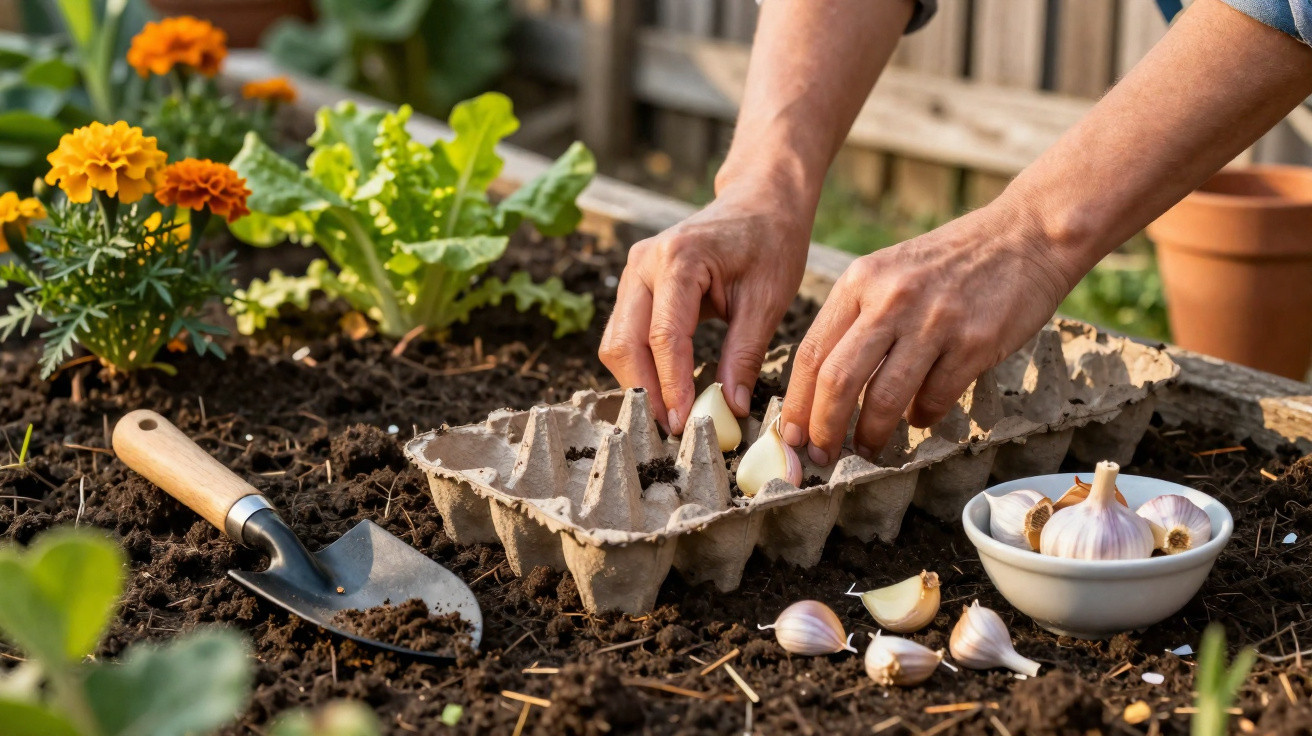
Rather than crawling along a bed with a tape measure, more and more home gardeners are using something that would otherwise end up in the household waste: empty egg cartons. The idea comes from the online gardening community and may seem almost too simple at first, yet it produces remarkably even rows of garlic and makes the job considerably easier.
How the egg carton trick works for planting garlic
The principle is straightforward: an egg carton already has a fixed grid of cups. This layout can be used perfectly to control the spacing between individual garlic cloves, with no measuring required.
“The egg carton replaces the tape measure and planting line, and almost automatically creates even spacing in the garlic bed.”
Step-by-step guide for the garden bed
This is how many home gardeners use the hack:
- Make a long, shallow trench in the bed, roughly as wide as the egg carton.
- Place empty egg cartons in the trench, lining them up until the required length is reached.
- Push one garlic clove into each individual cup, with its pointed end facing upwards.
- Cover the cloves and carton with soil, then water gently.
The egg carton gradually decomposes in the soil. It does not remain as an unwanted foreign material; instead, it becomes part of the bed’s organic matter.
Why this trick works so well
The cups in a standard egg carton are set at fairly regular intervals. Their size also happens to suit the recommended planting distances for garlic surprisingly well. When the trench is filled, the cloves are less likely to shift around, which is particularly useful in loose soil.
Many gardeners say this method creates very straight rows without needing to spend much time on preparation or marking out the bed.
The benefits at a glance
The egg carton trick offers several practical advantages. Much of this happens naturally once the cartons are in the ground.
- Even spacing: Each cup marks out a planting position, making the bed look tidy and professionally arranged.
- Less movement: The cloves remain where they were placed, even if soil shifts slightly back into the trench.
- Light weed suppression: At first, the carton forms a thin barrier that can slow the germination of some weeds.
- Moisture retention: Cardboard can hold water briefly and release it into the surrounding soil, offering a small buffer during dry periods.
- Recycling in the garden: A disposable item is given a useful second purpose.
Important: the carton must be uncoated and as free as possible from colourful plastic-based printing. Plain grey cardboard without a glossy layer is best because it breaks down more readily.
Why spacing is so important for garlic
Garlic may appear hardy, but it reacts poorly when plants are positioned too close together. The cloves then compete for light, water and nutrients. This often results in smaller bulbs that do not store as well.
“Gardeners who plan the spacing properly will generally get fuller bulbs and a more reliable harvest.”
Recommended planting distances and depth
Gardening guides and specialist websites generally give similar guidelines. The following overview can help when planning:
| Parameter | Recommendation |
|---|---|
| Clove-to-clove spacing | approximately 10–15 centimetres |
| Row-to-row spacing | around 25–30 centimetres |
| Planting depth | around 3–5 centimetres to the tip of the clove |
In many cases, egg cartons come reasonably close to these measurements. Anyone wanting greater precision can measure a carton first, then cut out individual cups or thin out rows if necessary.
What happens when garlic is planted too closely?
When cloves are too tightly packed, they often produce only narrow bulbs. The plants deprive one another of light, outer leaves flop over more quickly, and the crop becomes more vulnerable to fungal diseases because air circulates less effectively. In extreme cases, only a few thick cloves remain while the rest fail to develop properly.
Further tips for a plentiful garlic harvest
Even the ideal spacing has limited value if the site and care routine are unsuitable. Garlic is regarded as an easy crop to grow, but it still needs a few basic conditions to reach its full potential.
Choosing the right location
Garlic thrives in sunshine and an open, airy position. Partial shade often produces less vigorous plants. Soil should be loose, free-draining and not prone to waterlogging. Heavy, wet clay soil encourages the cloves to rot.
Where soil is dense and heavy, it is best improved with sand or fine grit, along with compost. Raised beds are also well suited, as they dry out and warm up earlier in spring.
Selecting the right cloves
Only healthy, firm cloves should be used for planting. Larger cloves usually produce stronger plants. Tiny inner cloves from the bulb are better used in the kitchen. Before planting, cloves should be undamaged and free from rotten patches or unusual discolouration.
The right time to plant
Many gardeners plant garlic in autumn, usually from October to November depending on the region. The soil should no longer be hot, but it must still be free from prolonged frost. The plants can then establish their first roots before winter and gain a head start in spring.
Planting in early spring can also work, although it often produces smaller bulbs. Anyone trying spring planting should do it as early as possible, once the soil can be worked.
Garlic care: from watering to harvest time
Once planted correctly, garlic needs only moderate attention. A few measures can help maximise the harvest.
- Watering: Water regularly while plants are establishing and during extended dry spells, but avoid creating permanently wet conditions.
- Feeding: An initial application of compost is often enough. Fertilisers high in nitrogen may encourage plenty of leafy growth, but can lead to smaller bulbs.
- Weed control: Keep the bed as clear as possible so garlic is not overwhelmed by weeds. The egg carton trick reduces the pressure slightly, but it does not eliminate the need for weeding.
- Harvest time: Many varieties are ready to harvest when roughly one third of the leaves have dried off. Waiting too long raises the risk of the bulb’s outer wrapper splitting.
Egg cartons as a planting aid – what to consider
Useful as the trick is, several details need attention. Not every carton is equally suitable, and not every soil responds in the same way.
Suitable types of carton
Simple cardboard cartons for ten or twelve eggs, without varnish or plastic-film coating, are ideal. Strong, thick cartons take longer to break down, but retain their structure for longer. Very thin versions disintegrate more quickly, which may be beneficial in areas with high rainfall.
Brightly printed surfaces may look harmless, but can contain plastics or metallic pigments. Gardeners seeking the most natural approach should choose plain, untreated versions.
How quickly does the carton decompose?
The rate of decomposition depends heavily on soil conditions. In moist, humus-rich soil with plenty of biological activity, cardboard usually breaks down within a few months. In very dry or sandy soil, remnants can sometimes persist for longer, although they quickly lose their shape.
Anyone unsure can bury a small test piece first and check after a few weeks how far it has decomposed. This gives a clearer idea of how the soil is likely to react.
Getting more from one bed: companion planting and follow-on crops
Garlic is well suited to bringing structure to garden beds. The clear rows created by the egg carton make it easier to plan neighbouring plants.
A popular option, for example, is to combine it with strawberries or carrots in separate rows, as garlic’s scent can confuse certain pests. Some gardeners also plant individual cloves among roses to keep aphids away to a limited extent. Such effects are not guaranteed, but are often reported as positive experiences.
After the garlic harvest, follow-on crops with a relatively short growing cycle are a good choice, including lamb’s lettuce, spinach or radishes. The soil is usually well prepared by the loose structure, while the established rows make the new sowing easier.
Anyone who regularly buys eggs can therefore do more with the empty cartons than simply put them in the recycling bin. The trick saves time, brings order to the bed and adds convenience, especially when there is already plenty to do in the garden.
Comments
No comments yet. Be the first to comment!
Leave a Comment