
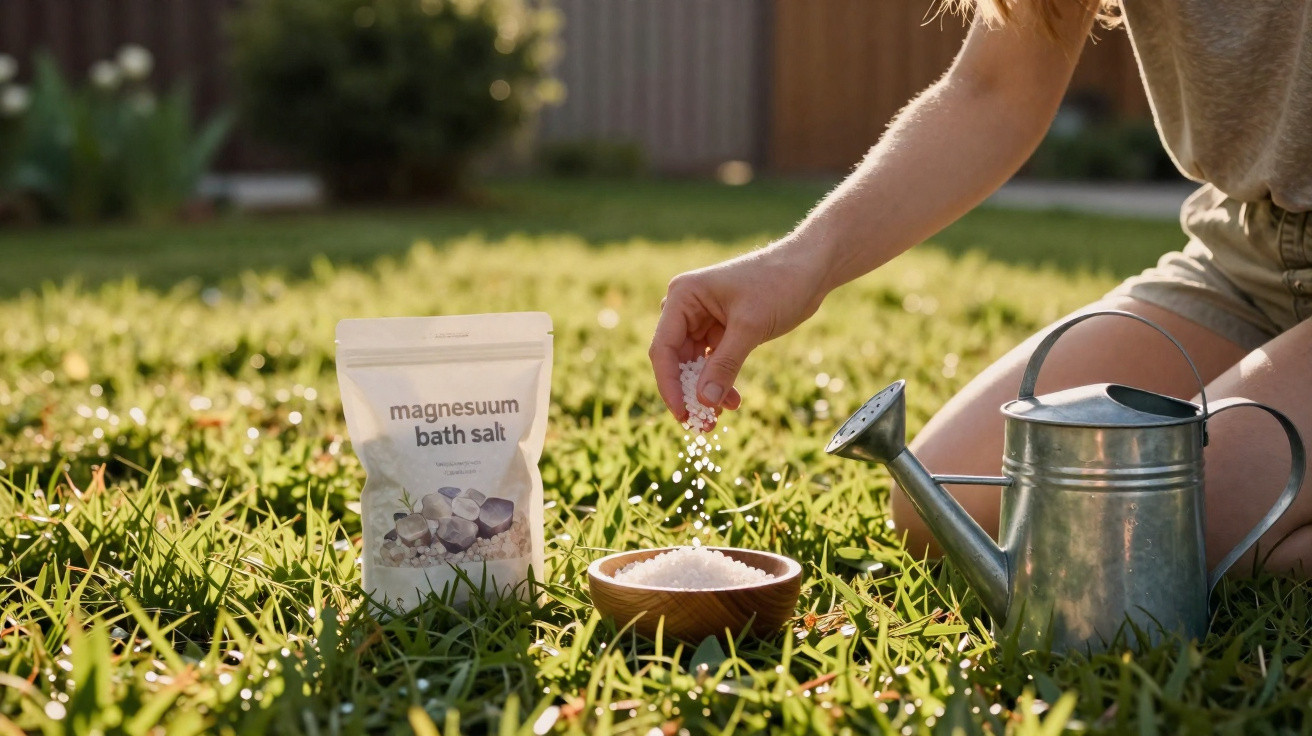
Between bare patches, yellowing blades and hard, compacted soil, many gardens look more bleak than welcoming in spring. A tip now circulating on social media has caught the attention of amateur gardeners: a simple bath salt from the supermarket, often available for about £1, is said to give lawns a noticeable growth boost and help them recover strongly before summer.
Why bath salt can help a lawn
There is no mystical trick behind this trend, but rather a familiar bath-time ingredient: magnesium sulphate, often sold as Epsom salt. It is added to warm bathwater to relax muscles, while in the garden the same substance acts as a source of minerals for plants.
Magnesium has a vital function in every plant. It forms the central part of the chlorophyll molecule, the component that allows leaves to capture light and turn it into energy. When a lawn does not receive enough of it, it can show several typical signs:
- the blades look dull and lacklustre
- yellowish areas appear between the leaf veins
- growth is poor despite watering and normal feeding
Magnesium also enables roots to make better use of nutrients such as nitrogen and phosphorus. Anyone already applying these nutrients in a lawn feed may enhance their effect with magnesium – provided that the soil genuinely lacks this essential element.
“Magnesium sulphate can make a lawn appear noticeably greener – but only where there is an actual deficiency.”
Many gardening professionals have used magnesium salt selectively for years, for example on vegetable beds, roses and heavily used lawns. The principle is simple: the soil is not given a colourful miracle treatment, but one clearly defined mineral.
When using magnesium salt makes sense – and when it does not
The excitement surrounding inexpensive bath salt can easily obscure the fact that not every garden will benefit. Soil type and the lawn’s history are what matter most.
Typical situations in which magnesium salt helps
Targeted use can be worthwhile particularly in the following cases:
- light, sandy soils that retain nutrients poorly
- established lawns that have been heavily watered and intensively used for years
- grass that remains yellowish despite fertiliser, with pale patches between the leaf veins
- areas that are mown frequently, with all grass clippings consistently removed
For certainty, arrange a soil test. Many garden testing laboratories also measure magnesium levels. If the result is low, a one-off application or an occasional repeat treatment may be appropriate.
When cheap bath salt is more likely to cause harm
Many ordinary domestic lawns already contain sufficient magnesium, either from natural reserves in the soil or from standard lawn fertilisers that supply this nutrient. Spreading extra magnesium salt in such cases will not necessarily improve the lawn.
Too much soluble salt may even become a problem. Rainwater can wash it down into deeper layers, where it may reach groundwater. At the same time, the salt level in the upper soil layer temporarily rises, which can put sensitive roots under stress.
“Anyone who simply scatters it without a diagnosis risks higher costs and, potentially, damage to the soil and groundwater.”
The foundations of a healthy, attractive lawn therefore remain essential: mow correctly, water sensibly, fertilise according to need and aerate compacted areas from time to time.
How gardeners should apply magnesium salt before summer
Where the soil does show a real deficiency, a targeted treatment in spring or early summer can help the lawn get going again. The key factors are the dose, timing and choice of product.
Choosing a suitable product
Anyone intending to use a product from the bath aisle should check the ingredients carefully. Only one type is suitable for garden use:
- pure magnesium sulphate, without fragrance
- no colourants or conditioning oils
- fine granules, so that it spreads and dissolves easily
Fragrance, skincare additives and foaming ingredients have no place on a lawn. They may scorch grass blades, contaminate the soil or simply leave sticky residues behind.
How much salt a lawn can tolerate
The correct application rate depends on the product. Many manufacturers of garden magnesium salt recommend using it only once a year. A typical guide rate is up to 600 grams per 10 square metres where the soil is severely deficient. Using less is often wiser, especially on light soils.
As a general rule:
- always read the pack instructions and avoid overdoing it
- apply a lower dose first, then add more later if needed
- distribute coarse granules with particular care
After application, water the lawn thoroughly straight away or wait for a period of natural rainfall. This dissolves the salt and carries it into the upper soil layer, rather than leaving it on the grass blades.
Spreading or watering in: two methods at a glance
Two approaches are particularly common in everyday gardening:
- Dry spreading: Spread the salt evenly by hand or with a lawn spreader over a slightly damp surface. Follow this with heavy rain or thorough watering using a garden hose.
- Applying with water: Dissolve one cup of the salt in a large bucket or watering can of water, then wet the area. Take care not to keep treating the same spots repeatedly.
| Method | Advantage | Disadvantage |
|---|---|---|
| Dry spreading | quick and practical for large areas | uneven distribution can result in patches |
| Watering in | gentler, with less risk of overdosing | more time-consuming and only partly practical for very large lawns |
What else a lawn needs for strong regrowth
Magnesium is one building block, but it is never the complete answer. Anyone aiming for a dense, hard-wearing lawn before summer should take several basic rules seriously.
- Mowing height: Do not cut the grass too short. Depending on the variety, 4 to 5 centimetres is usually ideal. Cutting too low weakens the blades.
- Frequency: Mow a little more often rather than cutting rarely and drastically.
- Watering: Water less frequently but deeply, encouraging roots to grow downwards.
- Nutrients: An organic-mineral lawn fertiliser with slow release keeps nutrient supply consistent.
- Soil care: Loosen compacted soil with a garden fork or aerator, incorporating sand where necessary.
Soil structure often suffers after a wet, cold winter. If the lawn is then walked on heavily early in the year, the top layer becomes even more compacted. In this situation, combining aeration, overseeding and a light application of magnesium can achieve far more than reaching for bath salt alone.
Risks, limitations and useful additions
Although this gardening tip may sound tempting, magnesium salt remains a chemical salt that affects soil and water balance. Anyone spreading it generously every year allows residues to build up below ground and, over time, wash beyond the root zone. This is particularly contentious in areas with sensitive groundwater reserves.
A restrained, carefully considered application as part of a wider programme makes more sense. For example, a family with a heavily used play lawn might aerate it in spring, work in some sand, fill bare areas with an overseeding mix and then apply a slow-release fertiliser. If the grass still shows clear signs of deficiency, a light magnesium application can be added – and no more.
If unsure, treat a small section of lawn first and compare it after a few weeks. If that area becomes noticeably greener than the rest, this strongly suggests a deficiency. If there is no effect, the cause is more likely to lie in soil structure, water management or another nutrient.
Magnesium salt can therefore be a useful aid when conditions are right. However, cheap bath salt is not a cure-all. Used correctly, it complements conventional lawn care and can give some areas the crucial boost towards greener growth just before summer.






Comments
No comments yet. Be the first to comment!
Leave a Comment