
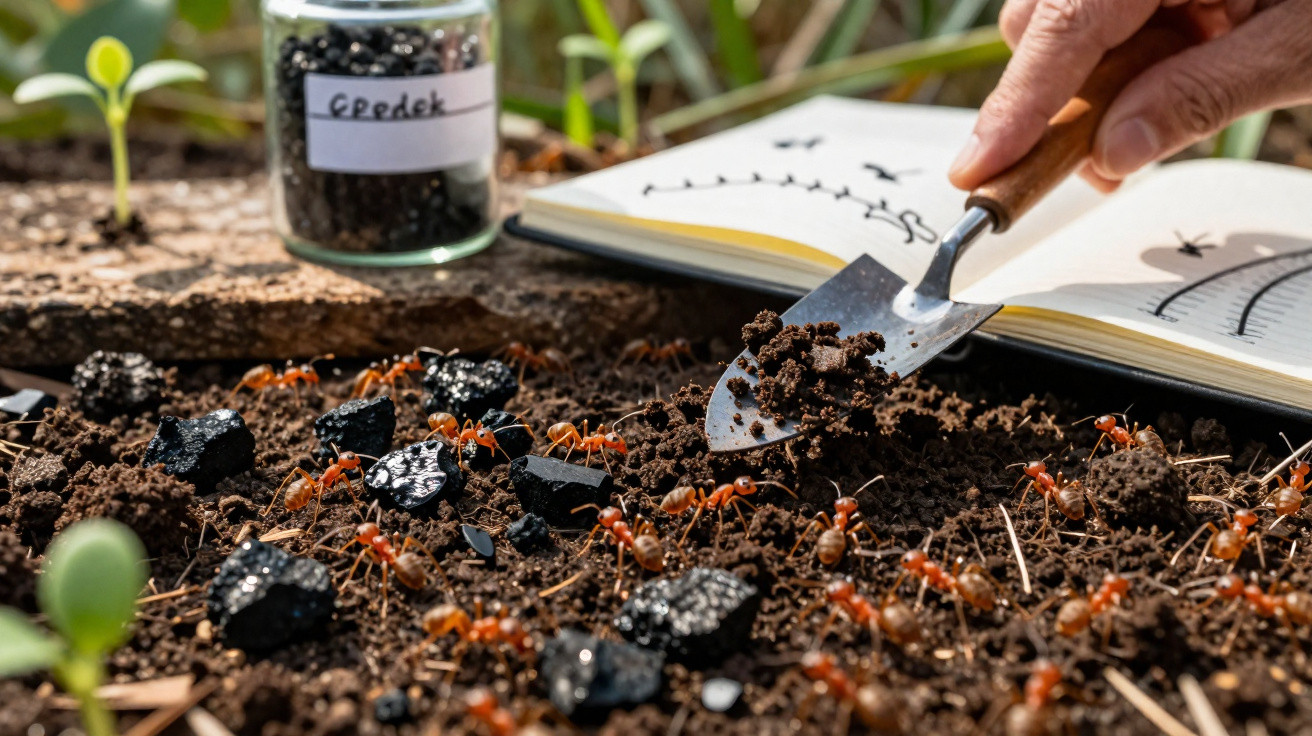
At first, biochar can appear to be a straightforward solution. Plant waste is converted into charcoal, added to soil, and the result is healthier ground that retains more water and encourages stronger plant growth. Yet soil is more than simply dirt: it is a living system.
New research from Shenyang Agricultural University has shown that introducing biochar can have unexpected knock-on effects within that system, including changes to the way ants live, work and relate to one another.
The findings offer a far more complex view of what can occur when people attempt to “improve” nature.
Soil is teeming with life
Although soil can seem lifeless, it contains an abundance of living organisms. Microbes and tiny creatures work continuously beneath the surface, even when they cannot be seen, helping to maintain healthy soil.
When this balance is disturbed, problems can develop rapidly. Plants grow less effectively, food production becomes more difficult, and the effects may even reach the climate.
Biochar is used to restore damaged soil because it can help the ground retain water and improve its condition. Initially, this may look like a simple answer. However, soil is not merely a mixture of chemicals: it is a living habitat.
The study highlights an unexpected point: even minor changes to soil can influence animal behaviour.
Why ants matter to soil
Despite their size, ants perform major functions. By digging tunnels, they allow air and water to travel through the soil. They transport food, distribute nutrients and can also help control pests.
Ants live collectively and operate as a team. They construct nests, look for food and defend their colony. This co-operation contributes to healthy soil.
Any factor that alters ant behaviour can therefore affect the wider environment.
Testing biochar on ants
Researchers examined a widespread ant species, Formica japonica. They mixed varying quantities of biochar into soil and observed how the ants responded.
Four treatment levels were assessed, ranging from no biochar to high quantities. The researchers aimed to establish how each condition affected the ants’ survival, nest construction and food-finding ability.
The pattern was clear: low quantities of biochar benefited the ants, whereas high quantities created difficulties.
“Our results show that biochar does not simply improve soil conditions. It also changes how soil animals behave and interact, which can amplify or undermine ecosystem recovery,” said the study’s authors.
When biochar benefits ants
At low-to-medium levels, the ants performed considerably better. They created sturdier, more intricate nests, helping air and water circulate through the soil more freely.
The ants also located food more quickly. Greater numbers reached food sooner, while their group performance improved. Their co-operation increased, including food sharing and mutual assistance.
These effects strengthened the colony. Robust ant colonies are important for soil health because they mix nutrients and keep the soil active.
Small quantities of biochar made the soil more suitable for ant life. The ground was softer and easier to excavate, while retaining water more efficiently.
Such improved conditions enabled ants to move, build and communicate with greater ease. Ants depend on chemical signals to identify one another, and better soil conditions allowed those signals to function more effectively.
Too much biochar harms ants
At high concentrations, biochar produced the reverse outcome. Many ants failed to survive, while survivors moved more slowly and found it harder to locate food.
Nest construction deteriorated and general activity declined. The ants were less organised, and their capacity to work together started to weaken.
Biochar also altered interactions between individual ants. Both co-operation and colony defence decreased, leaving the colony less stable.
The explanation is simple. Excessive biochar made the soil more hostile and added harmful substances that may affect ants’ bodies and behaviour.
“These findings suggest a classic hormetic response, where low doses stimulate biological activity but high doses become harmful,” the authors said. Since ants have an essential role in soil health, these disturbances can spread throughout the wider ecosystem.
Lessons for soil restoration
The research delivers a clear lesson: nature does not respond in a linear way. Increasing something beneficial does not necessarily make it better.
“Biochar has great potential, but its application must be carefully optimized. Too much can disrupt the very biological systems we aim to restore,” the authors noted.
Restoring soil calls for careful management. It involves more than adding materials; it requires an understanding of the life beneath the surface.
Biochar continues to show promise. Applied carefully, it can benefit both soil and the organisms that rely on it. However, genuine success depends on balance rather than excess.




Comments
No comments yet. Be the first to comment!
Leave a Comment